Key Takeaways
- There is no universal “best” loan origination software. Full-spectrum platforms are better suited to banks, fintechs, and non-bank lenders that require configurable workflows, multi-product support, automated decisioning, and lifecycle coverage beyond origination. Specialized LOS platforms provide specific compliance, closing, and investor-delivery capabilities.
- The core trade-off is configurability versus time-to-value. Ecosystem platforms like nCino, offer deep governance but longer, planning-heavy rollouts. Configurable, build-to-fit platforms such as HES LoanBox provide control over workflows, products, and, where it matters, the source code.
- Match the platform to the loans you'll originate next, not just today's. If BNPL, SME, embedded, or other products are on the roadmap, a multi-product configurable platform saves you a re-platforming project two years out.
- The strongest LOS is not necessarily the platform with the longest feature list. It is the system that fits the lender’s workflows, supports future growth, and can be implemented without creating unnecessary operational complexity.
What Is Loan Origination Software/LOS?
Loan origination software (LOS) functions as part of a broader lending system that manages the entire borrower journey, from application intake to credit decisioning, disbursement, and ongoing borrower communication. It controls the pre-portfolio stage of lending—the window between a borrower's first inquiry and the moment a funded loan moves into servicing. Where loan management systems deal with what happens to an active loan, origination software determines whether and how that loan gets created in the first place.
Modern lending platforms typically combine multiple capabilities within a unified LOS environment:
- loan application systems for digital onboarding
- loan processing systems for document handling and approvals
- decisioning engines for credit scoring and risk assessment
- borrower communication tools for notifications and engagement
What binds these functions together is less about automation and more about control. A well-implemented LOS makes the origination process something a lender can actually examine—where every decision references a policy, every exception has a paper trail, and the loan that enters the portfolio matches what the credit committee approved.
In this guide, we review the best loan origination software solutions available today, focusing not only on features but also on how each platform fits different lending models and operational needs. The comparison is grounded in publicly accessible sources, external reviews, and the general market positioning of each product—assessments of usability and fit are therefore indicative, not absolute, and actual performance may vary depending on system configuration and lender-specific requirements.
Best Loan Origination Software Vendors Shortlist in 2026
As “loan origination software” is not a single product category in practice, we first separated the list into two groups:
- full-spectrum LOS systems that function for a broad range of lending models and operational setups
- platforms where compliance, document handling, and workflow depth are optimized primarily for mortgage origination workflows.
Additionally, we give a short overview of an end-to-end enterprise- and bank-grade platform.
This separation makes it easier to compare vendors against the realities of a lender’s business model rather than against a generic feature list.
Further, you can find a more detailed overview of each software solution: the table contains key facts, while further details are covered in the overview below.
Best LOS Software for Digital Lenders & Fintechs Comparison Table
| Platform | Loan types supported | Origination scope | Configurability | AI / Decisioning | Best for | Free trial | Price | Deployment |
|---|---|---|---|---|---|---|---|---|
| HES LoanBox | SME, BNPL, auto, consumer, mortgage, microfinance, Islamic finance, student loans, embedded | End-to-end: intake through disbursement and servicing | High: no-code workflow builder, custom development via open-source license | High: real-time scoring, configurable scorecards, AI credit models | Banks, fintechs, alt lenders, SME lenders needing full customization and multi-product flexibility | Available | From $39k/year, no user or product limits | Cloud / On-prem |
| nCino | Commercial, corporate, SME, consumer, mortgage | End-to-end within nCino's cloud banking platform | High, but Salesforce-dependent | Medium: workflow-driven approvals and automation; oversight- and audit-first, not AI-scoring-led | Mid-size and large banks, credit unions, and enterprise lenders already in or building around the Salesforce ecosystem | Not available | Upon request | Cloud (SaaS) on Salesforce |
| Finastra Loan IQ | Syndicated, corporate, commercial, structured finance | Full lifecycle for complex commercial lending | High: configurable via SDK/API | Workflow automation; limited native AI | Large banks handling syndicated and corporate lending | Not available | Upon request | Hybrid |
| MeridianLink Consumer | Auto, personal, credit card, HELOC, unsecured consumer | Consumer origination with cross-sell and indirect lending | Medium: rule-driven, configuration via vendor services | Medium: rule-based decisioning with manual override | Credit unions and community banks running multiple consumer loan products | Not available | Upon request | Cloud / Hybrid |
Best Mortgage Loan Origination Software Comparison Table
| Platform | Loan types supported | Origination scope | Configurability | AI/Decisioning | Best for | Free trial | Price | Deployment |
| Encompass by ICE Mortgage Technology | Mortgage (retail, wholesale, correspondent) | End-to-end: application through closing and investor delivery | Medium: industry-standard configuration, deep compliance tooling | Yes: compliance automation, pricing engine, document recognition | Mid-to-large mortgage lenders, banks, credit unions needing a compliant enterprise LOS | Not available | Upon request | Cloud |
| LendingPad | Mortgage (retail, wholesale, correspondent) | Core origination through closing | Medium: cloud-native, user-configurable | Medium: automated compliance tracking, QM management | Mortgage brokers and smaller lenders needing a cost-effective modern LOS | Not available | Broker Edition: $59/user/month; Lender and Institution Editions: upon request. | Cloud |
Other loan origination platforms to consider
| Platform | Loan types supported | Origination scope | Configurability | AI/Decisioning | Best for | Free trial | Price | Deployment |
| Newgen (NewgenONE Loan Origination) | Global enterprise BFSI: end-to-end platform for retail, SME, commercial, and SBA | End-to-end on a unified platform: onboarding, underwriting, and decisioning through disbursement; extends into servicing and collections | High: low-code BPM automation, configurable workflows and approval routing, no-code report designer | Medium–high: rules-based auto-decisioning / STP; AI/ML for income analysis, fraud checks, and document classification | Enterprise and mid-to-large banks needing end-to-end retail and commercial/SBA origination on a low-code platform | Not available | Upon request | Cloud and on-premise |
Platform descriptions have been compiled and updated based on vendor-published materials and independent reviews accessible to the public, accurate as of July 2026.
How We Evaluate the Best Loan Origination Software
This loan origination software comparison is based on independent research conducted in 2026 and reflects publicly available data on leading loan origination platforms. The goal is to help lenders evaluate systems using consistent, practical criteria aligned with real-world implementation needs.
To build this comparison, we analyzed vendor documentation, product pages, client case studies, and verified user reviews from Capterra, G2, Gartner Peer Insights, Software Advice, and Gartner. Where third-party validation was limited, we relied on documented product capabilities and observable market positioning.
Each platform was assessed using a standardized scoring framework designed to reflect how origination software performs across the stages that matter most to lenders—from application intake and credit decisioning through to disbursement and handoff to servicing.
Key evaluation criteria for loan origination software
- End-to-end lifecycle support—measures how completely the platform covers the borrower journey from application intake to disbursement within a single software.
- Configurability and workflow flexibility—evaluates how easily lenders can adapt credit policies, approval flows, and loan products without custom development.
- Integration capabilities and API ecosystem—assesses the availability and maturity of APIs, and readiness to connect with credit bureaus, CRMs, payment providers, KYC services, and core banking systems.
- Feature depth and product coverage—examines the richness of core origination features, including document management, decisioning tools, scoring capabilities, and support for different loan types.
- Usability and operational experience—covers both borrower-facing interfaces and internal tools used by underwriters and operations teams.
- Deployment options and scalability—considers support for cloud, on-premise, or hybrid environments and how well the platform handles growth in loan volume, users, and geographies.
- Analytics and reporting—reviews the availability of dashboards, reporting tools, essential for performance monitoring and compliance.
- Compliance and model governance—assesses the audit trail behind each decision, fit with the rules that apply by market and product (TRID/HMDA/RESPA, IFRS 9/CECL), and whether AI-driven decisions are explainable and reproducible rather than a black box (the core of SR 11-7 and EU AI Act expectations).
How to use this evaluation
This framework is designed to compare loan origination platforms across dimensions that directly affect processing speed, decision quality, and compliance readiness. It does not identify a single best loan origination software for all lenders.
Instead, it helps identify which platform is better aligned with a specific business model, loan product mix, and operational structure—whether for banks, fintech companies, credit unions, or non-bank lenders.
Best Loan Origination Software for Non-Bank Lenders and Mid-Sized Banks
This group covers platforms built for lenders who need more than a basic application intake tool—institutions where origination is a competitive function, not just a processing step. They tend to emphasize configurability across loan products, AI-driven credit decisioning, API-first integration, and the ability to adapt workflows to the lender's credit policy rather than work around a fixed system architecture.
HES LoanBox: Modular API-first loan origination software
Best for alternative lenders and mid-sized banks
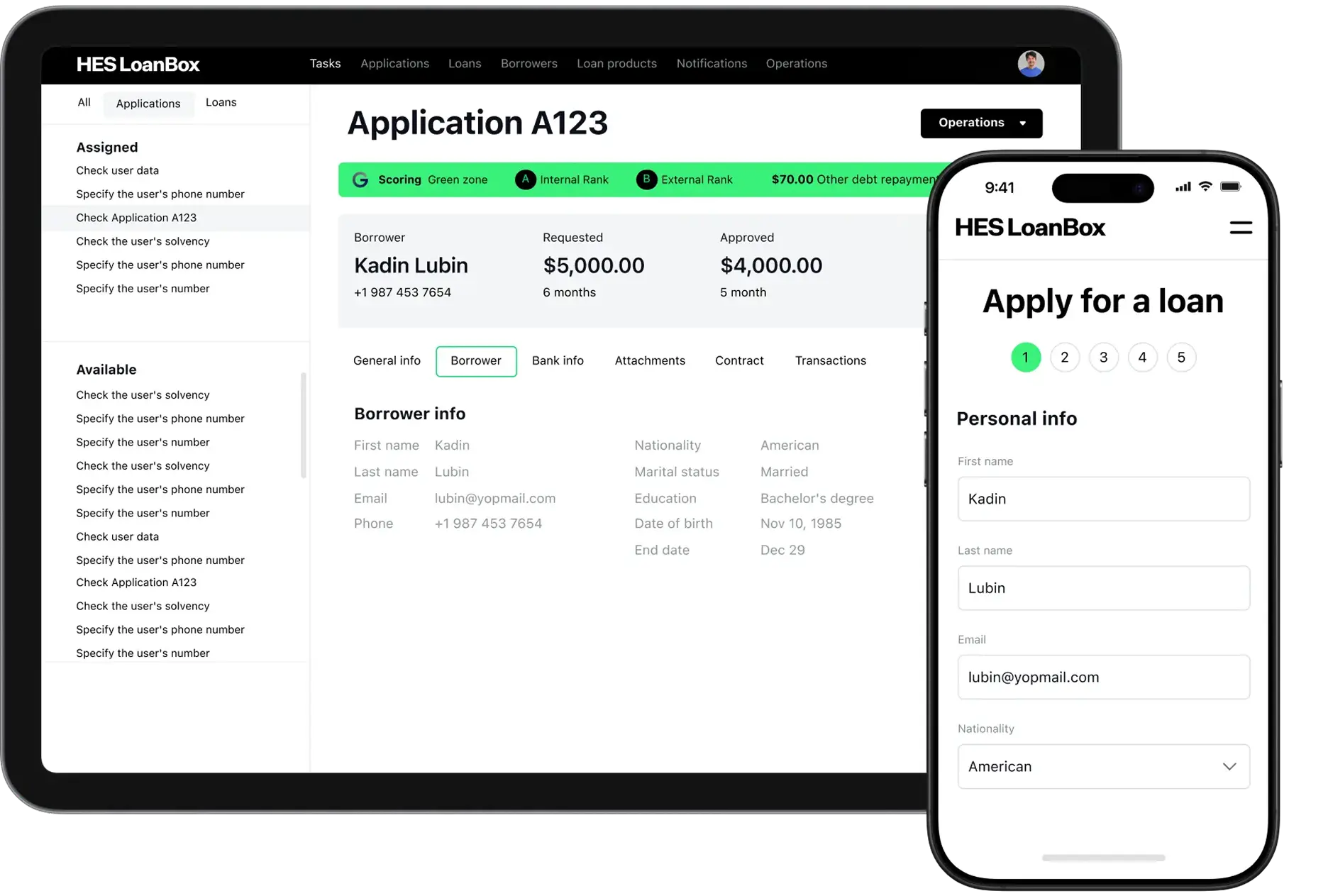
HES LoanBox is HES FinTech's modular loan origination platform built on open-source technologies—Java, and others. Institutions can purchase a developer license, with full access to the codebase and avoiding vendor lock-in.
HES LoanBox is best for lenders needing robust, modular loan origination solution, customization, AI decisioning, and multi-product flexibility.
The architecture lets lenders deploy specific modules alongside existing infrastructure or implement the full end-to-end stack. The platform supports SME lending, BNPL, mortgage, auto lending, and other loan types, with workflows configured to match each institution's credit logic rather than a fixed template. Security is handled at the infrastructure level: HES LoanBox is ISO 27001 and SOC 2 certified and hosted on AWS or Google Cloud with a Java LTS stack.
Top-rated loan origination software on G2, ranked #3 among all loan origination software products of 2026, outperforming the vast majority of competitors.
Key features
- End-to-end origination: application intake, document handling, credit scoring, approval, and disbursement in one flow.
- AI decisioning engine: real-time risk scores, stop-factor checks, in-built scorecards, and customizable AI models for credit limit calculation.
- Full loan lifecycle: the servicing module covers repayments, rescheduling, delinquency tracking, and automated collections—including AI-driven recovery with controls and records for region-specific compliance.
- Configurable product engine: launch any loan type with flexible terms, rates, and repayment schedules via a no-code interface.
- BPM workflow automation: no-code process builder with multi-workflow support, role-based access control, and full customization of scoring logic and UI.
- Multi-entity and multi-currency: manage multiple legal entities, currencies, and jurisdictions from a single instance.
- 100+ integrations: APIs, credit bureaus, CRMs, payment gateways, and internal systems.
- White-label suite: branded borrower portal, landing page, and back office.
- Security: ISO 27001 and SOC 2 certified, KYC/KYB support, encryption, audit trails—cloud and on-premise.
- Real-time analytics: KPI dashboards, portfolio metrics, and BI integrations.
The features listed represent a summary of publicly and internally documented capabilities but do not cover the full scope of LoanBox's functionality.
What users say: On Capterra, where HES LoanBox ranks as the №2 highest-rated platform in the loan origination software category, reviewers consistently highlight ease of configuration and integration, with one Head of Technology calling it "a real turnkey out-of-the-box solution" after 2+ years of use. HES LoanBox also holds the №3 position in the credit origination category on G2 by user satisfaction rating, with reviewers pointing to flexibility in practice—multi-entity and multi-currency setups, connections with local banks and data vendors—and noting the platform adapts to existing workflows rather than requiring teams to rebuild around it. Some clients report challenges during initial deployment: complex custom reporting, dashboard configuration, and user role setup required additional planning and coordination between the in-house team and the vendor.
Reviews are based on publicly available feedback.
Rating: 4.9/5 on Capterra; 4.8/5 on G2
Price: Licence starts from $39K/year, depending on business type. Typically, a fixed subscription model with no limits on users, products, or applications. Custom enterprise licensing available for multi-entity deployments. No vendor lock-in.
Notable clients: ID Finance (unicorn), Fintuity, Wa'ed, Alraedah, etc.
Demo and trial period: free demo and trial available.
Link to the product: here
nCino: Cloud-Native LOS Built on Salesforce and Designed for Banks
Best for mid-size and large banks, credit unions, and enterprise lenders
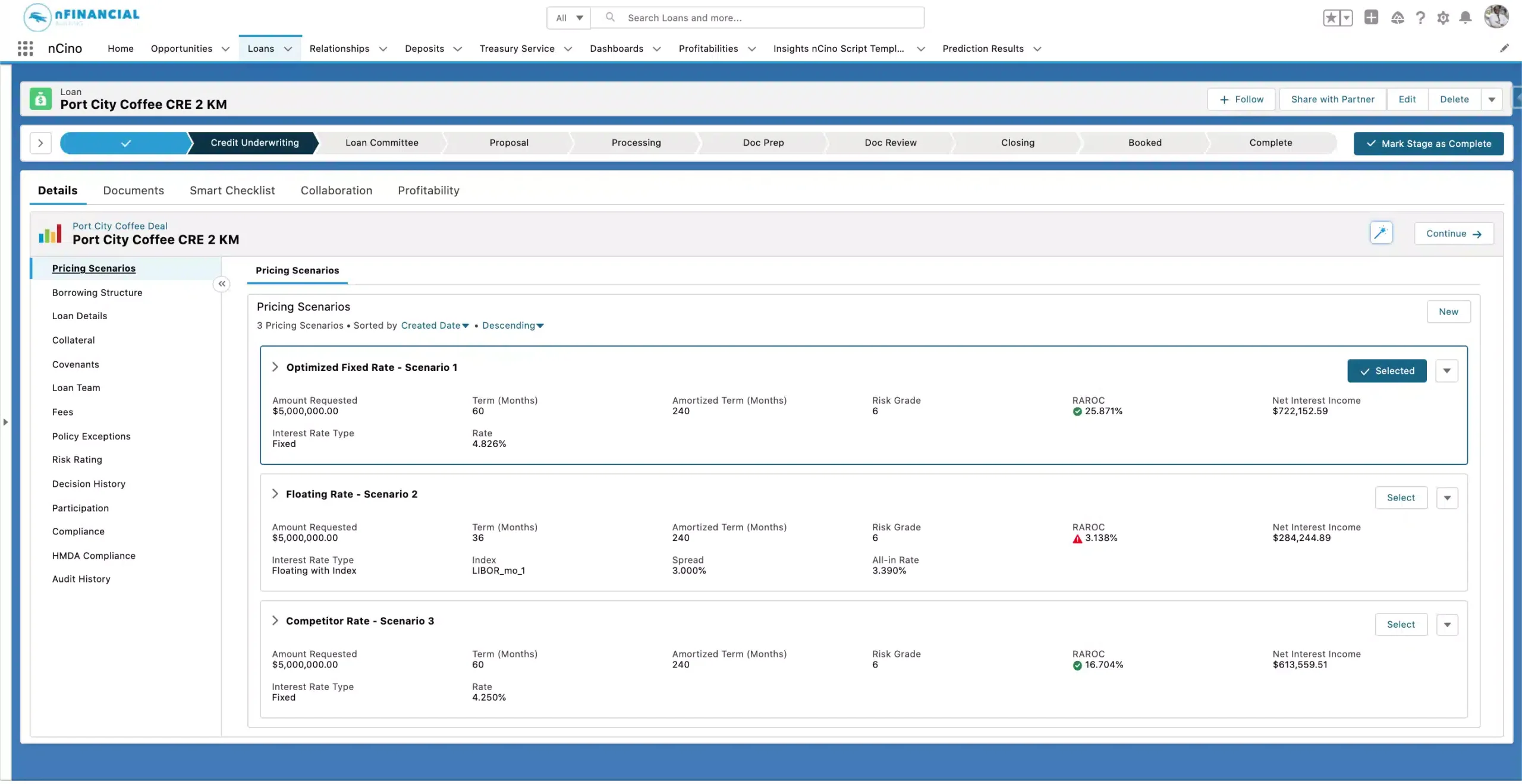
nCino is a cloud-based origination and banking platform built on top of Salesforce, which supports onboarding, application handling, underwriting, and loan approvals.
Best for: mid-sized and large banks, credit unions, and enterprise lenders working within the Salesforce ecosystem (or those planning to build around it), where oversight and strong compliance support are critical.
nCino works as part of a broad ecosystem: it helps connect the dots between lending processes, CRM data, and internal workflows, which enables teams across departments to keep everything centralized and accessible.
At the same time, the reliance on Salesforce means implementation can take longer and often requires more planning compared to lighter, standalone solutions. Overall, nCino is more about creating a consistent, well-governed lending environment that can scale across teams and regions.
Key features
- Salesforce-based foundation: as the platform is built directly on Salesforce, customer data, relationships, and lending processes are tightly connected.
- End-to-end origination: the system supports onboarding, applications, credit analysis, approvals, and document handling.
- Centralized data: borrower and loan data are kept in one place, which reduces duplication and improves visibility across teams.
- Workflow automation: configurable flows help standardize processes and reduce manual handoffs.
- Multi-product support for commercial, SME, retail, and mortgage lending.
- Compliance and audit tools: built-in tracking, documentation, and audit trails are aligned with regulatory requirements.
- Reporting and dashboards: Salesforce reporting tools providing pipeline visibility and performance tracking.
The features listed represent a summary of publicly documented capabilities and do not cover the full scope of nCino’s functionality.
Users like: nCino's users appreciate the cloud-based infrastructure of the platform, as customers can see the status in real time. Many users mention good coordination between sales and credit departments, along with stronger process control.
Users don't like: Implementation can be complex and require extensive customization. Several users suggest improvements in UX for help screens and technical issues in the approval process.
Rating: 4.2/5 on G2; 4.3/5 on Capterra
Reviews are based on publicly available feedback.
Price: upon request.
Demo and trial period: demo is available.
Finastra (Loan IQ): Enterprise-grade Platform Focused on Complex Commercial and Syndicated Lending
Best for large banks handling syndicated and corporate lending
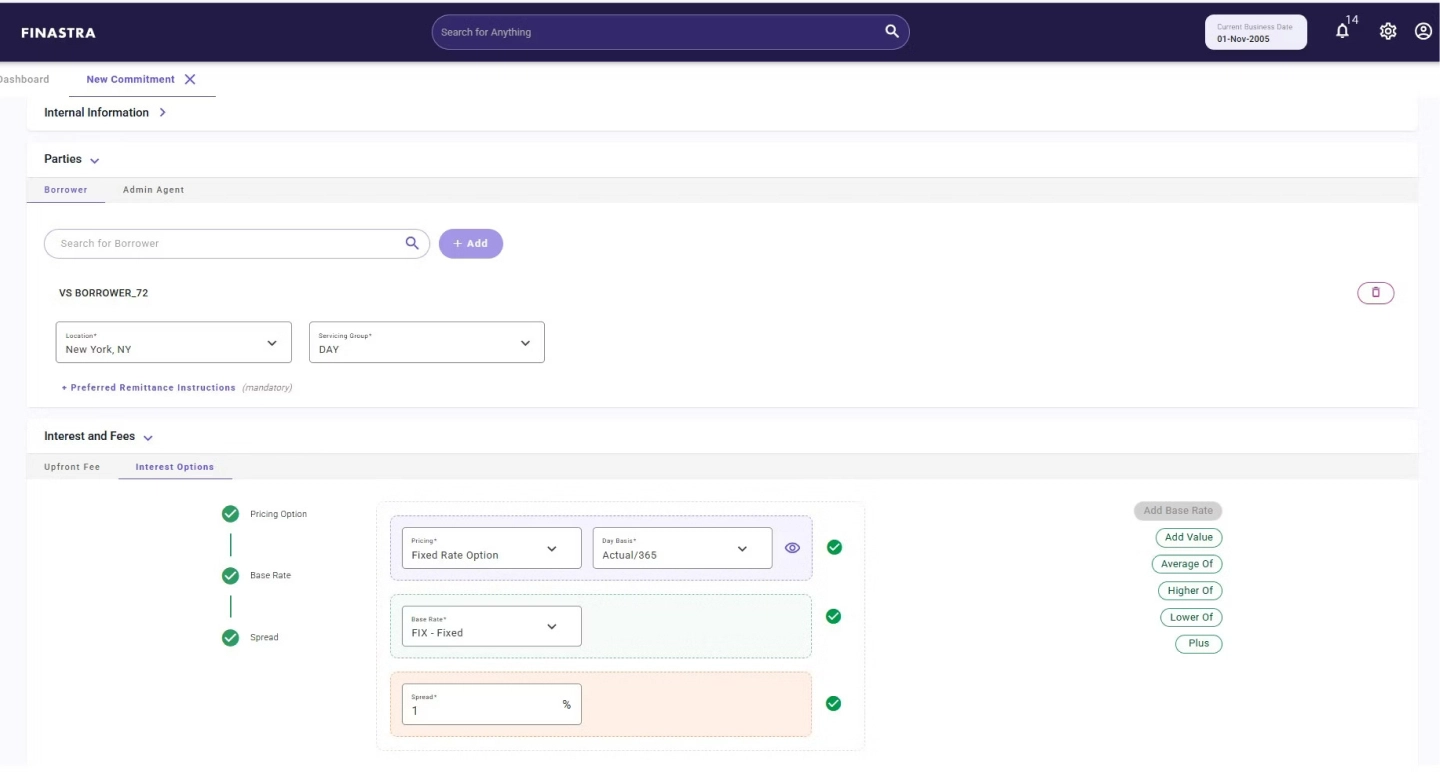
Finastra Loan IQ is a commercial loan servicing platform designed to help financial institutions manage the full lifecycle of lending, from origination intake through servicing, trading, settlement, and closure within one system.
Best for: large banks and financial institutions handling syndicated, commercial, and corporate lending, where complex deal structures, servicing depth, and regulatory control are key priorities.
Key features:
- End-to-end commercial lending lifecycle: supports the full process within one system.
- Syndicated and complex deal management: handles multi-lender structures, structured finance, and advanced pricing models, including multi-tranche and multi-currency facilities.
- Centralized loan portfolio management: supports multiple lending products and business lines within a single platform.
- Integration-ready architecture: connects with upstream origination systems, accounting platforms, CRM tools, and external market infrastructure.
- Reporting and dashboards: provides visibility into portfolio performance, risk exposure, and operational metrics through configurable dashboards.
The features listed represent a summary of publicly documented capabilities and do not cover the full scope of Finastra’s functionality.
Users like: In official testimonials, reviewers often highlight the platform's ability to handle multi-lender deals, detailed loan structures, and large portfolios with high accuracy.
Users don't like: At the same time, feedback often points to the system’s complexity. Implementation might take long and may require specialized expertise and significant integration work.
Rating: 3.3/5 on Gartner.
Reviews are based on publicly available feedback.
Price: upon request.
MeridianLink Consumer: Consumer Loan Solution for Community Banks
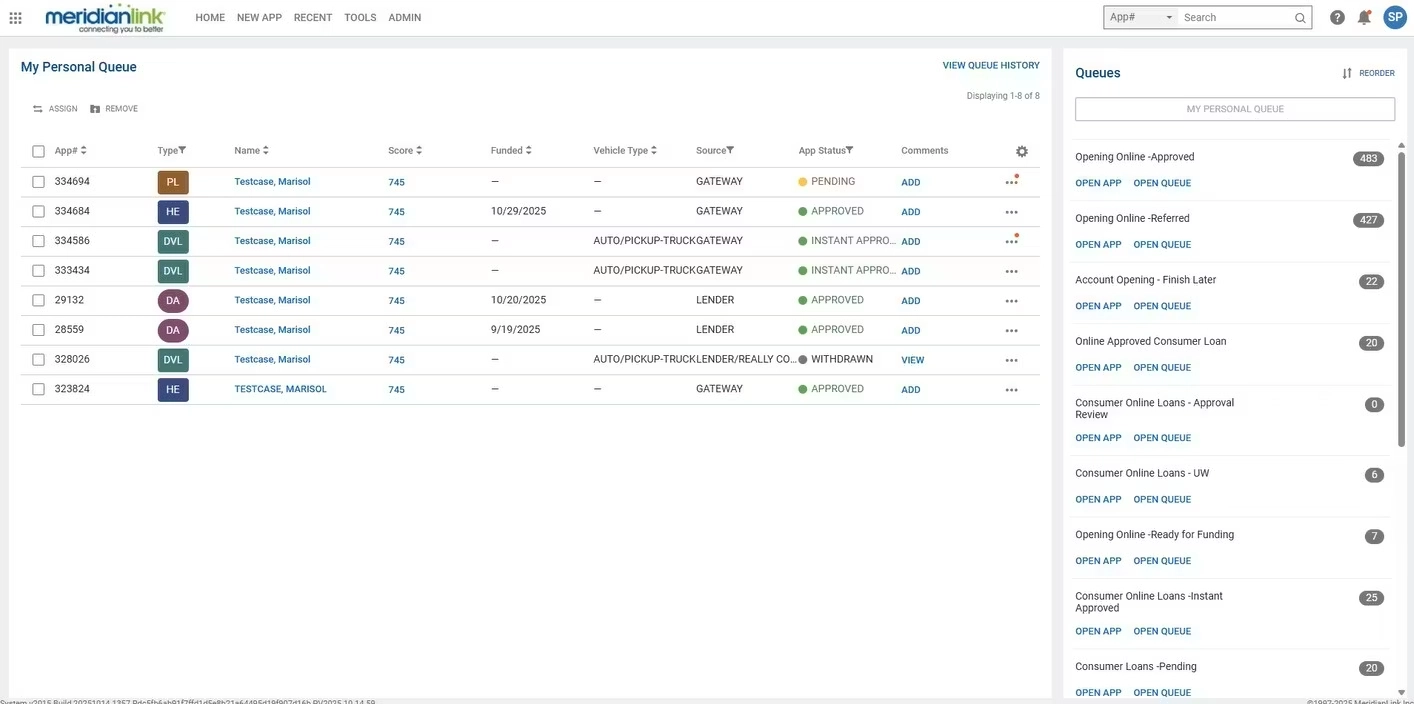
MeridianLink Consumer, rebranded from LoansPQ, is a U.S. consumer LOS used predominantly by credit unions and community banks. It sits inside MeridianLink's broader product family, where origination connects to credit reporting, account opening, mortgage, and collections through a shared data layer the vendor calls Access. Whether that shared layer translates into a real operational advantage depends heavily on which of the surrounding products an institution already runs—for lenders using only origination, the architectural benefit is limited.
Best for: Credit unions and community banks running multiple consumer loan products—auto, credit card, personal, HELOC—that want an established LOS with deep core-banking ties.
Cross-selling is a frequent point of discussion in product reviews: a member applying for an auto loan can be screened against other products on the same credit pull, governed by rules the institution defines. The platform unifies direct, branch, and indirect channels into one underwriting queue. Day-to-day configuration is done by business users through guided screens, but anything outside the standard rule engine typically routes through MeridianLink's professional services team.
Key features
- Multi-product consumer origination: unified application flow across auto, personal, credit card, HELOC, and unsecured lending.
- Indirect lending engine: dealer portals, decision automation, and funding flows for dealer-channel acquisition.
- One-pull cross-sell logic: evaluate multiple product offers against a single credit bureau request.
- MeridianLink Access: shared data layer connecting origination with the vendor's deposit, mortgage, and collections products.
- Rule-driven decisioning with override paths: auto-decisions with manual review trails.
- Built-in compliance handling: Reg B adverse action processing, ECOA notices, disclosure templates aligned with NCUA and FFIEC guidance.
- Pre-built integrations: Experian, Equifax, TransUnion; cores including Symitar, Corelation, and DNA.
- Member-facing intake: branded online application with save-and-resume, conditional logic, mobile support.
- Reporting suite: funnel analytics, decision-consistency reports, fair lending dashboards.
The features listed represent a summary of publicly documented capabilities and do not cover the full scope of MeridianLink’s functionality.
Users like: Reviewers point to platform stability across high application volumes and the breadth of pre-built connections to cores and bureaus. Credit unions specifically mention that the workflow assumptions match how their lending teams actually operate, with one G2 reviewer calling out that automated decisioning let them auto-approve roughly 50% of standard loans.
Users don't like: The interface looks dated—one Capterra review describes the back office as "dated and can be a little confusing to navigate… still clunky," and similar language appears across reviews on Software Advice and GetApp. Configuration past the standard rule engine usually routes through vendor services—multiple reviewers note they cannot rename fields or change required/optional logic without contacting MeridianLink Support. Self-hosted institutions report friction coordinating update windows. Earlier feedback also flagged the decision engine as the weakest part of the product, though the vendor has been iterating on it.
Rating: 4.1/5 on G2 (across the MeridianLink product family); Capterra reviews trend in a similar range.
Reviews are based on publicly available feedback.
Notable clients: Published case studies on the MeridianLink website include A+ Federal Credit Union (Central Texas), Rogue Credit Union (Oregon and western Idaho), APL Federal Credit Union (Maryland) etc.
Demo and trial period: Demo available via sales contact; no open trial.
Price: upon request. Base platform fee plus per-module licensing.
Best Software for Mortgage LOS Leaders: Detailed Overview
Encompass by ICE Mortgage Technology: Strong Enterprise U.S. Mortgage Specialist
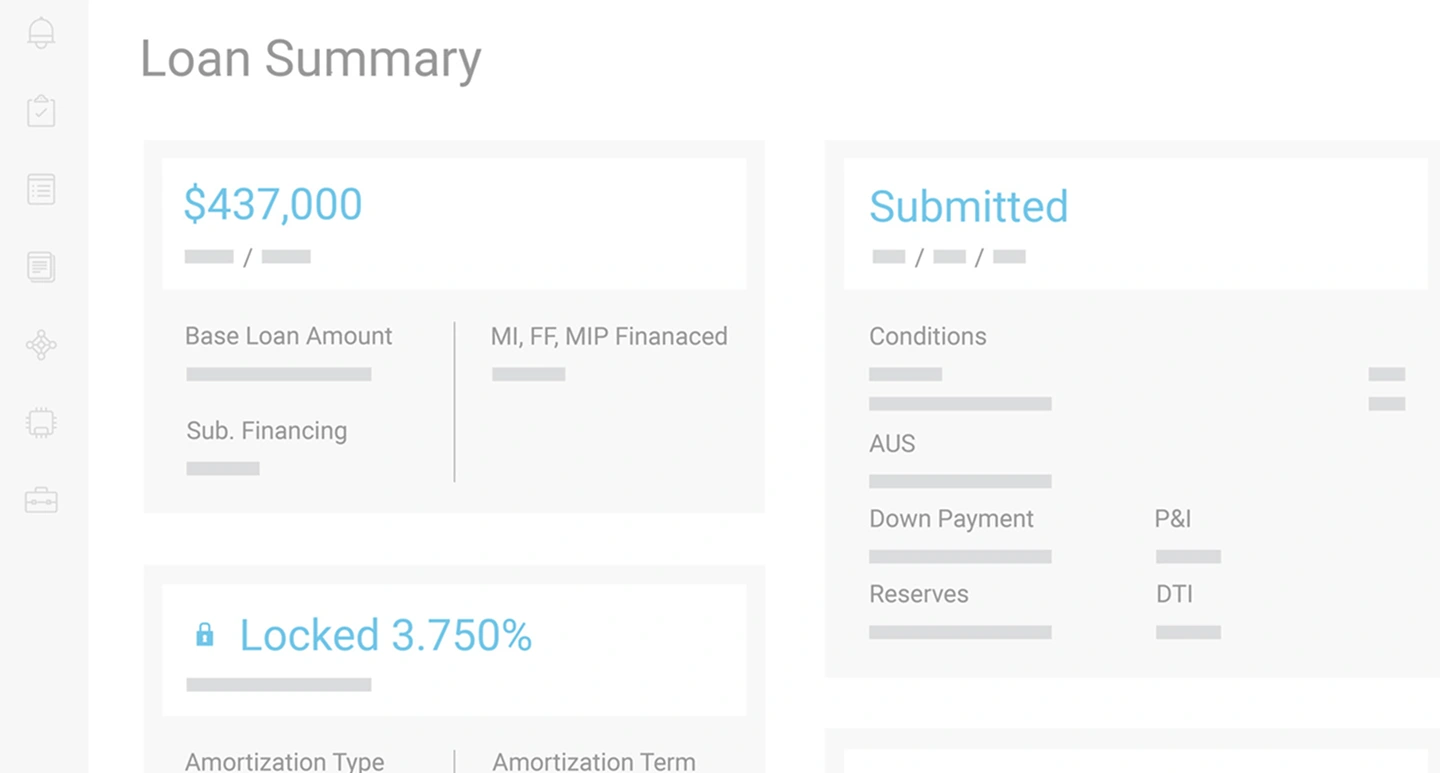
Encompass is one of the most widely adopted mortgage loan origination systems (LOS) in the U.S., developed by ICE Mortgage Technology (formerly Ellie Mae). It provides a comprehensive platform for managing the full mortgage lifecycle—from initial borrower application and underwriting to closing and post-closing investor delivery. The system integrates seamlessly with the ICE ecosystem, including product and pricing engines, document management tools, and eClose solutions. Encompass is recognized for its strong compliance coverage, extensive partner network, and enterprise-level scalability, making it a cornerstone solution for many banks and credit unions.
Best for: Mid- to large-size lenders, banks, and credit unions needing a unified, compliant, and scalable LOS
Key features:
- End-to-end workflow automation: Centralized loan management from origination to investor delivery.
- ICE Partner network: 500+ verified integrations with credit, appraisal, and title vendors.
- ICE PPE: Real-time rate quoting and best-execution pricing analysis.
- eClose functionality: Full digital closing with eSign, eNote, and MERS eRegistry support.
- Compliance engine: TRID, HMDA, and RESPA checks with real-time updates.
- Borrower portal: Online applications, document upload, and secure messaging.
- Document management: Intelligent document recognition and data extraction.
- Pipeline and analytics tools: Dashboards for loan tracking, profitability, and pipeline health.
The features listed represent a summary of publicly documented capabilities and do not cover the full scope of Encompass’s functionality.
Users like: Industry-leading LOS with robust compliance, extensive integrations, and high scalability. Reviewers on Capterra and G2 describe Encompass as a solid, all-in-one tool for mortgage origination. Users appreciate the extensive functionality and integrations but mention the "antiquated interface" and "steep learning curve."
Users don't like: Expensive and complex to implement; potential vendor lock-in; users report dated UI and slower performance under heavy loads.
Rating: Capterra: 4.0/5
Reviews are based on publicly available feedback.
Demo and trial: Demo is available; free trial is not available
Price: upon request
LendingPad: Strong Modern Mortgage LOS Challenger
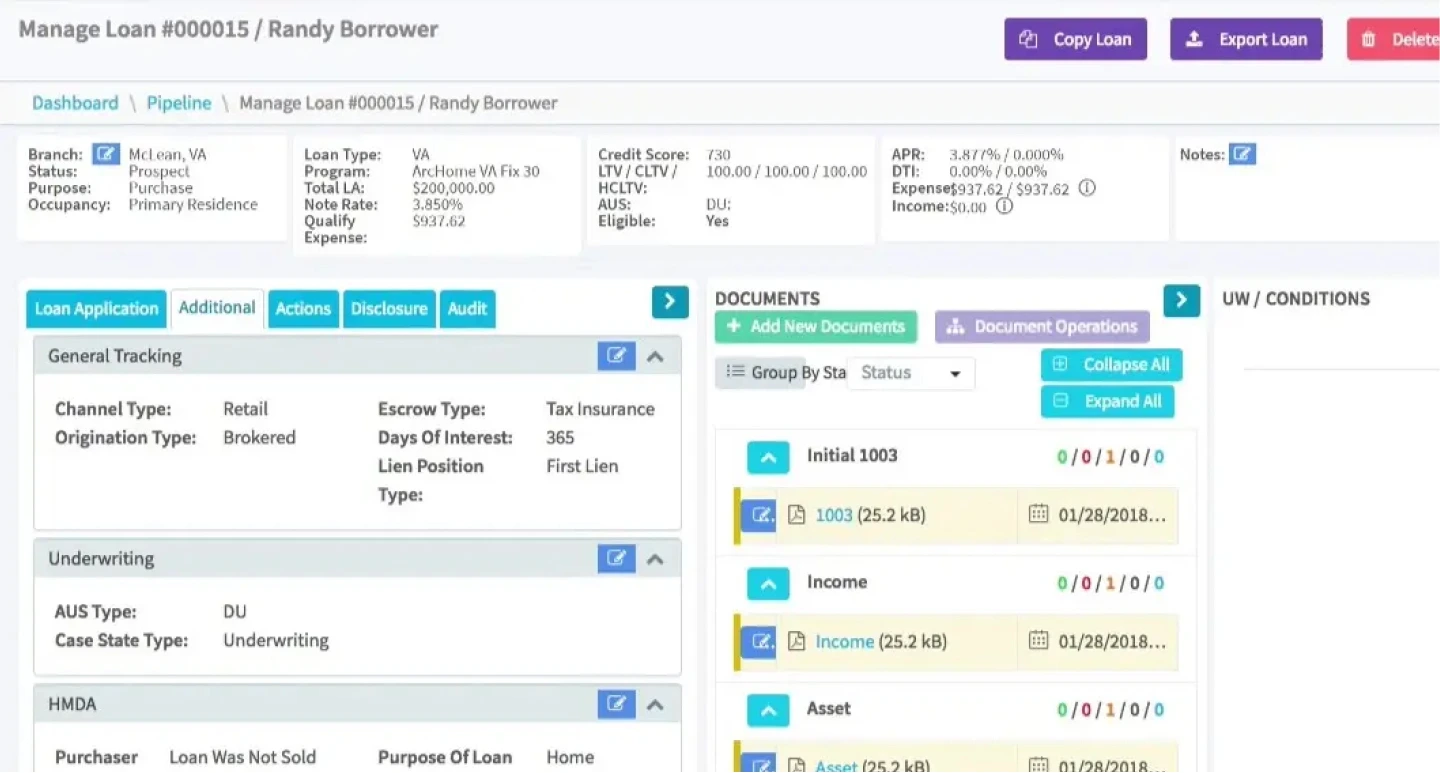
LendingPad is a cloud-native mortgage LOS developed in 2015 to modernize lending workflows through real-time collaboration and accessibility. The platform supports retail, wholesale, and correspondent lending, allowing multiple users to work simultaneously on the same loan file. LendingPad offers an integrated CRM, automated compliance tracking, and seamless integrations with credit bureaus, appraisal services, and title companies. It is known for its affordability and modern design compared to legacy systems like Calyx Point.
Best for: Mortgage lenders and brokers seeking a collaborative, cloud-based LOS with lower total cost of ownership.
Key features
- Real-time collaboration: Multiple users editing the same loan simultaneously.
- Cloud architecture: 100% web-based platform accessible from any device.
- Integrated CRM: Built-in lead and campaign management.
- Compliance tracking: Automated QM and disclosure management.
- Third-party integrations: Credit, appraisal, and title connectivity.
- Document management: Secure cloud storage and e-signature support.
- Live pipeline dashboard: Real-time loan updates and notifications.
The features listed represent a summary of publicly documented capabilities and do not cover the full scope of LendingPad’s functionality.
Users like: Modern, user-friendly interface; strong collaboration tools; cost-effective pricing; built-in CRM. Users on G2 and Capterra describe LendingPad as "intuitive, easy to use, and affordable." Many highlight its responsive support team and say it "modernized our workflow overnight."
Users don't like: Disclosure automation less straightforward than some users expect—requires manual setup; limited support options available; POS functionality requires a separate third-party tool with additional subscriptions.
Rating: Capterra: 4.4/5; G2: 4.7/5
Reviews are based on publicly available feedback.
Demo and trial: Demo is available; free trial is not available
Price: Broker Edition: $59/user/month; Lender and Institution Editions: upon request.
Other Loan Origination Platforms to Consider
Newgen: Low-Code Enterprise LOS for Retail and Commercial Bank Lending
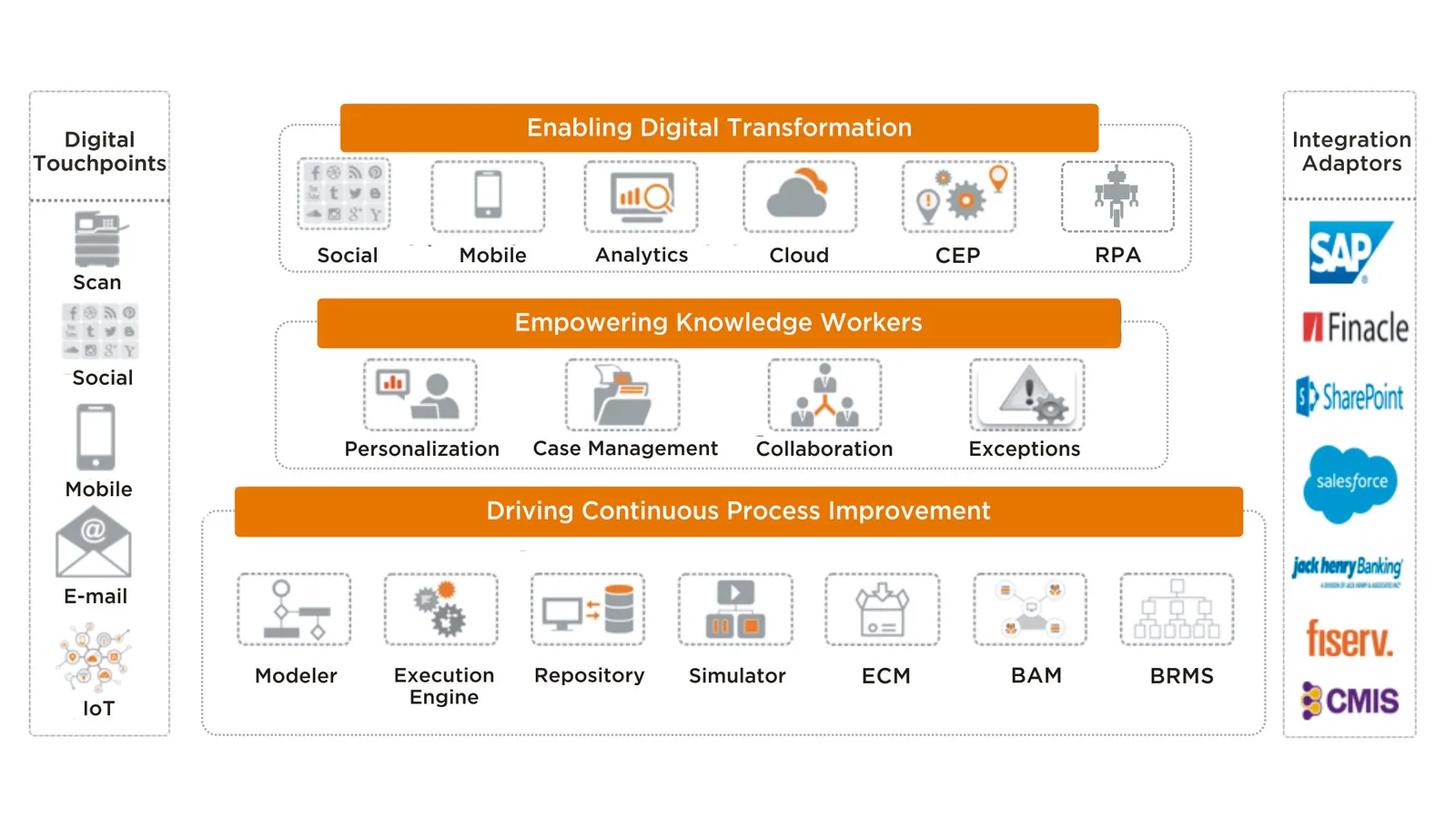
Newgen’s Digital Loan Origination System, marketed by Newgen as its Loan Origination Software, is a lending solution built on the NewgenONE low-code platform. It covers the origination journey from application intake and document processing through credit assessment, underwriting, approval, and disbursement. Newgen’s broader lending suite also includes loan management, servicing, and collections capabilities. Newgen Software is an NSE-listed enterprise software vendor founded in 1992 and headquartered in New Delhi.
Best for: Banks and established financial institutions that need configurable retail or commercial lending workflows on an enterprise low-code platform, particularly organizations already using or evaluating Newgen’s process and content-management stack. Reports and many workflow, routing, form, and rule changes can be configured through Newgen’s low-code and no-code tools. The amount of technical or implementation support required will depend on the complexity of the change.
Key features:
- Low-code automation: Configurable workflows, approval matrices, lender trees, and no-code reporting.
- End-to-end origination: Application intake, document capture, credit assessment, underwriting, decisioning, and disbursement, with links to servicing and collections.
- Straight-through processing: Rules-based no-touch, low-touch, and high-touch decision paths.
- AI/ML tools: Income analysis, fraud detection, financial spreading, and document classification.
- Broad loan coverage: Retail, consumer, SME, commercial, CRE, C&I, and SBA lending.
- Omnichannel intake: Branded borrower portal and online applications integrated with the LOS.
- Integrations: Experian, Equifax, LexisNexis, Wolters Kluwer, CoreLogic, and Compliance Systems.
- Audit and reporting: Detailed audit trails and dashboards for cycle times and bottlenecks.
- Deployment: Cloud or on-premises.
The features listed represent a summary of publicly documented capabilities and do not cover the full scope of Newgen's functionality.
Users like: The only LOS-specific Gartner review currently available highlights customization, integrations, multilingual support, and the ability to digitize the broader financial cycle.
Users don't like: Public review coverage for the LOS product itself is thin, which leaves buyers with less peer validation than they get for more widely reviewed platforms. At the broader-platform level, some users report that development effort on Newgen's low-code stack can exceed the low-code expectation, and its OmniFlow workflow engine draws occasional notes on stability and higher cloud pricing.
Rating: 5.0/5 on Gartner Peer Insights (based on one rating).
Reviews are based on publicly available feedback.
Demo and trial: Demo available on request; no open free trial.
Price: Available on request. Newgen uses subscription- and license-based commercial models, with pricing depending on deployment, scope, usage, modules, and implementation requirements.
Common Pricing Models for Loan Origination Software
Pricing in this market varies significantly depending on deployment scope, implementation complexity, loan product coverage, integration requirements, and origination volumes. No single model works for every lender — the right structure depends on the institution's size, growth trajectory, internal resources, and how much of the origination process needs to be covered.
The most common pricing models include:
Fixed subscription fee: a recurring monthly or annual platform fee, typically used in SaaS deployments and preferred by lenders who need cost predictability from the start.
Implementation fee: a one-time charge covering initial setup, workflow configuration, integrations, data migration, testing, and go-live support. Common for platforms with broader origination scope or significant customization requirements.
Usage-based pricing: fees tied to actual platform activity, such as application volume, credit decisions processed, or API call volume. This structure can align platform costs more directly with origination throughput.
Per-loan or per-application pricing: costs linked to the number of applications processed or loans originated through the platform. Often easier to map to pipeline growth and seasonal fluctuations in origination volume.
Module-based pricing: the total cost depends on which modules are activated: application intake, decisioning engine, document management, borrower portal, compliance tools, or analytics. Useful for lenders adopting a platform incrementally.
Enterprise or custom licensing: individually structured terms for larger institutions with complex deployment requirements, multi-entity setups, on-premise components, or specific security and governance needs.
You can also request a rough project estimate based on your loan products, target markets, expected origination volumes, integration landscape, and deployment preferences. Even an early-stage estimate can help clarify the likely implementation scope, pricing logic, and the most suitable commercial model for your operation.
Loan Origination vs Loan Management, Servicing, and Collections Software
The confusion between these terms is partly a vendor problem. Marketing materials use them loosely, and some platforms deliberately blur the boundaries to appear more comprehensive than they are. For lenders evaluating software, the distinctions are worth being precise about.
Loan origination software covers the decision-making phase—the window during which a lender evaluates a borrower, applies credit policy, produces documentation, and commits capital. The system's job is to get an application from submission to a funded, documented loan with a clean audit trail. That is where its primary responsibility ends.
Loan servicing software takes over once that funded loan becomes a live account. The operational focus shifts entirely: instead of making credit decisions, the system now tracks repayment behavior, applies interest according to the agreed schedule, handles payment exceptions, generates borrower statements, and maintains an accurate financial record of every account in the portfolio.
Loan management software is a broader category that different vendors define differently. Some use it to mean post-disbursement operations only—essentially a synonym for servicing. Others use it to describe a platform that connects origination, servicing, and portfolio administration within a single environment. When evaluating a platform described as a loan management software, it is worth asking which specific lifecycle stages it actually covers, rather than assuming the label answers that question.
Collections software addresses what happens when repayment breaks down—delinquency workflows, recovery strategies, regulatory compliance around debt collection, and borrower communication in default scenarios. It may sit inside a broader platform or operate as a standalone layer connected to the servicing system.
The practical implication for lenders is straightforward: a platform that excels at origination is not automatically capable at servicing, and vice versa. The two functions require different data models, different workflow logic, and different compliance tooling. Lenders who treat them as interchangeable tend to find the gaps later, when operational problems are more expensive to fix.
What Are the Modern Loan Origination Software Must-Have Features?
Loan origination software streamlines the workflow and reduces the risks of errors. And it does so due to the following functionality:
Application processing: LOS provides a possibility to store and process loan applications. The digital onboarding version of the software allows borrowers to submit applications online, eliminating the necessity to manually fill in paper forms. As a modern loan processing software, it saves time and reduces mistakes.
Document management: LOS allows lenders and borrowers to store their documents digitally. Therefore, authorized stakeholders can access any files instantly from anywhere. Possibilities like the generation of promissory notes, deeds of trust, and eSign increase customer satisfaction.
Credit decisioning: At this stage, the documents provided by the borrower are saved, and the lender makes a decision regarding their creditworthiness. Modern systems go beyond traditional credit bureau data by incorporating alternative data scoring. This technology analyzes non-traditional points, such as utility payments and transaction history, to build accurate risk profiles for borrowers with limited credit histories. Automated algorithms and AI smart scoring solutions replace legacy manual methods, ensuring fast analysis and relevant decision-making.
Compliance with regulations: There are multiple regulations that govern the lending industry. An LOS software is designed to support compliance with regional regulations governing security, accountability, and transparency. Key examples include TILA and RESPA in the United States, and the Consumer Credit Directive (CCD) and GDPR in the European Union. Enterprise-grade platforms also maintain SOC2 Type II compliance, ensuring that strict internal controls for data protection, availability, and confidentiality are consistently met. These controls lower the threat of financial penalties and legal challenges.
Reporting and analytics: The software provides lenders with valuable insights regarding application trends and metrics such as pull-through rates, loan volume, abandonment rate, etc. These KPIs help to make data-driven decisions regarding pricing and credit policy, resource allocation, etc.
Integration capabilities: Powerful and modern LOS systems provide integration possibilities. The easier the connection is, the better and more convenient the software is for the lender. Possible integrations might include core banking systems, CRMs, credit bureaus, and document verification services via APIs. It results in fast information exchange and convenient operations.
Credit product management: Modern LOS allows for configuring the lender's entire portfolio of credit products. Administrators may create new loan types, define their specific parameters, such as interest rates (fixed or variable), fee structures, repayment terms, and eligibility criteria, and scale these rules across different channels. This results in rapid product launches and precise targeting of customer segments.
Workflow configuration: This functionality allows lenders to create, customize, and scale the exact journey a loan application follows. Lenders can build workflows by defining rules for tasks like credit scoring, document collection, verification, approval, and funding. The result is a faster, more efficient process that reduces manual handling and shortens turnaround times.
Pricing and terms engine: The feature defines and assigns interest rates, fees, repayment schedules, and other loan conditions for each product. This allows for flexible pricing strategies based on risk and customer profile.
How to Choose the Best Loan Origination Software?
The loan origination platforms mentioned on our list differ in size, experience, scope of functionality, and pricing. Before plunging into any digital transformation, it is recommended to develop a roadmap that will navigate the choice of an appropriate solution.
- Determine the scope of need. Do you need a system for the entire mortgage process, or do you need to solve specific tasks, such as document generation or compliance?
- Develop a structured implementation roadmap. Establish a defined deployment plan with milestones. What are the owners, reasonable deadlines, specified dependencies, and quantifiable acceptance criteria at every phase?
- Choose the deployment model. Do you require easy accessibility and updates of a cloud-based platform, or does your enterprise have specific security and control requirements that demand on-premise servers?
- Consider the implementation time and customization capabilities. Do you need to reduce time-to-market and allow for easy tailoring without extensive developer resources? Low-code/no-code platforms might be a solution. Another option is implementing white-label tools that offer brands a seamless customer experience at a relatively low cost.
- Assess the scalability potential. Can the system grow with your loan volume and adapt to new products?
- Examine the integration possibilities. Does the new software connect with your existing systems (core banking, CRM, etc.)?
- Check the regulatory compliance and security measures. Does it have built-in compliance checks and robust data encryption to protect client data and eliminate breaches?
- Evaluate Total Cost of Ownership (TCO). What are direct costs (those for customization, third-party integrations, implementation services), recurring expenses (like hosting, maintenance, and support), and hidden costs (such as data migration, employee training, and any costs related to a postponed go-live)?

Compliance and Model Governance in Loan Origination Software
Most compliance scrutiny in origination lands when an examiner or auditor reconstructs how a decision was reached or when a declined applicant exercises the right to know why. The system earns its keep by making those answers easy to produce.
What the record has to prove differs by market and product:
- In the U.S., fair-lending and adverse-action rules (ECOA/Regulation B, FCRA) govern why an applicant was declined, while TILA/RESPA disclosure (TRID) and HMDA reporting govern how the loan was presented and recorded.
- In the UK, consumer lending sits under the FCA's CONC rules and Consumer Duty.
- On institutional balance sheets, provisioning follows IFRS 9 or CECL.
Once a model rather than a person shapes the decision, the bar rises again: U.S. supervisors apply SR 11-7 model-risk expectations; in the EU, GDPR Article 22 already treats an automated credit decision as one a borrower can contest today, and the EU AI Act's high-risk obligations for creditworthiness models phase in from August 2026.
Whatever the jurisdiction, the common thread is not a switch to turn on but a discipline to sustain: decisions that can be traced, explained, and repeated.
Two operational layers are table stakes for any loan origination system: a financial-crime layer (KYC/KYB with sanctions screening) and an access-security layer (role-based access, audit logs, two-factor authentication).
Tracked, audit-ready records are what carry adherence to the rules above through the examination cycle.
And at the platform level, buyers increasingly expect recognized certifications and attestations such as ISO 27001 and SOC 2 as a minimum.
How Do You Know It's the Best Loan Origination Software for YOUR Company?
Run this quick test before making a decision:
The 30-day reality check.
Ask yourself: can your team realistically go live in 30-60-90 days? If the vendor is talking about over 6 month of implementations for a standard setup, that's a red flag. Modern platforms should get you up and running fast.
Now, let's be realistic here—if you're running a complex, multi-country operation with dozens of custom loan products and legacy system integrations, yes, you're looking at 6+ months of customization work. That's just the nature of enterprise complexity. But we're talking about standard lending needs here: basic loan origination, underwriting workflows, and servicing. For those core functions, a modern platform shouldn't need half a year to go live. If a vendor needs 6 months to set up a basic consumer lending flow, they're either over-engineering it or their platform isn't as flexible as they claim.
The Monday morning test. Imagine it's Monday. Your loan officer just got back from vacation and needs to process an application. If they need to open 5 different systems or call IT for help, the platform fails. Good LOS should feel intuitive, not like rocket science.
The growth test. You're processing 500 loans a month now. What happens when that becomes 5,000? Ask vendors point-blank: "What breaks first when volume spikes?" Their answer tells you everything about scalability.
The real cost test. Add up everything: licensing, implementation, training, maintenance, and those "small" customization fees that pop up later. Then divide by your monthly loan volume. If the math doesn't make sense, walk away.
The support test. Something breaks at 9 PM on a Friday (because of course it does). Can you actually reach someone who can help, or are you stuck until Monday? Test their support response during the sales process—it only gets worse after you sign.
The exit test. I know you're just getting started. But ask anyway: "How easy is it to export our data if we leave?" If they get uncomfortable or vague, you're looking at vendor lock-in. Your data should always be portable.
'Look, here's what I've seen' work: Stop chasing features you'll never use. Instead, write down the 3 biggest pain points in your current process. Then ask each vendor, "Show me exactly how your platform solves THIS." If they start showing generic demos instead of addressing your specific problems, move on.
The right loan origination platform should feel like it was built for how you actually work, not how some product manager thought lending should work.
Conclusion
A fintech lender choosing the best loan origination software is like a head chef choosing a knife set. The right choice is an extension of their skill and directly determines the quality of their services. The wrong choice, however, leads to wasted effort, complicated processes, and ultimately, higher costs.
An appropriate LOS increases efficiency and ROI, saves operational time, and customizes workflows. The loan origination software comparison allows businesses to evaluate a diverse range of solutions, from full-scale, end-to-end platforms to customizable tools for specific tasks.
Key differentiators in 2026 include the rise of low-code customization, AI-powered underwriting, and the importance of seamless integration. By carefully assessing their specific needs against the features, pros, and cons of top providers, lenders can implement a system that not only streamlines operations but also drives growth, mitigates risk, and ensures long-term competitiveness in the financial landscape.
Looking for a configurable solution rather than a comparison? See how HES loan origination software handles the full origination cycle.