Process more consumer loan applications on your current headcount. End-to-end automation
clears the manual steps that stall files across the lending cycle.
10x
capacity
Credit assessment, verification, and approval run automatically at high volume. With fewer
files handled by hand, processing each loan costs less.
60%
cost reduction
Build a stronger, more resilient portfolio with AI-driven risk analytics that detect early
warning signals and improve credit quality at the point of origination.
50%
lower delinquency rates
Flexible software for the full
consumer lending lifecycle
Effortless onboarding
Launch a branded borrower experience optimised for any device or channel. Give personal loan
applicants a simple way to apply, check eligibility, and submit documentation. Powered by KYC
verification, automated data validation, and intelligent document processing.
Learn more
Precise origination
Accelerate credit decisions with configurable underwriting workflows, AI-driven scoring models,
configurable bureau and KYC/KYB data integrations. Structure and manage consumer loan products
with custom eligibility parameters, dynamic pricing logic, and tailored risk frameworks.
Learn more
Reliable servicing
Manage repayment schedules, disbursements, and borrower communications from one unified
platform. Give operations and borrowers the same real-time view of the portfolio, with lifecycle
steps automated.
Learn more
Intelligent collection
Improve recovery on past-due consumer loans as AI times outreach and forecasts delinquency
early, with restructuring shaped to each borrower's situation.
Learn more
Scope your consumer lending platform in 3 minutes
STEP:
/
Online onboarding
Consumer lending software that drives applications to approval
Move applicants from first click to approval without drop-off. Give consumers a fast digital path to
personal financing while enabling your team with automation tools to process more applications with
less manual effort.
An embedded loan calculator lets consumers adjust amounts, terms, and monthly
payments in real time. Arriving at the application with a clear expectation of costs
increases completion rates and reduces early drop-offs.
Approve faster with every check in place
Applicants submit personal details, upload supporting documents, and sign agreements
without visiting a branch. Your consumer lending software handles identity
verification and credit decisioning automatically, reducing approval times from days
to minutes.
Keep borrowers engaged after disbursement
A self-service portal lets customers view their repayment schedule, check
outstanding balance, and make payments instantly. Automated SMS and email
notifications reduce missed payments and keep engagement high throughout the loan
lifecycle.
Grow through retail and broker partnerships
Equip retail partners, brokers, and referral agents with dedicated portals to submit
applications and track approvals on behalf of their clients. Expand your consumer
lending platform footprint without adding headcount or opening new offices.
Loan origination
Cut consumer loan origination time
with AI and automation
Fast reviews on enriched borrower data protect conversion and lower default risk. AI verification
and scoring speed up each consumer credit decision.
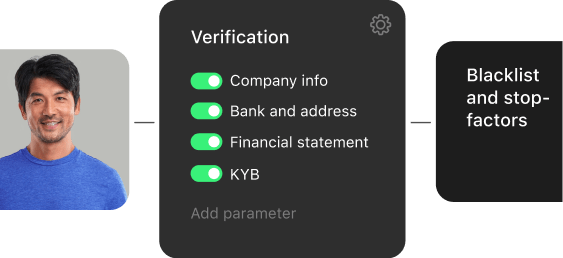
Run KYC, AML, and biometric checks in seconds, then enrich every consumer
application with credit bureau data, open banking signals, and alternative income
sources. You get a complete, audit-ready borrower profile before underwriting
starts.
Configurable underwriting at any speed
Approve consumer loans up to 80% faster with an underwriting engine that follows
your risk policies. Run applications fully automated, semi-automated, or manual by
product, ticket size, or risk segment, without losing conversion or compliance.
AI credit decisioning that grows your book
Combine your own scoring rules with AI-powered decisioning built for consumer
lending. Configure custom scorecards or switch on the GiniMachine AI engine to
approve more loans, cut NPLs by up to 40%, and price thin-file and near-prime
borrowers competitors turn away.
Self-learning scoring by GiniMachine
GiniMachine's AI scoring engine learns from every consumer credit decision you make.
It reads outcomes, picks up new risk patterns, and refines models on its own, fewer
defaults, fewer manual reviews, fewer missed approvals.
Paperless from application to signature
Cut paperwork across your consumer lending system and lower document handling costs
by up to 90%. OCR reads and validates payslips, IDs, and bank statements in seconds;
built-in eSignature closes the deal.
and much more
Unlimited product configuration
Launch any consumer loan product your market needs, from personal loans and installment
plans to revolving credit and co-branded financing. Configure rates, fees, schedules, and
eligibility rules per product or segment, no developers required.
Automated contract generation
Generate legally binding consumer loan agreements in seconds using dynamic templates with
merge variables. Cut drafting errors, speed up disbursement, and stay aligned templates you
can configure to the requirements of each jurisdiction you operate in.
Multichannel communication
Automate outreach across SMS, email, and in-app channels with rule-based triggers tied to
borrower behavior and loan status. Keep consumers engaged at every stage of the lifecycle
and take load off your support team.
Role-based security and access control
Protect borrower data with granular role-based permissions, password policies, and
two-factor authentication. Full activity logs keep you audit-ready across every user action.
Smart notification templates
Build SMS, email, and push templates with dynamic variables to automate every borrower
touchpoint, from application status and approval confirmations to repayment reminders and
renewal offers.
No-code workflow builder
Design and adjust consumer lending workflows visually, without extra development. Map
application flows, set approval logic, build conditional decision trees, and launch new
processes in days.
Configurable consumer lending workflows
Consumer loan servicing
Complete consumer loan management software
A unified consumer lending platform handles servicing end to end, from flexible terms to built-in
payments on real-time data. Automated reconciliation keeps ledgers accurate and teams moving, with
margins protected.
Run every consumer loan from disbursement to payoff on autopilot. Interest accruals,
fees, restructuring, refinancing, and early repayments all follow your business
rules, no spreadsheets, no recalculations, no late nights.
Adjust loan terms, schedules, and payments
Manage installment loans, revolving credit, top-ups, and consolidation products from
one workspace. Adjust schedules, grant payment holidays, restructure balances, and
process partial payments instantly, with full audit history preserved.
Get a complete borrower view for faster service
One record holds each consumer's full file: applications, current and past loans,
documents, messages, and risk profile. Agents resolve on first contact and
cross-sell from context, keeping borrowers loyal.
Keep ledgers and transactions in sync
Process disbursements and repayments through pre-integrated gateways, ACH, SEPA,
card networks, and local rails. Ledgers stay accurate as payments post, with
bank-grade security around every transaction.
Maximize loan portfolio performance
with AI risk intelligence
Clear scoring decisions
Apply predictive scoring across the full consumer lending journey, from pre-KYC filtering to
NPL forecasting, with transparent, explainable, and audit-ready outputs.
Tighter risk control
Set custom risk thresholds, anticipate defaults early, and rebalance pricing to keep your
consumer loan portfolio profitable.
Sharper credit decisions
Sharpen consumer credit decisions with integrated AI that delivers up to 3× better accuracy
than traditional scoring models.
Consumer loan collections
Boost recovery with automated
consumer loan collections
AI-run collections recover faster and cost less to run, with a borrower experience that stays
measured. It scores who is likely to repay, then paces contact across channels, with penalties
applied on audit-ready rules.
Cut manual workload and keep every delinquent loan moving.
Run outreach across SMS, email, and voice
Generate, sign, and store notices automatically
Apply pre-built or custom recovery workflows by delinquency bucket
Tailor every recovery action with AI
Drop one-size-fits-all dunning for borrower-specific strategies.
Match communication strategy to borrower segment
Use AI to optimize timing, channel, and messaging
Forecast repayment and cash inflows
Keep penalties within the rules
Apply overdue fees and interest within regulatory limits, automatically. Stay
aligned with consumer protection rules in every jurisdiction.
Configure penalty rules per consumer loan product and jurisdiction
Configure caps on fees and interest and keep audit-ready records
Keep records audit-ready
100+ integrations to power up your lending system
With flexible connection options and full customization, HES LoanBox provides a broad ecosystem of
integrations that enhance consumer operations across onboarding, scoring, payments, communication,
analytics, and core banking.
What you get by choosing
HES consumer lending software
Flexible customization
Tailor modules, add features, and adjust the interface. Connect any service you run, from
payment rails to the credit bureaus behind consumer lending.
Transparent pricing
HES keeps pricing simple: pay for the license, with custom features the only extra. No
per-user fees, so users and borrowers never add cost.
Industry expertise
Work with business analysts who bring over a decade building lending platforms. Built by
lending-software specialists who know the consumer market you serve.
Launch from 3 months
Go live in as fast as 3 months on a ready-to-deploy consumer lending platform and reach ROI
sooner.
Proven security
ISO 27001 certified and SOC 2 aligned, hosted on AWS or Google Cloud, on a secure Java LTS
stack with regular updates.
Dedicated support
A dedicated support team answers fast and knows your platform in depth.
Success stories
HES FinTech has been our reliable technology partner since 2012. I believe much of our success is due to the well-architected HES LoanBox solution.
ISO/IEC 27001 certification, SOC 2 aligned, and a secure software
development lifecycle help maintain consistent security across operations,
supported by data encryption at rest and in transit, role-based access
controls, and secure hosting infrastructure.
HES FinTech's consumer lending solution can be deployed on-premises, in the
cloud with a provider of your choice, or in a hybrid environment.
Powerful backend tools
HES Fintech builds solutions using free and open-source solutions, like Java
11, BPMN 2.0, and Form.io modeler.
The 2026 reality of
consumer lending
75%
of credit unions on legacy systems
Up to
75% of credit unions still operate on legacy loan origination systems that lack true
automation. Modernization is no longer optional for lenders competing on speed.
2008-level
consumer delinquencies in 2025
US credit card and auto loan delinquencies have climbed to
levels not seen since the 2008 financial crisis. Static scorecards and manual reviews can't keep
up.
Consumer lending software is the technology stack that lenders use to manage the entire life
of a personal loan, starting from the moment a borrower submits an application and ending
when the last repayment clears. Modern platforms cover four big jobs at once: digital
onboarding and identity checks, underwriting and credit decisioning, ongoing loan servicing
with payments and ledger management, and collections when something goes wrong. HES LoanBox
is one example of this category, designed specifically for banks, credit unions, and fintech
lenders that need to run high-volume personal loan portfolios without stitching together
five or six different tools.
What is the difference between consumer lending software and a loan origination system
(LOS)?
The two terms get mixed up constantly, and even reviewers on G2 and Capterra use them
interchangeably, so the confusion is understandable. The cleanest way to think about it: a
loan origination system handles the front end of the journey, meaning everything from
application through approval and funding. Consumer lending software is the broader category
that includes the LOS plus everything that happens after the loan is funded, such as
servicing, collections, restructuring, and portfolio analytics. Platforms like HES LoanBox
combine both into a single end-to-end consumer finance system, so lenders avoid the
integration headaches and data silos that come with running an origination tool and a
servicing tool side by side.
How do I choose the right consumer loan software for our institution?
Start with the part of the lending journey that is actually hurting your business. If
approvals take days and applications drop off, the priority is origination and underwriting
automation. If your team is buried in manual reconciliations and the portfolio is growing,
servicing depth matters more than anything else. From there, evaluate four things that
quietly determine total cost of ownership over five years: how flexible the product
configuration is, how the platform integrates with your core banking and bureaus, the
realistic implementation timeline, and the pricing model. HES LoanBox tends to come up in
shortlists when lenders evaluate loan software for a consumer lender that needs one
configurable platform across origination and servicing rather than separate point solutions,
but the right answer depends entirely on where your operational pain sits today and where
the portfolio is heading next.
How long does consumer lending software take to implement?
Implementation timelines in this market are all over the map. Legacy enterprise platforms
can take twelve to eighteen months and require a dedicated internal IT team. Modern
cloud-native platforms ship with pre-built workflows, integrations, and configurable
products, which compresses that timeline dramatically. HES LoanBox, for reference, gets most
clients live within 3–6 months, because the platform comes with ready workflows for personal
loans, installment products, and revolving credit, plus standard integrations to credit
bureaus, KYC providers, and payment gateways. Complex deployments with multiple loan
products, several jurisdictions, or unusual regulatory requirements usually run a bit
longer, which is normal and easier to plan for once the discovery phase makes the scope
clear.
Is HES LoanBox suitable for both banks and credit unions?
HES LoanBox consumer loan software works for both, from community banks and single-branch
credit unions to multi-state lenders running several loan products at once. The platform
connects to the major core banking systems and lets credit unions enforce their own policy
rules without custom development. Configurable workflows keep credit decisions consistent
across products, branches, and lending teams.
What loan types does HES LoanBox consumer lending software support?
HES LoanBox supports the full range of consumer credit products on a single platform, so
lenders don't end up running separate systems for separate offerings. That can include
personal loans, installment loans, revolving credit lines, point-of-sale (POS) finance,
BNPL, auto loans, HELOCs, and short-term consumer loans. Each product can be configured
independently with its own pricing logic, eligibility rules, fees, and repayment schedules,
and lenders can launch new products or adjust existing ones through the product builder
rather than through custom development. That matters when the market shifts and a new loan
type needs to go live in weeks, not quarters.
Does consumer loan software help with credit risk management?
Yes. HES LoanBox handles credit risk management as part of the consumer loan origination
workflow, not as a separate module bolted on later. It captures borrower data, applies
configurable risk thresholds, and stores the reasoning behind every credit decision in an
audit-ready log. Combined with AI scoring from GiniMachine, this gives banks and credit
unions stronger risk oversight without extra manual review steps.
Why choose an integrated consumer lending platform instead of separate tools?
Running origination, servicing, and collections on separate tools creates data silos,
handoffs that fall through the cracks, and inconsistent borrower records, which slows down
automated consumer lending and inflates operational costs. HES LoanBox brings the full
consumer loan lifecycle onto one platform, so underwriting, verification, and servicing
teams all work from the same data. For lenders evaluating consumer finance software, this
means fewer integration costs, faster cycle times, and a single source of truth across the
portfolio.
Is HES LoanBox cloud-based or available on-premises?
HES LoanBox is built cloud-native and runs on AWS, Google Cloud, or any provider the lender
prefers. For institutions with strict data residency rules, regulatory requirements (FCRA,
ECOA, Regulation Z), or internal IT policies that rule out public cloud, on-premises and
hybrid deployments are also supported. The underlying stack is Java LTS with an API-first
architecture, which means this automated consumer lending platform is scalable horizontally
as the portfolio grows and connects cleanly to core banking systems, credit bureaus, payment
networks, and other parts of the lending ecosystem.
Book a demo
HES FinTech has been our reliable technology partner since 2012. We owe much of
our success to their well-architectured solution.
Boris Batine, CEO at ID Finance
HES FinTech offers comprehensive front-to-back solutions with integrations. Our
machine learning platform will allow clients best-in-class investment advice.
Edward Downpatrick, Strategy Director at Fintuity
In just 6 months, we went from storing all our data in Excel to a fast,
reliable, and user-friendly platform that caters to our specific needs.
Hjortur H. Jonsson, Partner at ALM Securities
HES developed our lending software and predictive analytics. Their expertise
delivered automation, clear UI/UX, and customer portal.
Mazen Alasnag, Head of Loan Management at Wa’ed
The LMS provided flexible repayment options, automated restructuring and
branch-level management, enhancing efficiency and risk mitigation.