Invoice factoring software
for factoring companies and banks
For lenders that buy or finance their clients’ invoices. Onboard clients, verify and score invoices,
fund advances, and match debtor payments on one platform.
Customizable invoice factoring solution
that benefits all parties
Supplier
Suppliers submit invoices in a white-label portal and follow each one from submission to
funding. Fees on every advance are calculated automatically by the platform.
Factor
GiniMachine scores clients and debtors with models trained on your historical data. The
cycle from onboarding to payout runs in HES LoanBox.
Debtor
Debtors verify invoices and track their payment obligations in real-time, reducing
back-and-forth communications and accelerating the payment cycle.
Purpose-built factoring software
for the full receivables lifecycle
Streamlined client onboarding
Bring each new client and its debtor ledger onto the platform through a digital application.
Invoice data comes in from the accounting and invoicing systems you connect. KYB, credit-limit
setup, and document capture run inside the application, and each step is logged for audit.
Learn more
Receivables-based origination
Size each facility from real invoice data and debtor payment history. GiniMachine adds a score
trained on your own book. Set the advance rate and caps and decide which debtors are eligible.
Recourse and non-recourse structures run from the same engine.
Learn more
Live invoice servicing
Follow every funded invoice from drawdown to settlement, with debtor payments matched and the
sales ledger updated as cash lands. Client statements and reserve positions update with the
posting, and facility utilization recalculates at the same time.
Learn more
Disciplined debtor collection
HES LoanBox flags debtors whose payment times are getting longer, before their invoices reach
your overdue thresholds. Disputed invoices and short-pays are logged against the facility they
affect, and collectors handle them in the same queue as reminders.
Learn more
Get your lending
product estimate
in 3 minutes
STEP:
/
Digital onboarding
Factoring software that funds more receivables
Turn client inquiries into funded invoices without friction. Sellers request a quote, submit
invoices, and reach drawdown on one digital path, while the platform runs the repetitive checks and
your team clears far more facilities with much less manual effort.
Onboard a client and its full list of debtors in one pass. The platform prices the
facility against their invoices and checks each debtor for concentration and credit
limits. Exposure is clear up front.
Decide and fund in one workflow
Clients connect their accounting system, upload the invoice batch, and e-sign it,
with no call required. HES LoanBox clears KYB, runs risk checks, and returns a score
on its own, and a funding decision lands without delay.
Invoice and ledger verification
Clients upload their sales ledger and invoice batch. The system reads invoice
values, debtor concentration, and aged-debt patterns automatically, and flags
duplicates or invoices already financed elsewhere so dilution and double-funding
risk surface before you commit.
Grow through broker and introducer channels
Give brokers and introducers their own portal to submit clients, watch funding
status, and reconcile commission on the deals they bring. Add origination volume
through partner channels without growing headcount or opening branches.
Task management that keeps factoring teams in sync
HES LoanBox assigns each facility and invoice to a reviewer based on role and current workload. It
flags items close to their turnaround deadline, and credit and operations teams track every facility
in one shared view, from review to payout.
Every submission goes through invoice verification and scoring before funding. The decision follows
your policy rules, and borderline cases go to a credit officer.
The offer never runs ahead of what the receivables can support. The platform
validates each invoice and debtor, then sets advance rate, fee, and concentration
limit straight from the debtor profile.
Your risk rules, enforced automatically
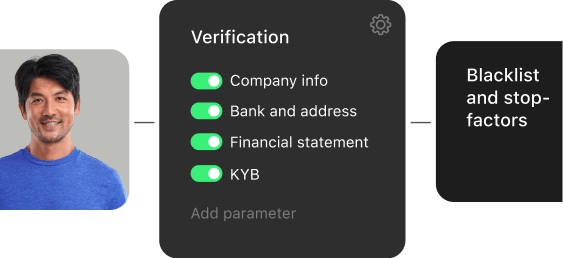
You set the credit policy once. From there, HES LoanBox clears straightforward
facilities on its own and routes the rest for partial or full manual review, with
the cutoffs you choose for facility size, debtor sector, and risk band.
AI scoring tuned to receivables risk
Bring your own scorecards, lean on the AI engine built for receivables risk, or run
both together. The model identifies more sound clients while it flags dilution and
invoice fraud early, which is how lenders cut losses by up to 40%.
GiniMachine models that keep learning
As facilities pay out or go bad, the GiniMachine engine learns from those outcomes,
updates its own risk patterns, and sharpens future scoring accuracy.
Notice of assignment, handled in-flow
When a facility goes live, the system builds the assignment notice from a
configurable template, sends it to each debtor, and records who has acknowledged.
While documents and reminders follow your own workflow, disclosed deals stay clean
and auditable.
and much more
Configurable factoring products
Recourse, non-recourse, whole-turnover, selective, and confidential invoice discounting run
from one configuration. Advance rates, fees, reserve, and debtor eligibility are set per
product or client. New configurations go live without a dev cycle.
Facility agreements, auto-generated
Master facility agreements generate from templates already populated with advance rate, fee,
reserve, and assignment terms. Get fewer drafting errors, faster funding, and a paper trail
that holds up when a client or auditor asks.
Reserve release and re-advance
As soon as a debtor pays, the held-back reserve is freed and the client can draw against
fresh invoices again. Release rules, holdback percentages, and re-advance limits follow the
terms you set per facility, keeping working capital cycling.
Dilution, credit notes, and disputes
Credit notes and short-pays get logged against the right facility and netted off
automatically. Disputed invoices are tracked on the same facility until they are resolved.
Debtor payment reconciliation
Debtor receipts are matched to the open invoice and reserve automatically. Shortfalls,
overpayments, and unapplied cash surface on their own. The ledger stays accurate as money
lands.
Workflows without the dev queue
Change how a facility moves from onboarding to funding with a visual builder. Operations
staff edit the steps and approval routes themselves.
Workflows shaped to your factoring book
Receivables servicing
One system for the entire receivables book
HES LoanBox keeps the whole receivables book in one system. You adjust facility terms when needed,
and each debtor payment posts to the invoice and facility it belongs to.
From the first drawdown to final settlement, a facility runs without anyone touching
a spreadsheet. Reserve releases, fee postings, credit notes, and term changes all
apply from your own settings, with servicing holding up as volume climbs.
Early warning on debtor risk
HES LoanBox flags a debtor when it breaches a concentration limit or starts
disputing invoices. Each flag goes to the credit team together with the facilities
and invoices it affects.
Every client and debtor in one view
Open any client in HES LoanBox and the full picture is there: every facility, the
invoices funded and settled, how their debtors actually pay, the current reserve,
and where risk sits today. Two relationships, the client and each debtor, stay
visible side by side.
Settling debtor cash and client payouts
Debtor receipts, reserve releases, and client payouts move through ACH, direct
debit, and bank transfer. You set the settlement schedule, the ledger updates as
money clears. The payment integrations move the volume, with nothing keyed in by
hand.
AI risk scoring for clients and their debtors
Debtor concentration and dilution tracking
The book stays balanced and profitable across every client, as you watch debtor
concentration, catch dilution as it builds, and flag a debtor sliding toward default early.
Scoring trained on your own book
AI engine trains on your own facility outcomes and keeps learning as new ones come in. In
commercial lending, it has delivered up to 3x higher scoring accuracy.
Scores your committee can question
Every client and debtor is scored from first review through to payoff, and each score is one
your committee can open up and challenge line by line.
Debtor collections
Rule-based collection of overdue invoices
HES Collection Agent ranks overdue debtors by value and age and escalates each case in stages, from
automated reminders to manual follow-up, under rules you set.
The moment a debtor payment is missed or short, HES LoanBox opens the recovery path
you built for it. Outreach goes out that day, the reserve position re-checks itself,
and each case advances through stages set by how overdue it is.
Overdue accounts in priority order
The AI scores each overdue account by expected recovery, tells you which channel and
what timing give the best odds on it, and gives finance a realistic read on
collections for the month ahead.
Head off late payments early
Reminders reach each debtor ahead of the due date by SMS, email, or a call, with a
log of which landed and which got ignored.
Fees and reserve, within policy
Late fees and reserve adjustments apply only inside the limits your compliance team
defines. Penalty terms are configured per facility type and region, caps are
enforced automatically. Every debtor contact and charge is logged, ready for any
audit.
100+ integrations across your factoring workflow
Through an open API and pre-built connectors, HES LoanBox links into the tools a factor already
runs: accounting and sales-ledger systems, credit bureaus and business data, KYB and sanctions
checks, payment rails, communication, and analytics.
What you get from our factoring software
Unlimited customization
Configure modules and workflows, including the approval routes your factoring committee
signs off on. Integrations with business bureaus or accounting systems are added as your
process needs them.
Transparent pricing
HES LoanBox pricing is simple: a license fee, plus custom development when you need it.
Users, clients, and debtors are all unlimited, and a developer license gives you full
control with no vendor lock-in.
Industry expertise
Our analysts bring 10+ years in credit and lending, from the US and EU to emerging markets.
HES lending software has been deployed for 160+ businesses in 32 countries.
3-month product launch
Go live from 3 months. Start funding receivables sooner and hit ROI well ahead of what a
legacy factoring system would take to stand up.
Proven security
ISO 27001 certified and SOC 2 aligned. Runs on AWS or Google Cloud on a Java LTS stack, with
audit logs and role-based access.
Dedicated support
Reach a dedicated factoring support team for fast, expert help, any time you need it.
Success stories
HES FinTech has been our reliable technology partner since 2012. I believe much of our success is due to the well-architected HES LoanBox solution.
HES FinTech is ISO 27001 and SOC 2 aligned, and HES LoanBox is built under a
strict SDLC. Role-based access and 2FA control who can open and change
client and debtor records. Audit logs keep a record of changes that auditors
can review.
HES LoanBox runs on-premises, in a private cloud, or with a public provider
such as AWS or Google Cloud. You choose the hosting model your compliance
requirements call for.
An open stack you can own
HES LoanBox runs on open-source components: Java LTS, BPMN 2.0, and Form.io.
The HES LoanBox license is the only license fee you pay.
The 2026 reality of
invoice factoring
€4T
in global factoring turnover
Worldwide factoring turnover passed
€4 trillion in 2025, up 3.7% on the year. Companies keep turning to receivables finance for working capital,
and the funding pool keeps growing.
76%
of US firms hit by payments fraud
More than three-quarters of US organizations met attempted or actual
payments fraud in 2025, much of it through fake invoices and vendor impersonation. Verifying debtors and invoices
is no longer optional.
23%
of North American B2B receivables are overdue
Around 40% of B2B invoices in North America are paid late, and close to
5% are written off as bad debt. Late payment is the norm your clients live with, and the gap factoring fills.
+35%
US factoring growth in one year
Factoring turnover in the US jumped
35.5% in 2025, the fastest-growing major market. More businesses are financing invoices and need a
funder who can onboard them fast.
Go live from three months
You source the receivables. HES FinTech delivers the
technology.
Invoice factoring software is the system a factor uses to advance cash against a client’s
unpaid invoices and then manage that facility until the debtors pay. The client and its
debtors sit in one record. Advances are sized from actual invoice data, and the held-back
reserve goes back to the client once an invoice settles.
What is a realistic timeline for implementing factoring software?
A focused launch with one factoring product takes from 3 months on HES LoanBox. Several
product types or custom development push most projects past 6 months. Migration usually
takes longer than configuration, because open invoices and reserve balances must reconcile
with the old ledger first.
Does factoring software support recourse and non-recourse factoring?
Both run as product settings, alongside whole-turnover and selective programs. Confidential
invoice discounting can run next to disclosed deals. A credit note or a short payment is
netted off the affected facility.
Can HES factoring software integrate with our accounting systems and credit bureaus?
Accounting and invoicing systems are usually connected first, because they carry invoice
data and the sales ledger into the platform without rekeying. Credit bureaus and
company-data providers follow for client and debtor checks, and the payment rails you use
for advances and debtor receipts can be connected as well. HES LoanBox works from a library
of 100+ integrations. When a service is not on that list yet, your team can build the link
under the developer license, or HES builds it.
How does AI scoring work in a factoring platform?
HES LoanBox uses GiniMachine, the HES AI decisioning engine, as a scoring provider. It rates
the client and each of its debtors on your own facility history. A credit officer sees each
score with the factors behind it and can challenge the call before funding. Models are
retrained as facilities settle or default, and in commercial lending deployments GiniMachine
scoring has been up to 3x more accurate than conventional models. Your policy rules and
cut-offs still decide which facilities clear without review and which need a manual look.
How are debtors checked before an invoice is funded?
Before an advance goes out, the platform tests each debtor on the batch against the credit
limit and concentration limit you set for it. Debtors outside your eligibility rules are
left out of the funding amount. A debtor that breaches its concentration limit (one buyer
carrying too large a share of the client’s ledger, for example) is flagged to the credit
team. Debtors can also confirm invoices in their own portal. On disclosed deals, the notice
of assignment is generated from a template and sent to the debtor, with acknowledgments
recorded on the facility.
How are duplicate or double-financed invoices caught in a factoring platform?
The platform checks each new batch for duplicates and for invoices another funder has
already financed, reading invoice values and aged-debt patterns as the ledger comes in.
These flags appear before the advance is approved. Dilution is watched after funding too:
credit notes and disputes stay logged against the facility, and the credit team can see
dilution building by client and by debtor.
How much does invoice factoring software cost?
HES LoanBox carries a license fee, and custom development is quoted on top only when a
factor needs features beyond configuration. Adding users or debtors does not raise the fee.
That matters once brokers and collectors start working in the platform. Hosting can be
on-premises or in the cloud, and owning the source code is an available option. For a first
figure based on your products and integrations, the estimator on this page takes about 3
minutes.
Book a demo
HES FinTech has been our reliable technology partner since 2012. We owe much of
our success to their well-architectured solution.
Boris Batine, CEO at ID Finance
HES FinTech offers comprehensive front-to-back solutions with integrations. Our
machine learning platform will allow clients best-in-class investment advice.
Edward Downpatrick, Strategy Director at Fintuity
In just 6 months, we went from storing all our data in Excel to a fast,
reliable, and user-friendly platform that caters to our specific needs.
Hjortur H. Jonsson, Partner at ALM Securities
HES developed our lending software and predictive analytics. Their expertise
delivered automation, clear UI/UX, and customer portal.
Mazen Alasnag, Head of Loan Management at Wa’ed
The LMS provided flexible repayment options, automated restructuring and
branch-level management, enhancing efficiency and risk mitigation.