Peer-to-peer lending software for marketplace lenders
Use P2P lending software for borrower-investor matching and for full-cycle loan automation in consumer
loans, SME loans, real-estate lending, and invoice notes.
Borrower and investor verification runs in one digital flow, so the same operations team
onboards more accounts with less manual document review.
44%
higher staff efficiency
AI scoring reviews applications before they go live on your peer-to-peer lending platform.
That check leaves fewer loans non-performing, which protects investor capital.
40%
fewer NPLs
Loan and investment agreements are built from templates and signed online, reducing document
handling.
90%
lower paperwork costs
Adaptable p2p lending software across
the entire lending lifecycle
Dual-side onboarding
Open a white-label peer-to-peer lending platform, one for borrowers, one for investors.
Applicants check eligibility and submit an application. Investors register and top up to start
funding. KYC and KYB run on both sides.
Learn more
Accurate origination
Decide faster with underwriting rules you configure and AI scoring backed by external data. Each
approved application becomes a graded listing, and investors see the same risk grade on each
deal.
Learn more
Reliable servicing
Manage repayment schedules, e-wallet balances, and investor payouts from one unified platform.
Keep both sides aligned through live portfolio insight and distribution of every repayment by
the rules you set.
Learn more
Smart recovery
Improve recovery on overdue loans through AI-powered outreach, predictive delinquency analytics,
and flexible restructuring that protects investor returns and your loan book.
Learn more
Get your lending
product estimate
in 3 minutes
STEP:
/
Digital onboarding
Peer-to-peer lending software that onboards both sides
Faster onboarding on both sides puts investor capital to work sooner. Borrowers get to a decision
and investors to their first listing, while your team reviews exceptions rather than routine
accounts.
Custom forms greet borrowers, while a clear sign-up path welcomes investors. Each
side sees only what matters to them, so more visitors finish registration and fewer
drop off before reaching a live listing.
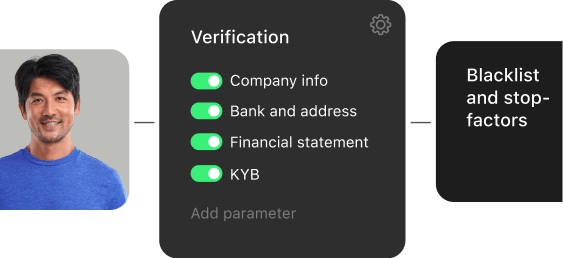
Verify borrowers and investors in seconds
Across borrower and investor accounts, individuals go through KYC and companies
through KYB, with sanctions screening added. Set the workflow so funding opens only
after checks pass, and keep a logged record of each check for auditors.
Fund investors and back deals fast
Investors top up an e-wallet, set their criteria, and start backing listings right
away. Bid amounts freeze until a project is fully funded, then move to the borrower,
so capital flows without manual transfers.
Grow through partners and referral channels
Equip brokers, affiliates, and referral agents with dedicated portals to submit
borrowers or introduce investors and track results. Expand your peer-to-peer lending
platform reach without adding headcount or new offices.
P2P lending platform software for smart task management
Borrower applications and investor approvals run through the same task queue. Assignment follows
role and available capacity, and turnaround is visible live, so underwriting and payout teams know
what waits on each side.
HES LoanBox scores each approved application and turns it into a priced, graded listing. Investors
see the risk data behind the deal, so they can commit without waiting for extra documents.
Set approval rules and scorecards in the no-code builder, then price each grade from
the same screen. Risk bands and limits move when your market does, and consumer,
SME, real-estate, and invoice loans can run on separate policies within one
peer-to-peer lending software.
Keep both sides of the market liquid
Investors set their criteria once, and auto-invest places their money into listings
that match. New listings meet standing demand instead of waiting for someone to
browse, which shortens the time from approval to full funding.
Give investors a clear risk view
Each approved loan shows the risk grade and rate your underwriting assigns. Retail
and institutional investors compare deals against one scale, which supports
transparency and repeat funding on your marketplace.
Self-learning scoring by GiniMachine
GiniMachine, the AI engine from HES, builds self-learning scorecards from your
historical data and scores new applicants in seconds. It flags weak deals before
they list, improving scoring accuracy while protecting the capital investors risk.
Paperless from application to funded loan
Agreements come from templates, get signed online, and the disbursement moves into
the borrower's wallet once the listing closes. Investor repayments post to their
wallets. Nothing in the chain waits on a printed file or a courier.
and much more
Configurable loan products
Run the products your marketplace lists: personal loans, SME credit, real-estate deals,
invoice notes. Pricing, charges, repayment timelines, and eligibility are configured per
product or investor segment, with no developer time.
No-code workflow builder
Build and revise workflows yourself, with no engineering ticket. Map application journeys,
set approval conditions, branch by scenario, and publish a revised process in days for
standard changes, without a release cycle.
Role-based security and access control
Limit who sees borrower and investor files with access rights assigned by role, two-factor
sign-in, password policies you set, and encrypted storage and transfer. User actions are
recorded in an audit log.
Automated contract generation
Produce legally binding loan and investment contracts within moments, built from reusable
templates that merge in deal data. Reduce manual errors, fund borrowers sooner, and keep
paperwork consistent with each market where you lend.
Investor and borrower e-wallets
Give both sides a wallet inside your platform. Balances are tracked in real time, bid
amounts freeze until a project is fully funded, and investors reinvest accrued interest
without moving money off your marketplace.
Multichannel communication
Trigger outreach by SMS, by email, and inside the app, driven by rules that respond to user
activity and loan status. Both borrowers and investors stay informed while your support team
carries less manual work.
Configurable workflow
Loan servicing
Peer to peer loan software for the full term
Peer to peer loan servicing software holds the funded loan, the investor positions behind it, and
the money moving between them. Terms can change mid-term, and payouts follow the same records, so
both sides see the same numbers.
Manage marketplace loans between disbursement and closure under your servicing
rules. Accruals and fees follow the repayment calendar, so month-end balances need
no manual recalculation.
Loan management in one workspace
Handle consumer, SME, real-estate, and invoice loans inside one workspace. Change a
schedule, approve a payment holiday, rework an outstanding balance, or take a
partial repayment, with each change kept on the record.
Investor payouts on each repayment
Divide each borrower repayment among the investors funding the loan. Calculated
shares reach investor wallets once the payment posts, and the recorded split keeps
payouts traceable on multi-investor deals.
Trusted payment operations
Money moves over integrated gateways and rails like ACH, SEPA, and card networks.
Each transaction is matched back to its loan and wallet with a log kept for audit.
Keep your loan book healthy
with AI risk intelligence
Scoring made clear
Scores run from pre-KYC screening through default forecasting, and each result shows the
factors behind it, so decisions can be explained to investors.
AI-driven risk precision
Built-in AI scoring reads patterns in your own loan history that a fixed rule set misses.
Smarter risk control
You set the cutoffs, and early default signals arrive in time to reprice risk or pause a
product.
Debt collection
Turn overdue loans back into payouts
Automated recovery returns overdue loans to payment faster and at lower cost. AI ranks accounts by
likelihood to pay and routes each case to the right channel, with fees applied only within the caps
you have set.
Run each overdue loan through stages you build in HES LoanBox instead of a manual
call list.
Set the channel sequence for each recovery stage
Switch a track on or off per product
Copy a workflow and adjust it for a new product
Match tone and pace to the borrower
Match tone and cadence to the borrower, so a first miss is not handled like a
default.
Pick an urgent or gentle track by case
Set contact days from the first missed payment
Let AI choose the channel for each step
Remind borrowers before payments slip
Reach the borrower in the app before the payment date, while paying is still simple.
Send reminders by push, in-app message, SMS, or email
Track what was delivered and what got a reply
Offer a payment plan before the loan turns delinquent
Show investors where recovery stands
Investors see the status of a late loan without asking your support team.
Publish recovery stage and last action per loan
Post recovered amounts against the loan ledger
Cap charges by product, with an entry in the record for each
Hold contact frequency to your own policy
Analytics built for marketplace lending
Custom dashboards carry the figures your operations team opens first: applications approved and
declined, how quickly listings fill, cash waiting in investor wallets. Raw data exports on demand,
and views split by product, grade, or vintage.
Over 100 key integrations to run your peer-to-peer lending software
Connect the services your borrowers and investors use daily: identity providers, payment rails,
wallets, messaging, accounting. HES LoanBox carries over 100 pre-built integrations, and the open
API covers whatever is missing.
What marketplace operators
get from our P2P loan software
From configuration to full code ownership
Rules differ by jurisdiction and loan class, so set listing criteria, investor limits, fees,
and eligibility yourself. Beyond configuration, custom P2P lending software development is
available, and the code base can be handed over, with no vendor lock-in.
Specialists in marketplace lending
HES has shipped lending platforms for 14+ years, serving consumer lenders, banks, and
marketplace operators in the US, EU, and emerging markets. Two-sided flows and investor
payouts are long-standing parts of the platform.
Live marketplace from 3 months
Launch a new loan class or a new market from 3 months. The platform arrives configured for
both sides, so listings can go up while a from-scratch build is still being scoped.
Pricing that holds as you scale
Pricing runs on a license, not per user, with no ceiling on accounts, so signing up more
small investors does not raise the bill.
ISO/IEC 27001 certified and SOC 2 aligned
Data on both sides is held under SOC 2 and ISO 27001 controls. The stack runs on hardened
Java LTS, deployed to AWS, Google Cloud, or your own servers, and records stay ready for
audit.
A team that answers fast
When a popular listing spikes traffic or a payout question is urgent, the answer comes from
engineers who built your instance, not a first-line queue.
Success stories
HES FinTech has been our reliable technology partner since 2012. I believe much of our success is due to the well-architected HES LoanBox solution.
ISO 27001 certification, SOC 2 alignment, and SDLC controls sit under daily
operations. Records on both sides are encrypted at rest and in transit, and
access runs through role-based permissions on hardened hosting.
Host HES LoanBox with AWS or Google Cloud, keep it on your own hardware, or
split the two where your market requires it.
Powerful backend tools
HES FinTech engineers on open-source foundations. The stack includes Java
LTS, BPMN 2.0, Camunda, and the Form.io modeler, a choice that spares
clients every licensing fee beyond the platform code itself.
The 2026 reality of
peer-to-peer lending
€4.25B
EU crowdfunding volume in 2024
In 2024, 181 authorized EU crowdfunding providers raised
€4.25 billion, and loan-based projects took about 58%. That makes investor funding and repayment
servicing the core of daily operations.
29%
of US small-business applicants chose online lenders
In the Federal Reserve's 2025 survey,
29%
of small-business credit applicants turned to online fintech lenders, up from 17% five years
earlier. Fast online decisions help a marketplace win this demand.
$3.3B
US lender exposure to synthetic identities
Synthetic identities left US lenders with
more than $3.3 billion
of exposure by year-end 2024, spanning auto loans, bank cards, retail cards, and personal
loans. Marketplace investors absorb the loss when a synthetic borrower defaults.
88%
of EU crowdfunding investors are retail
In 2024,
88%
of investors on EU crowdfunding platforms were retail, with an average stake of about €660.
Handling millions of small investments takes accurate wallet balances and loan-level risk
data.
Launch a marketplace from 3 months
You drive the growth, and HES FinTech takes care of
everything behind it.
It is the infrastructure a marketplace runs on, the software that matches borrowers with
investors and runs each loan from the day it is listed to the day it closes. Peer-to-peer
lending software, also called marketplace lending software, handles onboarding and identity
checks on the borrower and investor side, credit scoring, e-wallets, servicing, payouts, and
collections. The same category covers loan-based crowdlending platforms in the EU, where
investors fund business loans through a licensed provider. HES LoanBox takes this approach,
so marketplace operators launch on one platform instead of connecting separate tools.
What is the difference between P2P lending software and a P2P lending service?
Two different things sit behind one name. The software is the infrastructure: applications,
scoring, wallets, payouts, record keeping. The service is the business built on top of it,
which sets rates, attracts both sides of the market, and takes a fee on each funded deal.
HES sells only the first. It licenses the platform, and the marketplace itself stays yours,
under your brand, with your products, your pricing, and the markets you pick. Licensing for
running the marketplace stays with you as well.
How do I choose the right P2P lending software?
Compare vendors on the factors that decide cost over a five-year horizon. Look at the loan
products the platform can run, from consumer and SME credit to real-estate deals, and at the
effort needed to link your payment and data partners. Then check the realistic launch date
and whether pricing grows with the number of users. After that, match the shortlist to your
main bottleneck. Slow funding points to investor onboarding and auto-invest. If
reconciliation takes most of the week, servicing and payouts matter more. HES LoanBox suits
operators who want borrowers and investors handled in one configurable system, but the final
choice should follow the problem that costs you most today.
How long does P2P lending software take to implement?
Lightweight P2P products go live quickly and then constrain what can be changed later. A P2P
lending software development company that starts from a configurable core sets a different
date than one building each screen from scratch. HES LoanBox clients typically launch from 3
months, since onboarding, scoring, servicing, and payout flows arrive configured, with
connections to common identity providers and payment gateways. More loan products, more
markets, or unusual regulatory requirements extend that. A discovery call sets a realistic
date before commitments.
How does P2P lending software handle risk, fraud, and compliance?
The platform handles each of the three at a different point. Credit risk is assessed before
a loan is listed, as configurable rules and AI scoring assign the grade investors see. Fraud
prevention happens at onboarding, where individuals pass KYC and companies pass KYB, with
sanctions screening on both sides. Compliance rests on controls and records: role-based
access, an audit trail of user actions, ISO 27001 certified infrastructure, and SOC 2
aligned processes that help you meet the requirements of your markets.
How much does P2P lending software development cost?
P2P lending software prices depend on four variables: loan volume, how many products you
run, the deployment model, and integration scope. Budget for more than the license, since
implementation, integrations, hosting, and support all add to the five-year cost. Low-cost
packages keep the entry price down but limit customization, and enterprise suites often add
per-user charges to the license. HES LoanBox is licensed without per-user fees and with
unlimited users, so more borrowers or investors do not raise the price. Custom work is
priced as a separate item.
Does HES LoanBox integrate with our payment providers and systems?
Yes. The architecture is API-first, so the payment and data services a marketplace depends
on can be wired in, including ACH, SEPA, card networks, and providers such as Flinks and
VoPay. Identity and sanctions tools, eSignature, accounting, and analytics connect the same
way, through more than 100 pre-built integrations or the open API when something is bespoke.
How much work it takes depends on your providers.
How does HES handle the investor side of the marketplace?
The investor half of the marketplace has its own portal and its own rules inside the
platform. Investors sign up through a flow of their own, pass identity checks and the
eligibility you configure, fund an e-wallet, and set the criteria auto-invest follows. When
a borrower repays, each investor's share is calculated and credited to their wallet, and the
split is recorded, so a loan backed by hundreds of investors reconciles like one backed by
two. Accrued interest can be reinvested without leaving your platform.
Where do the HES LoanBox performance numbers come from?
The figures attached to HES LoanBox, such as 44% higher staff efficiency, up to 90% lower
document handling cost, up to 40% fewer NPLs, and a launch from 3 months, come from HES
implementations and platform benchmarks rather than round marketing numbers. They show what
teams reach once onboarding, scoring, servicing, and payouts stop being manual. Results
shift with products, volumes, and starting point, so a demo goes through the assumptions
behind each number for your marketplace.
Book a demo
HES FinTech has been our reliable technology partner since 2012. We owe much of
our success to their well-architectured solution.
Boris Batine, CEO at ID Finance
HES FinTech offers comprehensive front-to-back solutions with integrations. Our
machine learning platform will allow clients best-in-class investment advice.
Edward Downpatrick, Strategy Director at Fintuity
In just 6 months, we went from storing all our data in Excel to a fast,
reliable, and user-friendly platform that caters to our specific needs.
Hjortur H. Jonsson, Partner at ALM Securities
HES developed our lending software and predictive analytics. Their expertise
delivered automation, clear UI/UX, and customer portal.
Mazen Alasnag, Head of Loan Management at Wa’ed
The LMS provided flexible repayment options, automated restructuring and
branch-level management, enhancing efficiency and risk mitigation.