Made for storefront and online short-term lenders. Single-payment payday loans, installment advances,
and small-dollar lines of credit, all from one configurable platform.
Identify genuine repayment capacity across your delinquent book, prioritize the right
accounts, and deploy targeted strategies that return borrowers to good standing faster.
40%
fewer NPLs
Streamline every stage of the short-term lending workflow. Document capture and templated
agreements cut per-loan handling cost and speed each payout.
90%
lower document cost
Clear higher application counts without adding staff. Automation handles intake and
verification, so a small team keeps pace at short-term volume.
44%
leaner operations
Purpose-built payday loan software for the full lending cycle
Rapid onboarding
Give borrowers a white-label mobile journey they can finish in one sitting. KYC checks and pay
stub uploads happen inside it, and affordability is assessed before any credit decision.
Learn more
Confident origination
Make precise short-term lending decisions using configurable credit rules, AI-enhanced risk
scoring, and real-time access to income and banking data. Rollover limits and fee structures are
set per payday product.
Learn more
Controlled servicing
Maintain clear operational oversight across your payday portfolio with automated payment
tracking and proactive borrower engagement from a single platform.
Learn more
Effective collection
Recover more short-term delinquencies with AI-prioritized outreach, salary-cycle-aware retry
logic, and repayment plans that help borrowers clear past-due balances.
Learn more
Get your lending
product estimate
in 3 minutes
STEP:
/
Digital onboarding
Payday loan software that takes applicants from tap to payout
The application flow runs fully online, request to payout, so short-term applicants self-serve and
get a fast decision. Automation handles intake, letting the team keep pace with far higher
application counts without adding staff.
Give payday loan borrowers a fast and convenient lending experience. They can check
fees, total repayment amounts, and due dates upfront, apply, upload documents, and
sign agreements directly from their phones.
Support on-time repayment after payout
After payout, the borrower portal shows the due date and current balance and accepts
early or on-time payments. Text and email reminders are sent before the deadline,
reducing missed installments.
Add storefront and referral channels
Storefront partners and referral agents work from a dashboard of their own, logging
applications and following approvals for their customers. Reach short-term borrowers
in new locations and channels without hiring or opening branches.
Keep short-term lending teams moving as one
Every short-term loan keeps moving because each task goes to the right agent, chosen by role and
current workload. SLAs stay visible, and verification, underwriting, and collections work from a
single view.
In short-term lending, a slow yes is a lost borrower, and a careless one is a default. Automated
verification and AI underwriting turn each application into a quick, defensible decision.
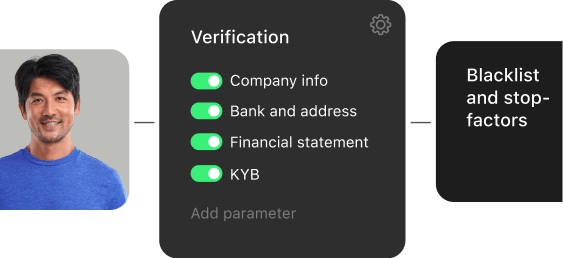
Run automated identity verification, KYC, sanctions, and fraud checks in seconds.
Combine credit bureau data, bank account activity, and alternative income signals to
verify borrowers and assess their repayment capacity before making a lending
decision.
Underwrite faster, lend smarter
Combine custom credit rules, scorecards, and AI-powered scoring to assess short-term
borrowers in minutes. Automate decisions for standard applications and route
higher-risk cases for manual review. Evaluate thin-file borrowers using alternative
data, improve approval rates, and keep credit risk under control.
GiniMachine scoring that sharpens itself
GiniMachine learns from every short-term credit decision you make. It reads how
loans perform, spots fresh risk signals, and retrains itself, pushing scoring
accuracy toward 3x while cutting defaults, hand reviews, and good loans wrongly
declined.
No paper from first form to signed contract
Strip paper from the entire short-term loan flow. OCR pulls and verifies payslips,
IDs, and statements within seconds; built-in eSignature then signs the contract on
screen. Document handling costs fall by up to 90%, printing and scanning gone.
and much more
Configure any payday product
Stand up whatever short-term product you sell: single-payment payday, installment advances,
or a small credit line. Tune fees, rates, due dates, and who qualifies, by product or by
segment, with zero developer time.
Borrower outreach across channels
Push timed outreach to borrowers by rules that react to their behavior and loan status,
across the channels they use. Engagement holds through the whole term, and the support desk
handles fewer manual messages.
Auto-generated loan agreements
Dynamic templates with auto-filled fields turn out a binding short-term agreement. Drafting
errors are gone, payout is faster, and each contract holds to the policy you configure per
product and state.
Access control and data protection
Lock down borrower records behind role-level permissions you define, password rules you
control, and a second sign-in factor. Every action is recorded in the activity log and stays
audit-ready.
Custom notification templates
Compose text, email, and app-alert templates, each driven by dynamic fields, to cover every
touchpoint: status, approval, repayment nudges tied to payday, and renewal offers.
No-code process builder
Set up and change short-term lending flows, no engineering team involved. Lay out
application paths, set approval logic, branch decision trees, and ship a new process in days
rather than quarters.
Automated decision processes
Loan servicing
All-in-one payday loan servicing
HES LoanBox manages the whole short-term loan in one place, payout through final payment, so
servicing stays accurate and no payment is missed. Balances update in real time, terms stay
configurable, and payments are processed in the platform.
Each short-term loan is serviced from payout through the final payment. Interest,
fees, rollovers, top-ups, and early payoffs compute by your rules, so there are no
spreadsheets and no end-of-day reconciliation.
Manage every product together
Handle single-payment payday, installment, and line-of-credit products side by side.
Shift due dates, grant hardship extensions, restructure a balance, or post a partial
payment instantly, while the full history stays intact for audit.
One screen per borrower
Pull up any borrower on one screen: application history, live and settled loans,
documents, messages, and current risk. Agents answer at first contact, notice
repeat-borrower patterns, and keep service tidy.
Payments you can rely on
Move payouts and repayments through gateways you connect, plus ACH, SEPA, card
networks, and local rails. Set retry rules for failed pulls, keep balances current,
and run on ISO 27001 and SOC 2 controls.
AI risk intelligence that keeps
your short-term book profitable
Scoring you can defend
Scoring spans the short-term flow front to back, pre-KYC filtering through NPL forecasting,
with outputs you can explain and defend in review.
Risk flagged early
Set the risk thresholds that fit your book and identify likely defaults before they occur.
Pricing can be adjusted to keep the short-term portfolio profitable.
Sharper decisions with AI
Back each short-term credit call with GiniMachine AI, which scores up to three times sharper
than a standard scorecard.
Loan collections
Recover more from automated
short-term collections
Automated recovery returns overdue short-term loans to payment faster and at lower cost. AI ranks
accounts by likelihood to pay and routes each case to the right channel, with fees applied only
within the caps you have set.
Take manual effort out of recovery and run every overdue short-term loan through HES
LoanBox.
Drive text, email, and phone outreach from one queue
Generate and track collection notices from templates you control
Apply templated or fully custom workflows by days-past-due bucket
Make each action borrower-specific
Drop blanket dunning for strategies driven by data on each borrower.
Choose the approach that works per borrower segment
AI sets the best time, channel, and message
Predict repayment odds and forecast incoming cash
Score accounts to work the highest-recovery cases first
Prevent missed payments early
Keep short-term borrowers on track with reminders that actually get read.
Schedule reminders with wording suited to each borrower
Track what lands, gets read, and gets a reply, live
Reach people through push, voice bot, in-app, or another channel
Fees and penalties within your limits
Add overdue charges and hold them to the caps you configure, with a clear record
behind each one.
Set penalty rules by short-term product and the state you lend in
Hold fees and interest to the caps you configure
Keep borrower notices clear, every record audit-ready
Analytics built for short-term lenders
HES LoanBox shapes live dashboards around the short-term KPIs your team watches. Get the underlying
numbers out, set up whatever metrics matter, and view the book across product, vintage, and channel
as needed.
100+ integrations across the payday lending stack
HES LoanBox connects to the tools a short-term lender runs, and connection options stay configurable
across your stack. Set up onboarding, scoring, payments, messaging, reporting, and your core system
to match how you operate.
What you get with HES
Configure, customize, or own the code
Short-term rules vary by state and product, so set caps, fees, rollover terms, and
eligibility yourself. For anything beyond configuration, commission custom development or
take ownership of the source code, with no vendor lock-in.
Pricing that survives high volume
HES LoanBox uses one-time platform licensing, so small-dollar economics hold at scale: no
per-seat or per-loan fees, and unlimited users and borrowers at any volume.
Live, and lending, from 3 months
Launch a short-term product, or open a new state, from 3 months. It deploys ready to lend,
so you book loans and reach ROI early, ahead of competitors' slower rollouts.
Specialists in short-term lending
For 14+ years we have built lending software for consumer and short-term lenders across the
US, EU, and emerging markets. We know how the model works and build the platform that runs
it.
Success stories
HES FinTech has been our reliable technology partner since 2012. I believe much of our success is due to the well-architected HES LoanBox solution.
ISO 27001 certification, SOC 2 alignment, and a secure SDLC keep security
controls consistent across operations. Data is encrypted, access is granted
by role, and hosting runs on hardened infrastructure.
Deploy HES LoanBox on-premises, in the cloud provider you choose, or in a
hybrid setup, to match your security and operational requirements.
Open-source at the foundation
HES FinTech runs the backend on open-source, license-free tooling: Java LTS,
BPMN 2.0, and the Form.io modeler. There are no license fees, only the
platform source code itself.
The 2026 reality of
payday lending
12M+
Americans borrow payday yearly
More than
12 million Americans
use payday loans every year, a high-volume, fast-turnaround market where manual processing
cannot keep pace.
391%
typical payday loan APR
A median storefront payday loan runs about
391% APR
at $15 per $100 over two weeks. Fee and interest caps of this kind have to be configured
precisely, with each charge logged.
80%
of loans rolled over or reborrowed
Over
80% of payday loans
are rolled over or reborrowed within two weeks. Scoring real repayment capacity up front is
what separates a sustainable book from a churn of renewals.
20%
of payday borrowers default
Around
20% of payday borrowers
default over the course of a year. AI scoring that filters weak applications before payout
is able to cut NPLs by 40%.
Launch your product in 3 months
Keep your focus on growth, We handle the platform.
Short-term lenders run on payday loan software to manage the whole loan: intake, decision,
payout, repayment, and collection. The strongest platforms pull four jobs into one place:
KYC and document capture at onboarding, affordability checks with AI decisioning quick
enough to answer in minutes, servicing of single-payment and installment products on
scheduled ACH, and collections the moment a pull fails. HES LoanBox is one such platform,
made for storefront and online lenders who prefer a single configurable system over a stack
of separate tools.
What is the difference between payday loan software and a loan origination system (LOS)?
The labels blur together, so the confusion is fair. Think of a loan origination system as
the front end: apply, verify, decide, fund. Payday loan software wraps around that and keeps
going after the money lands, covering repayment servicing, rollovers, borrower messaging,
and collections on missed pulls. Buy only an LOS and you usually add a separate servicing
tool, then a separate collections tool, and your data ends up living in spreadsheets between
them. HES LoanBox and platforms like it fuse those stages into a single configurable setup,
the whole reason end-to-end short-term systems are winning out.
How do I choose the right payday loan software?
Begin where the money is leaking. Losing applicants before payout, or deciding too slowly,
points you at onboarding and instant affordability decisioning. Drowning in failed ACH and
climbing delinquency points you at scoring and collections. Then weigh four cost drivers
over a few years: whether the product engine bends to single-payment, installment, and
line-of-credit setups state by state; how easily it ties into bank verification, alternative
data, and payment rails; the honest go-live date; and whether the license counts seats. HES
LoanBox earns a place on the list for lenders after one platform spanning intake to
recovery, though your own answer follows your own bottleneck.
How long does payday loan software take to implement?
It ranges a lot. A legacy on-premise build can run beyond a year and tie up your IT staff
plus paid consultants. Cloud systems that arrive with prepared workflows, connectors, and
configurable products cut that down hard. Most short-term lenders go live on HES LoanBox
inside 3 to 6 months, since it ships with single-payment and installment workflows and ready
links to bank-data feeds, scoring engines, and payment processors. Scope that covers many
products, several states, or odd rule sets stretches the calendar, which is expected and
easy to scope once discovery is done.
How does payday loan software help with credit risk and compliance?
Good software runs risk and compliance as a single flow. For risk, it gathers bank and
income data next to AI scoring, filtering shaky applications before payout so a thin-margin
book does not bleed on defaults. For compliance, an audit trail follows every action,
documents stay tracked, permissions split duties by role, and ISO 27001 and SOC 2 certified
controls sit under the infrastructure. Overdue charges stay inside the caps you configure
per state, each one backed by a clear record. When an examiner asks why a loan was approved,
the answer is right there, and the surprises grow fewer.
How much does payday loan software cost?
What you pay tracks volume, product range, deployment, and integration depth. Legacy
enterprise tools tend to want big yearly license fees, seat charges, and a heavy setup
budget on top. Cloud rivals shifted to subscriptions keyed to volume or modules. HES LoanBox
runs a straightforward license model with no seat charges, so adding agents, analysts, or
borrowers never moves the price, which is what keeps high-volume, thin-margin lending
viable. Anything custom carries its own quote. One short call settles it once your products
and likely volume are clear.
Does HES LoanBox connect to the tools we already run?
Yes. Being API-first, HES LoanBox fits the stack a short-term lender already runs. Hooks
reach bank-verification and open-banking feeds, alternative-data and scoring engines, ACH
and card processors, document and signature tools, accounting, ERP, and BI, across 100+
integrations with open APIs covering anything else. The effort scales with how many systems
are involved, but the point holds: data flows on its own rather than getting rekeyed by
staff. For any service not yet on the list, the open API is the way in.
Book a demo
HES FinTech has been our reliable technology partner since 2012. We owe much of
our success to their well-architectured solution.
Boris Batine, CEO at ID Finance
HES FinTech offers comprehensive front-to-back solutions with integrations. Our
machine learning platform will allow clients best-in-class investment advice.
Edward Downpatrick, Strategy Director at Fintuity
In just 6 months, we went from storing all our data in Excel to a fast,
reliable, and user-friendly platform that caters to our specific needs.
Hjortur H. Jonsson, Partner at ALM Securities
HES developed our lending software and predictive analytics. Their expertise
delivered automation, clear UI/UX, and customer portal.
Mazen Alasnag, Head of Loan Management at Wa’ed
The LMS provided flexible repayment options, automated restructuring and
branch-level management, enhancing efficiency and risk mitigation.