Islamic finance software for Sharia-aligned lenders
Made for Islamic banks, Sharia-first fintechs, and Islamic windows inside conventional banks. Configure
Murabaha, Ijarah, Tawarruq, Mudarabah, and beyond, in the product engine.
Maintain portfolio quality with AI risk analytics tuned to Islamic finance structures,
flagging accounts that show early signs of stress.
40%
fewer NPLs
Score applicants across multiple data dimensions with GiniMachine, the AI engine built to
work within profit-rate and risk-sharing frameworks for more reliable financing decisions.
3x
scoring accuracy
Automate credit workflows and approval steps for each Sharia structure, cutting the manual
handling that slows day-to-day operations.
90%
lower document costs
Sharia-compliant software for the complete Islamic finance journey
Compliant onboarding
Launch a fully branded onboarding experience aligned with Islamic finance principles across
channels. Applicants get a guided path to compare products and confirm eligibility before
verifying identity, built on KYC standards, automated documentation, and Sharia-aware data
workflows.
Learn more
Structured origination
Make confident financing decisions with configurable underwriting for Murabaha, Ijarah, and
other Islamic structures, using third-party data and AI-assisted scoring within your profit-rate
and risk-sharing frameworks.
Learn more
Principled servicing
Manage profit schedules, repayment plans, and customer communications in one workspace built for
Islamic finance operations. Get real-time visibility and automated lifecycle management across
your portfolio.
Learn more
Considerate collection
Recover overdue accounts in a manner consistent with ethical lending values, use empathetic
AI-driven outreach, risk-based prioritization, and restructuring options that respect both
borrower circumstances and Sharia obligations.
Learn more
Get your lending product estimate
in 3 minutes
STEP:
/
Online onboarding
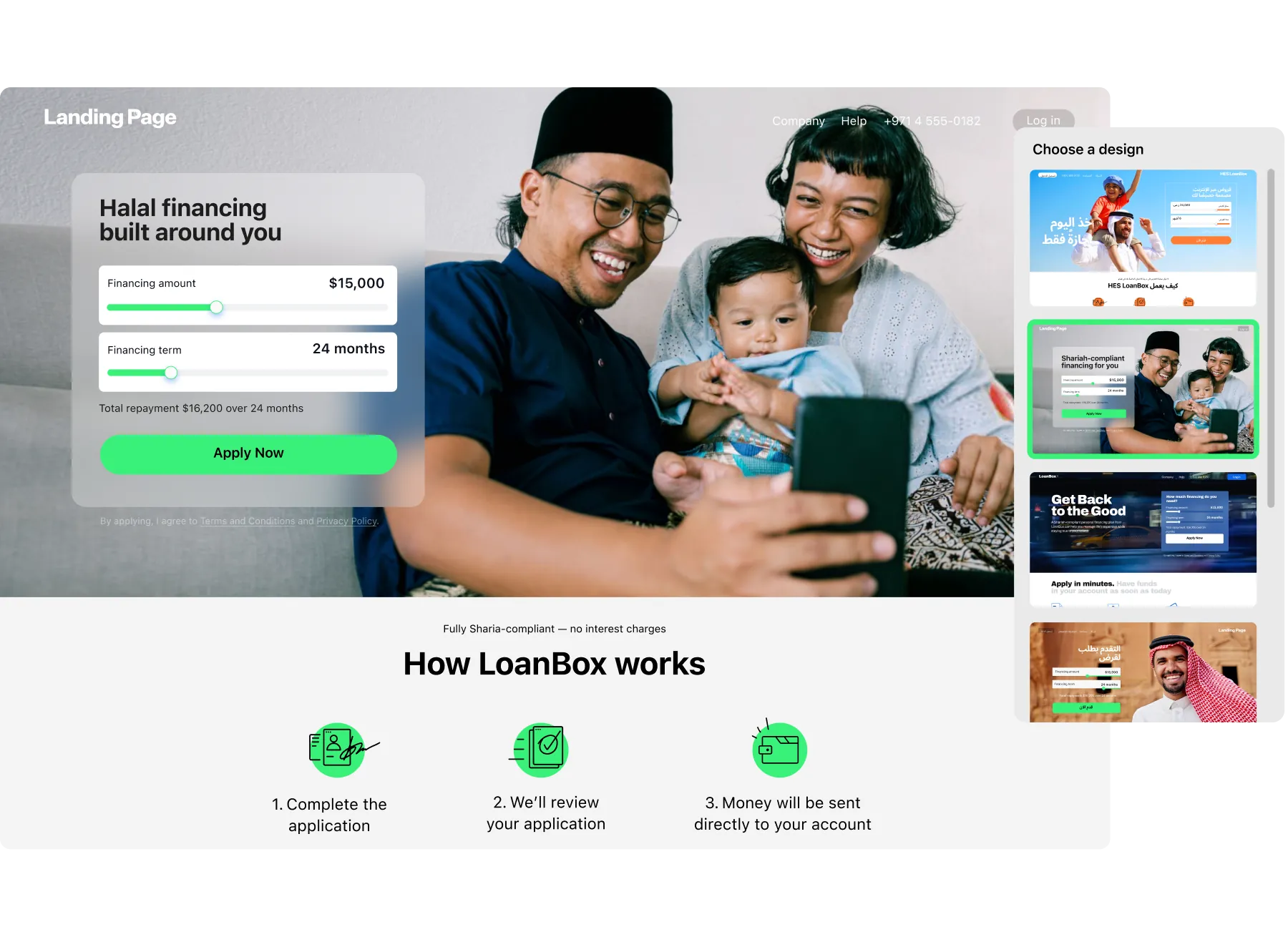
Sharia-compliant financing, fully digital
Reach borrowers who avoid conventional channels, serve communities far from branch networks, and
give every applicant a clear, guided path to financing.
An integrated product calculator lets applicants configure financing amounts, profit
rates, and schedules across different Islamic structures. Clients understand what
they are committing to before they apply, reducing abandonment and building
confidence from the first interaction.
Digital contracts without the branch visit
Applicants submit documents, complete identity verification, and sign
Sharia-compliant agreements entirely online. Removing in-person steps shortens
onboarding from days to minutes while keeping every transaction fully auditable and
compliant.
Full account control, anytime
A self-service portal gives clients visibility into their financing schedule,
outstanding profit, and upcoming payments — with the ability to make payments
instantly. Automated notifications keep borrowers engaged and support timely
repayment without manual outreach.
Reach underserved communities
Onboard field agents digitally and equip them to submit applications, track
approvals, and manage client portfolios through dedicated portals. Expand your
islamic finance software into regions where branch infrastructure is limited —
without the cost of physical expansion.
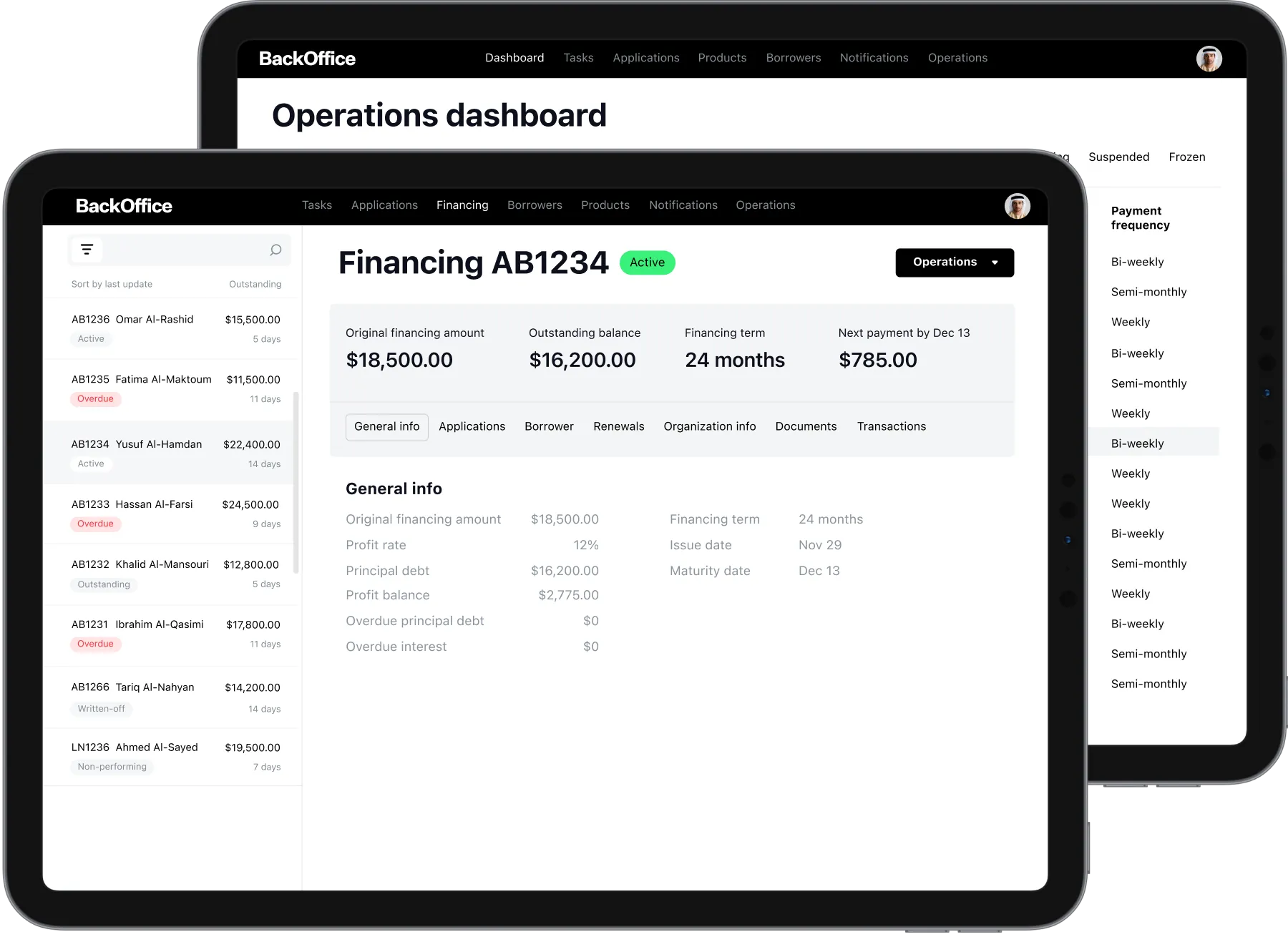
Task management built for Sharia-compliant lending teams
An Islamic finance file carries a step conventional loans never have, the Sharia review. HES LoanBox
routes it alongside tasks by current load, so origination, compliance, and servicing all work from
the same contract status.
AI-driven loan origination built for
Sharia-compliant financing
Every Murabaha or Ijarah application must be structured, documented, and scored before funding, and
manual review slows it down. HES LoanBox runs those steps automatically, so a file reaches its
decision the same day.
Before any contract is structured, the file already holds a verified identity, KYC,
AML, and sanctions results, plus bureau, open banking, and income data pulled in
automatically. Underwriters open a profile that is complete and audit-ready, not a
blank form.
Underwrite each structure at its pace
A small Murabaha and a large Ijarah lease should not move at the same pace. Run each
one fully automated, semi-automated, or manual according to the structure, the
amount, and the risk, while the engine holds your policy steady.
Reach more customers without lifting risk
Your scorecards alone turn away good applicants. Add the platform's AI scoring,
which weighs alternative and behavioral signals next to the bureau, and thin-file or
new-to-credit borrowers get a fair read while non-performing loans come down up to
40%.
GiniMachine sharpens with every financing
GiniMachine treats every closed Murabaha, Ijarah, or Tawarruq as fresh training
data. Emerging risk shows up in the model rather than in your losses, and the more
financings you book, the sharper its scoring gets, up to three times more accurate.
Close every contract without the paper
A Murabaha or Ijarah file carries more paperwork than a plain loan. OCR reads and
validates IDs, payslips, and asset records as they land, eSignature closes the
contract, and paper-handling costs come down up to 90%.
and much more
Draw contracts from Sharia-ready templates
Build Murabaha and Ijarah agreements from approved templates that pull in merge fields, so
every contract comes out consistent and ready to sign. Fewer hand edits mean cleaner
contracts and quicker disbursement.
Set up any Sharia-compliant product
Launch the structures your market expects, Murabaha, Ijarah, Musharakah, or Tawarruq, then
set profit markup, rental terms, fees, and eligibility by segment or campaign. None of it
needs a developer.
Borrower messages from reusable templates
Build email, push, and SMS templates with dynamic fields for application status, approval,
profit-payment reminders, and renewal offers. Each one sends on its own trigger, without
manual input.
Trigger outreach across every channel
Stay in touch through in-app, email, and text, with rules keyed to how each customer behaves
and where the contract stands. Customers stay informed all term long while routine load on
your support desk drops.
Rework any workflow without developers
On a drag-and-drop canvas, map the application flow, set approval logic, and slot the Sharia
review in as its own step. Launch a new process in days, not after a long developer queue.
Lock down data by user role
Each role sees only the borrower data it needs. Password rules and two-factor sign-in are
yours to set, and actions are logged and ready for audit.
AI-assisted decision-making
Sharia-compliant servicing
Islamic finance software for end-to-end servicing
Once a Murabaha or Ijarah is live, servicing takes over: profit accruals, schedules, and payments,
the detail that breaks on spreadsheets. It carries the full term from one place, and nobody
recalculates anything by hand.
HES LoanBox runs every contract from disbursement to final payment under your rules.
Profit accruals, fee calculations, payment deferrals, restructuring, and early
settlement each happen on schedule, no manual spreadsheets, no month-end scramble.
Every Sharia structure in one workspace
Handle Murabaha installments, Ijarah leases, Tawarruq facilities, and consolidations
side by side. Reschedule, grant a payment holiday, restructure, or take a partial
payment when it arrives, and the full history is kept for review.
One full view of every customer
Open one screen and the whole customer is there: who they are, every financing live
or settled, their documents, the last conversation, and where their risk sits today.
First-call answers get easier, and cross-sell openings stop hiding.
Disbursements and repayments, fully reconciled
Connect disbursements and repayments to ACH, SEPA, SWIFT, card networks, and bank
transfers through the open payment API. Every transaction is matched and posted to
the ledger, and the whole flow runs on an ISO 27001 and SOC 2 aligned platform.
AI risk intelligence built
for Sharia-compliant lending
Scoring the Sharia board can follow
From pre-KYC filtering through NPL forecasting, the same predictive model scores each step,
and it shows its reasoning so reviewers and the Sharia board can audit any decision.
Read risk a bureau pull misses
Built-in AI reads behavioral and transaction signals a bureau file leaves out, scoring up to
three times more accurately than legacy models.
Identify defaults before they form
Set your own risk limits and flag accounts under stress while a contract can still be
recovered. Adjust profit pricing to keep the portfolio sound.
Sharia-compliant collections
Recover arrears the Sharia-compliant way
In Islamic finance, recovery has an extra constraint: you cannot profit from a late payment. The
platform automates outreach and scoring, predicts who will repay, finds the channel that works, and
routes any late charge to charity, not to your margin.
HES LoanBox handles the routine so your team works only the accounts that need a
human.
Reach borrowers by phone, email, and text out of one inbox
Create, send, and store late-payment notices without rekeying
Set ready or fully custom workflows per delinquency band
Shape recovery around each borrower
Drop the blanket dunning script and let the data say how to approach each case.
Pick wording and tone by borrower segment
Have AI choose when, where, and what to say
Score accounts by recovery odds and work the best first
Forecast who repays and what cash comes in when
Reach borrowers before a payment slips
A reminder a few days early keeps a good customer from drifting into arrears.
Design reminder cadences with wording you control
Track what lands, gets opened, and gets a reply
Reach out by push, voice bot, email, or any channel you add
Late charges that go to charity
A late charge cannot become lender income under Sharia, so the platform keeps it
separate and sends it where it belongs.
Set late-charge rules for each product and structure
Post late charges to a separate charity ledger, never to profit
Keep messaging to the borrower plain, with an audit-ready record behind it
Islamic finance analytics and reporting
HES LoanBox builds dashboards around the Islamic finance metrics your team tracks, from profit yield
and NPL trends to portfolio mix by structure. Pull the underlying data and configure your own
measures, then segment the portfolio by whatever dimension a question requires.
Tap 100+ integrations, or extend with the open API
HES LoanBox connects across scoring, payments, onboarding, messaging, core banking, and analytics.
When a connector is missing, the open API fills the gap.
Why teams choose HES LoanBox for Islamic finance
Murabaha and Sharia-compliant lending software
Our platform provides controls that help you meet Sharia and regulatory requirements, and
keeps records auditors can review.
Configurable down to the detail
Reshape modules, screens, and features to match your process. Then connect the external
services your lending stack depends on, from payment providers to credit bureaus.
One license, no per-seat surprises
Pricing stays simple: you license the platform, and only custom work costs extra. Internal
teams and borrowers come included, with nothing charged per seat.
A team that knows lending
Work with analysts who have spent 14+ years on lending technology for US, European, and
emerging-market lenders, with 160+ deployments behind them.
Live from three months in
Launch from three months in, not next year, on a configurable core you adjust rather than
build from scratch.
ISO 27001 certified and SOC 2 aligned
ISO 27001 and SOC 2 compliant, and it runs on AWS or Google Cloud on a Java LTS stack that
stays patched.
Support that responds fast
Reach a team that works on the platform directly and answers quickly, whenever an issue
comes up.
Success stories
HES FinTech developed our lending software and predictive analytics. Their expertise delivered automation, clear UI/UX and customer portal.
Adherence to ISO 27001 and SOC 2 aligned frameworks reflects our unwavering
commitment to safeguarding your data. Since our founding in 2012, we have
proudly maintained a record of zero data breaches.
Our tech stack includes Java 21, Spring 6, and PostgreSQL 16, backed by the
capabilities of Oracle, Google Cloud, and AWS, depending on the needs of the
specific solution. This combination ensures high performance, scalability,
and security, providing a reliable foundation for your business.
Powerful backend tools
HES FinTech's Islamic finance solutions are built using cutting-edge, free,
and open-source technologies such as Java 11, Camunda, and Form.io modeler.
The 2026 reality
of Islamic finance
$3.8T
global Islamic finance assets in 2024
Islamic finance assets reached $3.88 trillion in 2024, up 14.9% year-on-year, with sukuk
issuance climbing 25.6%, growth that outpaced conventional banking by a wide margin (IFSB Stability Report 2025).
$341B
Islamic fintech market by 2029
The Islamic fintech market is on track to climb from $198 billion in 2024/25 to $341 billion
by 2029, an 11.5% annual rate, with 484 firms now active across 41 countries (GIFT Report 2025/26).
50%
of the world's unbanked live in Muslim-majority countries
Nearly half the world's 1.4 billion unbanked adults live in Muslim-majority countries, an
estimated $200 billion in untapped retail and MSME finance waiting for Sharia-aligned
products (World Bank).
22%
of Islamic banks apply AI to risk assessment
Among Islamic banks, 67% already use AI for identity checks, yet only 22% apply it to risk
assessment and 11% to Sharia advisory, the gap where the next five years get decided (IFSB Stability Report 2025).
Launch financing from three months
You focus on growing the book. HES FinTech handles the platform
underneath.
Islamic finance software is the system behind a Sharia-compliant facility, carrying it from
first inquiry through to final settlement. One platform handles what used to need several:
onboarding and document intake with KYC and KYB; structuring and credit decisions across
Murabaha, Ijarah, Tawarruq, and Musharakah; servicing of profit and rental schedules once a
contract goes live; and arrears work, with any late-payment charge directed to charity
rather than income. HES LoanBox suits lenders that would rather run Islamic finance from one
configurable setup than attach a separate tool at each stage.
How does Islamic finance software differ from a loan origination system (LOS)?
Both terms get used loosely in practice. Origination systems cover the opening phase:
application intake, contract structuring, approval, and signing. The broader Islamic finance
software category absorbs that layer and adds what follows: profit and rental accrual,
early-settlement rebate handling, payment reconciliation, a record of Sharia-board
sign-offs, and analytics across the book. Lenders that buy origination alone usually add a
servicing system afterward, then a collections tool later, and data ends up moving through
spreadsheets in between. By keeping structuring, servicing, and arrears in one configurable
place, HES LoanBox removes that stitching, which is why full-lifecycle platforms tend to
hold up better than single-purpose tools.
How do we choose the right Islamic finance software for our institution?
Start by naming which part of the financing lifecycle causes the most friction today. When a
Murabaha or Ijarah contract runs on for weeks and applicants drop off, structuring, KYC, and
asset setup come first. When the team is stretched by profit-schedule spreadsheets as the
book grows, servicing and portfolio monitoring move up the list. After that, four factors
settle what the platform truly costs across a five-year horizon: how wide a contract range
the product engine configures, from Murabaha to Musharakah; how well it ties into core
banking and bureaus; the length of a realistic rollout; and whether the vendor charges by
the seat. HES LoanBox often makes the shortlist when a team wants one configurable Islamic
finance software platform from structuring through servicing, though your actual bottleneck
should settle it.
How long does Islamic finance software take to implement?
There is no single number. Established enterprise suites can run anywhere from one to one
and a half years, drawing on an internal IT team and outside specialists. Cloud-native
Islamic finance software arrives with configurable contract types, connectors, and prepared
workflows from the outset, which shortens the schedule considerably. Most HES LoanBox
clients reach go-live between three and six months, since it includes Murabaha, Ijarah, and
Tawarruq workflows, profit and rental calculation, a Sharia-board approval step, and
connectors you configure for bureaus, KYC providers, and payment rails. A build that spans
many products, multiple jurisdictions, or unusual Sharia-governance rules runs longer, which
is routine and straightforward to plan around once discovery sets the scope. For a focused
rollout, three months is a realistic floor.
How does Islamic finance software support credit risk and Sharia compliance?
Here risk and Sharia compliance run as one process rather than two. On the risk side, the
platform gathers borrower financials and portfolio exposure in one place and runs
applications through GiniMachine, so signs of deterioration surface well ahead of any manual
check. Governance works the same way: actions log from end to end, documents stay tracked,
and role-based access keeps structuring separate from servicing. Each product holds its
Sharia-board decision on record, a late-payment charge lands in a charity ledger rather than
income, and ISO 27001 and SOC 2 aligned controls protect the infrastructure beneath. The
result is a steadier examination cycle, with faster, defensible answers whenever a
facility's approval and its Sharia alignment come into question.
How much does Islamic finance software cost?
Your cost tracks the size of the book, the number of contract types, the hosting choice, and
the integration it calls for. Established enterprise platforms usually carry six- and
seven-figure annual licenses on top of per-user fees and a sizable implementation spend. The
cloud-native generation moved to subscriptions priced by volume, by modules, or by a mix of
the two. HES LoanBox keeps a clear license model with no per-seat fee, so the bill does not
grow as more officers, analysts, or customers come onto the system. Anything bespoke is
priced separately. Once your product set, expected volumes, and integration scope are clear,
a discovery call pins down the total quickly.
Does HES LoanBox connect with our core banking system?
It does. Built API-first, HES LoanBox links into the systems a bank or non-bank financier
already operates, core platforms among them such as FIS, Fiserv, Jack Henry, and Temenos.
Beyond that it covers credit bureaus, KYC, KYB and sanctions services, payment rails,
document and eSignature tools, accounting and ERP, and BI, with 100+ integrations on hand
alongside open APIs for whatever is bespoke. Scope of work rests on the core platform in
place and the count of adjacent systems involved, yet the goal holds steady: information
moves across systems by themselves instead of being retyped from spreadsheets by hand.
Book a demo
HES FinTech has been our reliable technology partner since 2012. We owe much of
our success to their well-architectured solution.
Boris Batine, CEO at ID Finance
HES FinTech offers comprehensive front-to-back solutions with integrations. Our
machine learning platform will allow clients best-in-class investment advice.
Edward Downpatrick, Strategy Director at Fintuity
In just 6 months, we went from storing all our data in Excel to a fast,
reliable, and user-friendly platform that caters to our specific needs.
Hjortur H. Jonsson, Partner at ALM Securities
HES developed our lending software and predictive analytics. Their expertise
delivered automation, clear UI/UX, and customer portal.
Mazen Alasnag, Head of Loan Management at Wa’ed
The LMS provided flexible repayment options, automated restructuring and
branch-level management, enhancing efficiency and risk mitigation.