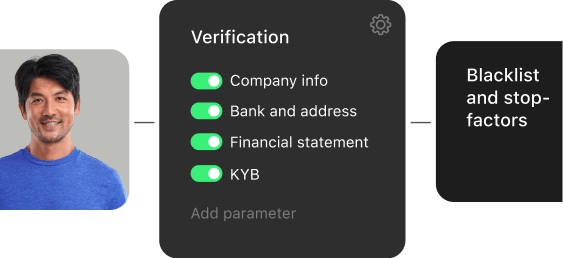
Built for transaction banks, specialist lenders, and fintech platforms. Letters of credit, guarantees,
supply chain financing, invoice discounting, all instrumented and monitored on one trade finance
solution.
Automate document verification, compliance checks, and facility management, reducing the
manual overhead embedded in every trade finance transaction.
60%
cost reduction
Assess counterparty risk, document integrity, and cross-border exposure with AI models built
for the complexity of multi-party trade finance decisions.
3x
scoring accuracy
Monitor trade finance facilities in real time and detect early counterparty stress before
exposure becomes a portfolio-level problem.
40%
fewer delinquent accounts
Integrated software for the complete
trade finance lifecycle
Document-ready onboarding
Onboard importers, exporters, and counterparties through structured digital workflows built for
trade finance complexity. Automate KYC, KYB, and sanctions screening across multiple parties,
with intelligent document capture that handles letters of credit, invoices, and shipping
documentation.
Learn more
Risk-aware origination
Assess trade finance risk across counterparty credit quality, transaction structure, and
cross-border exposure using configurable underwriting rules and AI-assisted decisioning. Build
facility and instrument-level products with custom tenor conditions, concentration limits, and
country risk parameters.
Learn more
Transaction servicing
Manage the full lifecycle of trade finance instruments, drawdowns, document verification,
payment milestones, and facility utilisation, from a single operational platform. Maintain
real-time visibility across open transactions, counterparty exposure, and facility headroom with
automated compliance and reporting workflows.
Learn more
Exposure-focused collection
Monitor counterparty repayment behaviour and transaction performance continuously. Identify
stress signals early, initiate structured recovery conversations, and manage overdue trade
finance exposures through disciplined workout processes that protect both principal and
relationship value.
Learn more
Get your lending
product estimate
in 3 minutes
STEP:
/
Online onboarding
Trade finance software that converts
counterparties into active clients
Turn counterparty interest into funded transactions without friction. Give importers, exporters, and
supply chain partners a fast, fully digital path through your onboarding process, and give your team
the automation tools to process more applications with the same headcount.
An embedded facility calculator lets counterparties adjust transaction size, tenor,
and structure in real time. A clear picture of costs up front reduces early
drop-offs and shortens conversations on deals unlikely to close.
Onboard counterparties online
Importers, exporters, and corporate applicants submit details, upload trade
documents, and sign facility agreements without a branch visit. KYB, sanctions
screening, and document validation run automatically, speeding up counterparty
onboarding.
Keep clients informed across every transaction
A self-service portal gives counterparties real-time visibility into facility
utilisation, outstanding balances, document status, and payment milestones.
Automated notifications reduce queries and keep all parties aligned throughout the
trade finance lifecycle.
Scale broker and correspondent networks
Equip brokers, agents, and correspondent banks with dedicated portals to submit
applications and track deal status. Expand your trade finance platform reach into
new corridors without adding internal headcount or back-office complexity.
Smart task management for trade finance teams
Move every trade finance transaction forward without bottlenecks. Auto-assign tasks by role and
workload, track SLAs in real time, and keep document verification, counterparty review, and facility
management teams perfectly aligned.
Cut trade finance origination time
with AI and automation
Slow document reviews and fragmented counterparty data stall deals and inflate exposure. AI-driven
verification and configurable underwriting give every trade finance application a fast, defensible
credit decision.
Run KYB, AML, and sanctions checks across importers, exporters, guarantors, and
correspondent banks in seconds. Apply country risk screening and set facility limits
before underwriting begins, so your credit team starts from a complete, audit-ready
risk picture.
Configurable underwriting per instrument type
Structure underwriting rules per instrument: letters of credit, guarantees, supply
chain facilities, or invoice financing. Configure compliance checklists, track
facility headroom in real time, and run applications fully automated or with manual
credit committee review depending on transaction size and counterparty tier.
AI decisioning that builds a stronger book
Combine your policy rules with AI-powered decisioning for trade finance precision.
Configure custom counterparty scorecards or activate the built-in AI engine to
approve more transactions, reduce NPLs by up to 40%, and extend facilities to
counterparties that rule-based models would turn away.
Self-learning scoring by GiniMachine
GiniMachine's scoring engine learns from every trade finance decision on your book.
It analyzes outcomes, surfaces emerging counterparty risk patterns, and refines
models continuously, raising accuracy and reducing defaults without adding analyst
time.
Paperless trade documentation
Cut documentation overhead by up to 90% across the origination process. Intelligent
OCR reads invoices, bills of lading, and counterparty ID documents in seconds, and
built-in eSignature completes facility agreements digitally without delays.
and much more
Automated document generation
Generate facility agreements, guarantee documents, and trade finance contracts using dynamic
templates with auto-populated counterparty data. Eliminate drafting errors, accelerate
closing, and maintain documentation standards across every jurisdiction you operate in.
Unlimited instrument configuration
Launch any trade finance product your market requires: letters of credit, standby
guarantees, supply chain facilities, or invoice financing. Configure tenors, fees, and
concentration limits per product or counterparty tier without extra code.
Multichannel counterparty communication
Automate outreach across SMS, email, and in-app channels with rule-based triggers tied to
transaction events and facility status. Keep counterparties informed at every stage without
manual follow-up.
Smart notification templates
Build SMS, email, and push notification templates with dynamic variables for every
counterparty touchpoint, covering application status updates, document requests, facility
approval confirmations, and payment milestone alerts across the transaction lifecycle.
Role-based security and access control
Protect sensitive counterparty and transaction data with granular role-based permissions,
two-factor authentication, and device-level access rules. Every user action leaves a full
audit trail, keeping your operations examination-ready at all times.
No-code workflow builder
Design and adjust trade finance workflows visually, without technical resources. Map
approval logic per instrument type, configure country risk routing, and deploy changes in
days rather than quarters.
Trade finance books spread across disconnected systems lose accuracy fast. HES LoanBox centralises
trade finance management with current facility data, flexible tenor terms, and built-in payment
processing across every corridor you operate in.
Run every trade finance instrument from issuance to settlement without manual steps.
Drawdown processing, fee accruals, document milestone tracking, and facility
renewals run automatically within your configured parameters, with no spreadsheets
and no end-of-day reconciliation work left for your team.
Document presentation and verification
When a counterparty presents documents under a letter of credit, the platform checks
each item against instrument conditions automatically. Discrepancies are flagged
before your ops team reviews, cutting the time between document receipt and payment
authorisation from days to hours.
Instrument amendments and expiries
Track expiry dates, utilisation headroom, and amendment requests across every active
instrument in one view. Automatic alerts fire before a guarantee expires or an L/C
amendment deadline passes, so your team acts on time without manual diary
management.
Cross-border payment operations
Settle disbursements and incoming repayments through pre-integrated gateways, SEPA,
SWIFT, ACH, and local payment rails. Transaction matching runs automatically,
ledgers stay accurate in real time, and PCI DSS compliance is built in from day one.
Maximize trade finance portfolio performance
with AI risk intelligence
Dynamic limit management
Counterparty risk changes after origination. AI-driven limit reviews flag when facility
headroom needs adjusting, keeping exposure within approved parameters between credit
reviews.
Portfolio-level early warning
Track concentration risk by country and sector, including correspondent bank exposure, while
AI flags deteriorating counterparty profiles before the next scheduled review.
AI-driven risk precision
The built-in AI engine raises counterparty assessment accuracy up to 3x. Viable transactions
that rule sets would decline can be financed within approved exposure.
Trade finance collections
Recover overdue trade finance
exposures without losing the relationship
Overdue trade finance exposures erode margins and strain relationships. Configure recovery
workflows, scoring, and penalty rules specific to each instrument type, so your collections team
spends time on accounts that can actually be saved.
When a counterparty defaults, the platform initiates the appropriate enforcement
path for each instrument type. Guarantee demand notices are generated and issued
automatically, L/C drawing procedures follow configured steps, and the full
escalation sequence runs without manual case management from your team.
Prioritize recovery with AI-driven scoring
Exposure size alone does not determine where your team should focus. AI scoring
ranks overdue accounts by recovery likelihood, separating viable workout candidates
from write-off risks early, so collection effort concentrates where it produces
returns.
Prevent missed payments before they escalate
Reduce missed payment events with scheduled, counterparty-specific alerts issued
ahead of each payment date. Configure message content, channel, and timing per
instrument type, and track engagement so your team knows which counterparties need
direct follow-up.
Penalty management built for compliance
Apply overdue charges and accrued interest within every contractual limit,
automatically. Configure penalty rules by instrument type and jurisdiction, keep fee
application within compliance boundaries, and maintain audit-ready records
throughout every recovery conversation.
Trade finance reporting and analytics
HES LoanBox builds dashboards around the metrics your trade finance team actually tracks. Monitor
facility utilisation and headroom per counterparty, outstanding exposure by country and sector,
instrument expiry pipeline, and document turnaround times, then export raw data or configure custom
views on demand.
100+ integrations to power
your trade finance platform
Open API and 100+ pre-built connectors give HES LoanBox reach across the full trade finance stack:
counterparty data providers, KYB and sanctions services, supply chain finance software connections,
payment rails, document management, compliance tooling, and core banking systems across every
corridor you operate in.
What you get by choosing
our trade finance software
Instrument-level configuration
Configure any instrument type, adjust workflows, extend integrations, and connect to any
service, from payment rails to trade credit bureaus. Where needed, HES delivers fully custom
trade finance software built to your exact specification.
3-month product launch
Standard deployments reach production in three months. Instrument workflows, document
templates, and integration connectors arrive pre-configured so setup time goes into your
specific products and policies, not platform construction.
Transaction banking expertise
Your team works alongside HES business analysts with a decade of hands-on experience in
transaction banking and cross-border lending across Europe, North America, and high-growth
markets.
License-based pricing
One license fee covers the full platform. You own the source code with no lock-in to HES as
a vendor, and there are no per-user or per-counterparty charges as your trade finance book
scales.
Certified data security
ISO 27001 and SOC2 certified. Encrypted data storage, role-based access controls, and a
hardened Java LTS stack running on your choice of cloud or on-premises infrastructure.
Specialist-led support
Issues reach specialists directly, not a generalist help desk. Our support team knows the
platform and handles trade finance questions without routing delays.
Success stories
HES FinTech has been our reliable technology partner since 2012. I believe much of our success is due to the well-architected HES LoanBox solution.
ISO 27001 certification and SDLC controls keep every operation secure,
backed by full data encryption, granular access management, and hardened
hosting infrastructure.
HES FinTech trade finance software runs on-premises or in the cloud: AWS,
Google Cloud, or any provider your infrastructure team already uses.
Powerful
backend tools
HES FinTech builds on free and open-source foundations: Java LTS, BPMN 2.0,
Camunda, and Form.io modeler. No extra licensing fees apply beyond the
platform's own source code.
The 2026 reality of
trade finance
$9.7T
global trade finance gap
The unmet global trade finance demand reached
$9.7 trillion in 2023, up from $2.5 trillion in 2019. Manual processing and document-heavy workflows are the
primary reason viable applications never get funded.
72%
of trade finance rejections affect SMEs and mid-caps
72% of rejected trade finance applications
come from SMEs and mid-sized companies, citing documentation burden and slow turnaround as
the leading barriers. Faster, automated decisioning directly expands the addressable market.
56%
of banks see compliance and KYC cost as growth barrier
56% of banks
in the 2024 ADB Trade Finance Gaps survey identified compliance and KYC complexity as the
primary cost driver limiting their ability to expand trade finance books. Automation is no
longer optional.
15%
annual growth in digital trade finance platforms
The digital trade finance platform market is projected to grow at
15% CAGR through 2029. Institutions still running manual workflows are competing against platforms that close
deals in hours, not weeks.
Start lending in just 3 months
Focus on growing your trade finance book. HES FinTech
handles the rest.
Trade finance software is the operational backbone banks, specialist lenders, and fintech
platforms use to run trade finance instruments from application through to settlement. A
modern platform handles four distinct jobs: digital counterparty onboarding with parallel
KYB and document capture, structured credit assessment across multi-party transactions
including letters of credit, guarantees, and supply chain facilities, lifecycle servicing
covering drawdowns, document milestones, and facility utilisation, and recovery workflows
when a counterparty fails to perform. Without purpose-built software, most of this work runs
on spreadsheets, email threads, and disconnected point tools, which is why transaction banks
are replacing that stack with integrated trade finance systems.
What is the difference between trade finance software and a standard loan origination
system?
An origination system moves a credit application from intake to funding decision. That scope
ends at closing. Trade finance software covers a much broader operational range: instrument
issuance after approval, milestone-by-milestone document tracking, utilisation monitoring
against approved limits, drawdown and repayment processing, and structured workout when a
counterparty defaults. Every transaction also involves multiple parties requiring
independent onboarding, KYB, and sanctions checks. General origination systems were not
designed for that level of complexity, which is why institutions with active trade finance
books replace workaround-heavy LOS setups with purpose-built platforms.
What is the difference between trade finance software and supply chain finance
platforms?
Supply chain finance platforms are typically focused on one specific flow: the relationship
between a buyer, their suppliers, and the financing of approved invoices. The scope is
narrow but deep. Trade finance software covers a wider instrument set: letters of credit,
documentary collections, bank guarantees, standby L/Cs, and pre- and post-shipment finance,
alongside supply chain facilities. The counterparty structures are more complex, the
document verification requirements are heavier, and the cross-border payment flows involve
correspondent bank relationships. If your programme is purely buyer-led invoice financing
with a fixed supplier network, a dedicated SCF platform may be sufficient. If you are
running a multi-instrument trade finance book across jurisdictions, you need a platform
built for that breadth.
How long does trade finance software implementation take?
Most enterprise trade finance platform deployments take between six and eighteen months,
driven by the complexity of core banking integration, instrument configuration, and
multi-jurisdiction compliance requirements. Modular platforms built for faster delivery
compress that window considerably. HES LoanBox gets most clients into production within
three months, because instrument workflows, document checklists, KYB integrations, and
payment connectors ship pre-configured rather than built from scratch. Deployments involving
multiple instrument types, several jurisdictions, or deep integration into legacy core
banking systems take longer. That is expected and worth scoping carefully before signing a
contract, because an honest timeline at the start avoids a difficult conversation six months
in.
How does trade finance software handle counterparty risk and compliance?
Trade finance sits at the intersection of credit risk, operational risk, and compliance in a
way most lending categories do not. Regarding credit, the platform aggregates counterparty
financials, corridor exposure, and AI scoring into one view so concentration and early
deterioration surface before the next renewal. For compliance, each origination decision
carries a timestamped audit record, document presentation is checked against instrument
conditions, and role permissions keep approval teams isolated from servicing access. Faster
decisions result, and they hold up in both internal credit review and external examination
cycles.
How much does trade finance software cost?
Trade finance software pricing depends on four variables: deployment model, instrument
scope, integration complexity, and transaction volume. Established enterprise vendors charge
annual license fees that frequently run into seven figures, plus per-seat costs and
implementation fees that add significantly to the total. Newer modular platforms price
differently. HES LoanBox charges a single license fee with no per-user or per-counterparty
costs, so the bill does not grow as your team expands or your book scales. Custom
development sits outside the base license and is quoted separately based on scope. Getting
to an accurate number requires a short discovery conversation to map your instrument mix,
volume expectations, and integration requirements.
How does AI improve trade finance decisioning?
AI improves three distinct parts of the trade finance workflow. At origination, machine
learning models score counterparty credit quality and cross-border exposure more accurately
than static rule sets, approving more viable transactions without widening portfolio risk.
During servicing, AI monitors exposure shifts, flags concentration risk by country and
sector, and surfaces counterparty stress signals before they escalate to the facility level.
At collections, scoring models rank overdue accounts by recovery likelihood, directing team
effort toward accounts where intervention produces results rather than spreading recovery
resource evenly across the book. In aggregate, the effect is fewer defaults, tighter
exposure management, and a collections team that spends its time on cases that can actually
be resolved.
Book a demo
HES FinTech has been our reliable technology partner since 2012. We owe much of
our success to their well-architectured solution.
Boris Batine, CEO at ID Finance
HES FinTech offers comprehensive front-to-back solutions with integrations. Our
machine learning platform will allow clients best-in-class investment advice.
Edward Downpatrick, Strategy Director at Fintuity
In just 6 months, we went from storing all our data in Excel to a fast,
reliable, and user-friendly platform that caters to our specific needs.
Hjortur H. Jonsson, Partner at ALM Securities
HES developed our lending software and predictive analytics. Their expertise
delivered automation, clear UI/UX, and customer portal.
Mazen Alasnag, Head of Loan Management at Wa’ed
The LMS provided flexible repayment options, automated restructuring and
branch-level management, enhancing efficiency and risk mitigation.