Mortgage loan software for community banks, credit unions, and independent mortgage banks, covering
purchase, refinance, home equity, HELOCs, jumbo, and construction lending end to end.
Income and asset verification, condition tracking, and underwriting decisions run across the
whole pipeline, pulling down the cost to originate each mortgage.
60%
cost reduction
The same headcount closes far more loans once mortgage automation software clears the manual
bottlenecks at every stage of the mortgage lifecycle.
10x
capacity
AI-driven risk analytics guard portfolio quality, catching early warning signs and
tightening credit calls before a mortgage reaches the closing table.
40%
fewer NPLs
One platform across
the full mortgage lending lifecycle
Digital application intake
The borrower meets a white-label portal that opens on any screen. From the first application
through the eligibility check to the final uploaded document, intake runs in one unbroken
sitting, and the identity and document checks happen out of sight.
Learn more
Underwriting and decisioning
Decisions land sooner once underwriting workflows are yours to shape, scoring leans on AI, and
bureau, income, and asset feeds you connect arrive without rekeying. Purchase, refinance, and
home equity each carry their own eligibility rules, pricing logic, and risk frameworks, matched
to the way you lend.
Learn more
Servicing and escrow
Amortization, escrow, payoffs, and borrower messaging share one workspace instead of four. Live
portfolio visibility holds the servicing desk and homeowners on the same page, from the first
payment through final payoff.
Learn more
Default and loss mitigation
Delinquency scoring flags a mortgage at the first missed payment, and outreach rules open the
loss mitigation path you configure, a repayment plan, forbearance, or modification, matched to
each homeowner’s case rather than a script.
Learn more
Price your mortgage
product in just
3 minutes
STEP:
/
Online onboarding
Mortgage lending software that takes applications to a yes
Digital mortgage software carries borrowers through the whole application without a manual break in
the path, so rate shoppers turn into closed loans. The team behind them leans on automation to push
far more files on a fraction of the manual load.
Early drop-off usually traces back to payment shock. An embedded calculator defuses
it: the borrower nudges the amount or stretches the term, principal and interest
recalculate on the spot, and the form opens with the monthly number already settled.
Completion climbs, abandonment fades.
Faster approvals without shortcuts
No branch visit enters the picture. The borrower keys in details and uploads income
and asset documents from wherever they are, then eSigns disclosures in the same
session, while identity verification and a first credit pull run underneath. A
process once measured in days now closes in hours.
Open broker and correspondent channels
Origination volume can grow without a single new branch or hire. Give brokers and
correspondents their own portals, open the same door to referral partners, and each
one submits files and tracks conditions and approvals for their borrowers directly.
Every channel adds throughput; none of it adds overhead.
Mortgage loan
processing software
that keeps each file moving
Mortgage loan processing software routes files by role and workload and keeps open conditions in
front of each processor. Turn times and SLAs stay on screen. Processing, underwriting, and closing
read from one live view of each loan.
Mortgage loan
origination software
that shortens
cycle time
Reviews stay on schedule inside the mortgage origination software, and open conditions clear on the
same screen. Verification and automated underwriting run together, so each application turns into a
quick decision that holds up.
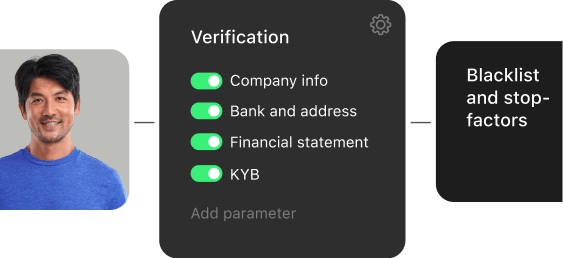
KYC and sanctions screening clear in seconds, and onto each file flow credit report
data, verified income, and the bank and asset records the credit team needs.
Document classification and data extraction run through the OCR service you connect
on each upload, so nothing waits on a manual pull.
Underwriting that flexes per file
How hard a file gets scrutinized is your call, not the platform default. Credit
policy and investor guidelines drive the logic, and the level of automation shifts
with product, loan size, or risk tier: fully hands-off on a clean conforming file,
more manual where the risk earns it. Pull-through and compliance never give way.
AI-assisted decisions that widen the funnel
Sharper credit calls come from pairing your own rules with AI-powered decisioning.
Bring custom scorecards or lean on the built-in engine, and either path approves the
self-employed and thin-file borrowers rivals wave off, then writes more loans
without loosening your risk standards.
GiniMachine scoring that keeps learning
GiniMachine's AI scoring engine learns from the decisions your team already makes.
Feed it loan outcomes and it surfaces risk patterns early, retraining itself as the
book shifts; scoring accuracy climbs up to 3x, while defaults, redundant manual
reviews, and the approvals that used to slip through all fall back.
A paper-free path to closing
Take paper out of processing and document handling costs drop by up to 90%. OCR
reads a pay stub, a W-2, an ID, or a bank statement and validates it on the spot,
and every disclosure is eSigned inside the flow. Nothing gets printed; nothing gets
scanned.
and much more
Mortgage products you configure yourself
Fixed and adjustable rate loans, jumbo, home equity, HELOCs, construction financing, and any
product your market asks for, ship from the same builder. Rates, fees, amortization, and
eligibility rules bend per product or borrower segment, and none of it waits on a developer.
Outreach on each channel
Rule-based triggers tied to file status and borrower activity fire outreach across SMS,
email, and in-app channels. Homeowners stay in the loop at each stage, and the routine load
lifts off your servicing and support teams.
Documents and disclosures on demand
Closing documents and disclosures roll off dynamic templates with merge fields in seconds.
You configure templates to the disclosure requirements of each state you lend in.
Workflows without code
Mortgage workflows take shape visually, no engineering hours spent. Lay out application
flows, wire approval logic, branch conditional decision trees, and a new process goes live
in days instead of quarters.
Granular access control
Borrower data stays guarded by fine-grained role permissions and two-factor sign-in. Each
action your team takes is logged in full, so the file is ready whenever an auditor asks.
Notifications that adapt
Dynamic fields drive personalized SMS, email, and push templates that span each borrower
touchpoint, application status, conditional approval updates, payment reminders, and escrow
notices alike.
Configurable mortgage lending workflows
Mortgage loan servicing
Mortgage loan servicing software that runs the whole book
Live data, configurable terms, escrow, and payments run in the same place once the whole book sits
on HES LoanBox, so the servicing team stops hopping between systems and reconciling by hand, and
margin stays with the servicer.
From funding through payoff, a mortgage runs on the rules you set: loan boarding,
interest accrual and escrow analysis, statement generation, fee calculation, ARM
resets and recasts, the early payoff, each handled without a spreadsheet or a
late-night reconciliation.
One workspace across the product line
One workspace holds the whole product mix, fixed, adjustable, jumbo, home equity.
From it you reschedule a loan, grant forbearance, restructure a balance, or post a
partial or curtailment payment in the moment, and every change leaves a full audit
trail behind it.
A complete view of each homeowner
Your team answers on the first call because everything about a homeowner sits in one
record: application history, active and paid-off loans, the documents, the message
trail, the current risk profile. That same view is where refinance and cross-sell
openings surface, and where service starts to feel worth remembering.
Payments that post and reconcile
Money moves both directions: repayments arrive through pre-integrated gateways over
ACH and bank transfer, and disbursements go out on schedule, escrow payments to tax
authorities and insurers included. Reconciliation and ledger posting happen in real
time, each borrower payment is secured at every step, and a clean record trails
every transaction.
Stronger mortgage portfolio
performance through AI risk insight
Clear, explainable scoring
Carry predictive scoring through the whole mortgage journey, from filtering applications on
day one to forecasting defaults later, and keep every output explainable and ready for
review.
Risk controls you set
Set your own risk thresholds and reprice as needed, with likely defaults flagged ahead of
time, so the mortgage book stays profitable across any rate cycle.
Sharper credit precision
Tighten mortgage credit decisions with the GiniMachine engine, which reaches up to 3x the
accuracy of conventional scoring.
Mortgage loan collections
Recover more on delinquent mortgages
with automated collections
HES CollectionAgent builds the collection strategy for each delinquent mortgage step by step,
reaches the borrower on the channel they answer, and keeps outreach and fees inside the limits you
set. The file stays audit-ready throughout.
SMS, email, and voice outreach runs from a single queue, and collection and breach
letters generate from templates straight to the file. Each delinquency bucket
follows a flow you take pre-built or shape yourself. Once a borrower is ready to
catch up, enroll them in a repayment plan from the same screen.
Move borrowers into the right workout
Payment and behavior data flag a mortgage sliding toward default early. The platform
routes the borrower to forbearance, a modification, or a repayment plan, with each
option modeled before it reaches them, and the workout runs through to resolution
with a full audit trail behind it.
Head off missed payments
Reminders that actually get read reach homeowners before the due date, not after it.
The schedules are yours to set and the wording is personalized, while delivery,
opens, and replies stay visible as they land, across SMS, email, push, and voice bot
alike.
Fees and penalties staying in line
Late fees and default interest apply only inside the limits you configure, set per
product and per state and capped to the local ceilings. Every step answers to the
borrower-protection rules of the states you lend in, borrower messaging stays clear
throughout, and the record stays audit-ready.
Reporting and analytics for your mortgage book
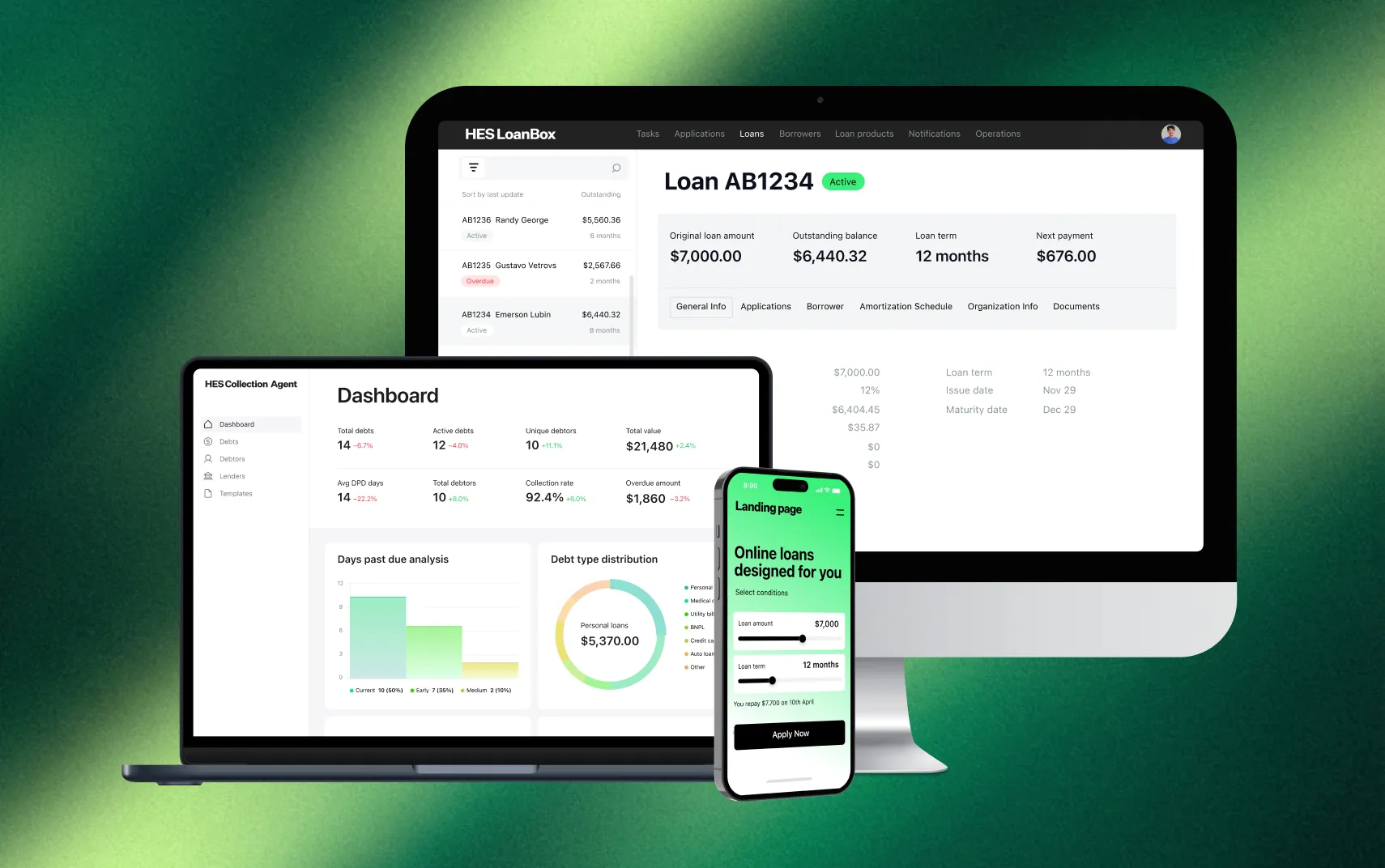
Interactive dashboards in HES LoanBox center on the mortgage KPIs your team watches, pull-through,
cycle time, delinquency, escrow. Pull the raw data and define your own metrics, then cut the
portfolio for the board or for investor reporting.
Connect your mortgage stack with 100+ integrations
Flexible connection options and full customization give HES LoanBox a wide reach, linking mortgage
operations across onboarding, scoring, payments, communication, analytics, and core banking.
Why lenders pick
our mortgage lending software
Fit to your operation
Shape the mortgage lender software to your operation: rework modules and add features,
redraw screens, and connect the services you run, from payment rails to credit bureaus.
Pricing you can read
HES FinTech keeps the bill plain, one license fee, with custom work billed only on request.
Internal users and borrowers are never metered.
Live from three months
Go live from three months on end-to-end mortgage software that is ready to deploy; heavier
customization typically runs longer.
Lending expertise
Our business analysts bring 14+ years in lending spanning the US, EU, and emerging markets.
Security that stands
ISO 27001 certified and SOC 2 aligned, running on AWS or Google Cloud over a secure Java LTS
stack kept current with regular updates.
Support that sticks
A dedicated support team sits one message away for fast, expert help.
Success stories
HES FinTech has been our reliable technology partner since 2012. I believe much of our success is due to the well-architected HES LoanBox solution.
ISO 27001 and SOC 2 alignment, paired with a secure SDLC, hold protection
steady across operations, with full data encryption, role-based access
control, and hardened hosting underneath.
Run HES LoanBox as cloud mortgage software on AWS or Google Cloud, or
on-premises if your policy requires it.
Open-source backend stack
The HES LoanBox build rests on free, open-source tooling, Java LTS, BPMN
2.0, and the Form.io modeler, so extra licensing fees never enter the
picture and cost stays limited to the platform's source code.
The 2026 reality of
mortgage lending
$11K
to produce a single loan
Producing one mortgage cost lenders an average of
$11,094
in 2025, close to a record high (MBA, 2025). With pull-through slipping and wages climbing,
automation is the realistic way back to healthy per-loan economics.
1.8%
single-family mortgage delinquency
The delinquency rate on single-family residential mortgages climbed to
1.87% by the end of 2025
(Federal Reserve, 2025). As defaults edge up, servicing and loss mitigation can no longer
ride on spreadsheets and manual reconciliation.
1:118
applications carry fraud risk
An estimated
1 in 118 mortgage applications
carried fraud risk in late 2025, with far higher rates on investment and multi-unit loans
(Cotality, 2026). Identity and income verification cannot stay a manual step.
$2.2T
2026 origination forecast
Single-family origination volume is projected to rise about 8% to
$2.2 trillion in 2026, much of it arriving in sudden refinance waves (MBA, 2025). Adding capacity without adding
headcount is the whole task.
Start lending in just 3 months
You drive the growth; HES LoanBox runs the platform behind it.
Think of it as the operating layer for a home loan, from the moment a borrower applies to
the day the balance is paid off or worked out. Lenders, whether a community bank, a credit
union, or an independent mortgage bank, rely on home loan software to handle four jobs
without switching tools: digital intake with KYC and document capture, underwriting that
weighs income, assets, and collateral, day-to-day servicing of fixed, adjustable, jumbo, and
home equity products, and the collections or modification work that starts when a borrower
misses payments. HES LoanBox sits in this category, designed for teams that would rather run
their book on a single configurable platform than wire together point of sale (POS), LOS,
and servicing stack.
Mortgage lending software vs. a loan origination system (LOS): what is the difference?
Even analyst reports blur these two, so the confusion is fair. Here is the clean line: an
LOS, sold as mortgage loan origination software or simply mortgage LOS software, owns the
front half of the deal, application to approval to closing. The broader category picks up
everything the LOS does and adds what happens after the keys change hands, payment and
escrow servicing, ARM resets, modifications, and portfolio analytics. Buy an LOS on its own
and you usually inherit a second system for servicing and a third for workout, with
integrations and data silos wedged between them. One configurable environment that spans
origination, servicing, and recovery is the shape HES LoanBox is built around, and it is the
reason lenders increasingly compare end-to-end tooling against single-purpose products
rather than buying an LOS first.
How do I choose the right mortgage lending software for our business?
Begin where the money is actually leaking. Long cycle times and slipping pull-through point
you toward origination, document automation, and faster underwriting. A servicing team
drowning in escrow analysis and payoff requests tells you depth on the back end matters
more. Five quieter factors then separate mortgage software solutions on what you will really
pay over time: how far the product engine bends across fixed, ARM, jumbo, and home equity,
whether retail, wholesale, and correspondent channels run on one pipeline, how cleanly it
ties into your core, the bureaus, and verification feeds, how long a realistic rollout
takes, and whether the pricing carries per-user fees. Lenders chasing a single configurable
platform from application through servicing often put HES LoanBox on the list, though the
right choice tracks back to where your pain actually sits.
How long does mortgage loan software take to implement?
Expect a wide spread. Older enterprise suites can stretch across twelve to eighteen months
and demand a standing IT crew alongside outside consultants. Cloud-based platforms arrive
with workflows, connections, and configurable products already in place, which pulls that
schedule in hard. Straightforward HES LoanBox rollouts go live from three months, since
purchase, refinance, and home equity workflows ship ready, and the bureau, verification, and
payment connections are configured alongside. Multi-state programs, large product catalogs,
or unusual investor and regulatory terms push the timeline out, which is entirely normal and
far simpler to budget for once a brief discovery phase pins down the scope.
How does mortgage loan origination software help with credit risk and compliance?
In mortgage lending these two run as a single thread, and capable software keeps them that
way. For risk, mortgage underwriting software keeps borrower financials, collateral data,
findings from automated underwriting systems, and AI-driven scoring in one place across the
whole book, so a credit team spots deterioration well before a manual pass would surface it.
For compliance, each action drops into an audit trail, documents stay tracked, decision
outputs stay explainable for fair lending reviews, role-based permissions hold origination
and servicing apart, and ISO 27001 and SOC 2 aligned controls wrap the infrastructure. What
you get is fewer jolts when examiners arrive and quicker, more defensible answers the moment
someone asks how a specific loan moved from approval to servicing. The file stays ready for
review without anyone reconstructing it by hand.
How much does mortgage lending software cost?
Pricing for software for mortgage lenders swings with portfolio size, product count,
deployment model, and how much integration you need. The cloud-native wave shifted toward
subscriptions priced on volume, modules, or some blend of both. HES LoanBox runs on a
transparent license-based model with no per-user charges, so adding loan officers,
processors, or borrowers never inflates the bill; custom development is scoped and quoted on
its own. The complete figure tends to fall into place fast on a discovery call, once product
mix, expected volume, and integration needs are on the table.
Does HES LoanBox integrate with our core and existing mortgage systems?
It does. Built API-first, HES LoanBox is meant to slot in beside the systems a lender
already operates, core banking and the major mortgage platforms included. From there it
reaches credit bureaus, KYC and sanctions screening, income and asset verification,
appraisal and title and settlement providers, payment gateways, document and e-signature
tools, accounting, and BI, drawing on 100+ pre-built integrations plus an open API for
whatever falls outside that set. How much work the connection takes depends on your core and
the number of neighboring systems involved, but the aim never shifts: data should travel
between platforms on its own rather than getting rekeyed across processing, underwriting,
and servicing desks.
How is mortgage loan servicing software different from origination software?
Origination software carries a file from application through underwriting to funding;
mortgage loan servicing software picks it up at loan boarding and runs it until payoff:
payment posting, escrow analysis, statements, ARM resets, investor reporting, and loss
mitigation when a borrower falls behind. Many lenders run the two as separate systems from
separate vendors, which is where rekeying and reconciliation gaps come from. Mortgage
servicing software built as part of a wider mortgage loan management software platform
avoids that handoff. In HES LoanBox, origination and servicing share one borrower record and
one rules engine, so the servicing desk sees the same data underwriting approved, and a
modification or workout later in the life of the loan stays on the same file.
Book a demo
HES FinTech has been our reliable technology partner since 2012. We owe much of
our success to their well-architectured solution.
Boris Batine, CEO at ID Finance
HES FinTech offers comprehensive front-to-back solutions with integrations. Our
machine learning platform will allow clients best-in-class investment advice.
Edward Downpatrick, Strategy Director at Fintuity
In just 6 months, we went from storing all our data in Excel to a fast,
reliable, and user-friendly platform that caters to our specific needs.
Hjortur H. Jonsson, Partner at ALM Securities
HES developed our lending software and predictive analytics. Their expertise
delivered automation, clear UI/UX, and customer portal.
Mazen Alasnag, Head of Loan Management at Wa’ed
The LMS provided flexible repayment options, automated restructuring and
branch-level management, enhancing efficiency and risk mitigation.