Loan servicing software
for accuracy and growth


Get loan servicing software that does more and pays back faster
Software for the full loan
servicing cycle


Automated loan lifecycle management

Smart recovery management

Reporting and analytics

Compliance support
Get your free
lending
product estimate
Build and configure loan products
without limitation


Unlimited loan product configuration

Interest calculation logic

Payment allocation rules

Revolving credit lines

Advanced product customization

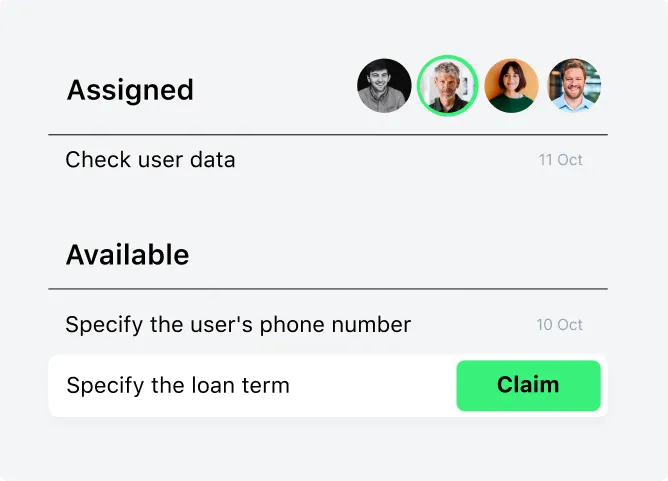
Task orchestration for teams
Achieve unlimited flexibility
in loan calculations
All servicing operations covered in one place

Automated credit disbursements

Payment delay and delinquency handling

Loan rescheduling

Repayments schedules and restructuring


AI for risk management

Documentation registration and control

Security and access control

Rule-based controls for regulatory compliance

Self-service borrower portal

First payment date

Floating interest rate

Automated contract templates

E-signature
Strengthen repayments
with automated collections
Automate and streamline debt recovery

Personalize collection strategies with AI

Reduce missed payments

Compliant overdue penalties


HES CollectionAgent
for tailored strategies

Track your portfolio with
a real-time loan tracking system

Integrations for a growth-ready
loan servicing platform

What you get with
the
HES loan servicing system
Predictable costs
Pay for the core platform, with additional investment only when you need custom functionality, or opt for fixed-scope pricing before development starts.
Security you can trust
Our loan servicing software is ISO 27001 and SOC 2 compliant, deployed on AWS or Google Cloud, with a stable Java LTS technology stack and continuous security updates.
Deployment without lock-in
Opt for a deployment license that gives you full control and avoids dependency on a single vendor.
Faster ROI
Move from implementation to production in three months. Launch faster, scale sooner, and start generating ROI.
Unlimited flexibility
Shape the servicing platform around your lending model. Modify modules, extend functionality, tailor user interfaces, and connect external systems.
Dedicated support after go-live
Get timely, knowledgeable assistance from a dedicated support team with implementation, scaling, and ongoing operations.















Secure by design,
ISO 27001 & SOC 2 certified

Aligned with global regulatory standards

Flexibility without
sacrificing security

Scalable future-ready architecture


Scale loans
servicing, not
headcount

FAQ
What are loan servicing solutions and how do they benefit business?
What is loan servicing software?
Loan servicing software is the technology a lender uses to run every process that begins after a loan is approved and funded: disbursements, repayment schedules, interest accruals, fee application, delinquency tracking, borrower communications, and portfolio reporting.
Modern loan servicing systems do four things at once. They automate the full loan lifecycle from activation through payoff, applying rates, grace periods, and penalty rules by product rather than by hand. They process payments across multiple rails and reconcile in real time, so balances are always accurate. They flag delinquency early and route accounts to the right treatment before a delay becomes a write-off. And they generate the audit-ready records and dashboards that compliance, finance, and executive teams rely on. HES LoanBox covers all four within one configurable platform, supporting mortgage, auto, SME, and BNPL lending.
How do I choose the right loan servicing platform?
Start with the specific operational pain that is costing you the most right now. If your servicing team spends most of its time on manual reconciliations and schedule corrections, the priority is calculation accuracy and automated transaction matching. If delinquency is climbing, early warning tools and configurable collection workflows matter most. If you are scaling products or entering new markets, flexibility in the product engine becomes the deciding factor.
From there, four things quietly determine real cost over five years: how configurable the calculation and product engine is across your loan types, whether payment rail coverage matches how your borrowers actually pay, how cleanly the platform connects to your core banking and reporting stack, and what the pricing model charges as volume and headcount grow. HES LoanBox tends to come up on shortlists when lenders want a single platform that handles the full post-origination lifecycle without per-user fees or vendor lock-in, but the right answer depends on where your servicing operation is breaking down today.
How long does loan servicing software take to implement?
It depends heavily on what you are replacing and how many products you run. Legacy servicing platforms from vendors like FIS, Fiserv, or Temenos typically take twelve to eighteen months to go live, require significant internal IT resource, and come with consulting fees on top of license costs. The complexity is real: data migration from an active loan book, product configuration across multiple rate structures, and integration with payment providers all take time when the platform was not built with configurability in mind.
Modern platforms designed around configurable workflows and pre-built integrations compress that significantly. HES LoanBox gets most clients to production within three months, because the platform ships with ready servicing workflows, standard payment rail connections, and configurable product and calculation logic that does not require custom development for common use cases. Deployments spanning several loan products, multiple jurisdictions, or a large active portfolio to migrate do run longer, which is normal and straightforward to scope once discovery clarifies the starting point.
How customizable is HES loan servicing software?
Our web based loan servicing software is highly customizable across business, product, and workflow levels. The solution is designed to let you configure payment schedules, fee structures, calculation methods, custom grace periods, approval workflows, document requirements, or pre-payment penalty structures.
HES LoanBox is modular, meaning you can start with servicing alone, or deploy the full lending lifecycle from origination through collections from day one, and expand modules as the business grows. If your products or regulatory environment require calculation logic or workflow behavior beyond what the platform covers out of the box, a developer license gives your team full access to the source code, with no vendor lock-in and no dependency on HES for future changes. Deployment choice, on-premise or in the cloud (AWS, Azure, GCP), follows the same logic: the architecture fits the business, not the other way around.
Can HES loan servicing software integrate with our existing systems?
Is your loan servicing solution compliant and secure?
HES FinTech is ISO 27001 certified and SOC 2 aligned, with independently verified controls covering access management, data protection, and audit trails. The platform deploys on AWS or Google Cloud with encryption in transit and at rest, role-based permissions, two-factor authentication, and full action logging across the servicing lifecycle.
On compliance, the platform provides calculation controls, audit-ready records, and configurable product rules that support lenders operating under GDPR, AML/KYC standards, and regional financial regulations across 32 countries. Rule-based controls enforce internal policy automatically, so compliance is built into the workflow. Specific requirements around data residency or reporting format are addressed during implementation.