Small and medium-sized enterprises account for 99.8% of enterprises in the EU business economy, while firms classified as small under the US Small Business Administration definition represent 99.9% of US businesses. The two figures rest on different definitions and are not directly comparable, but each points the same way: in both markets, smaller firms make up nearly the entire business population and carry a substantial share of employment.
Access to credit remains the constraint. Limited collateral and short credit histories push these borrowers into higher risk bands, documentation requirements are heavy, and approval cycles measured in weeks rarely match the working-capital need that triggered the application. Pricing and covenants tend to be tighter as a result, disclosure practices vary, and coverage thins out further outside major markets.
Lending software for medium and small businesses can tackle these challenges, make daily work easier, lower risks, and give customers a better experience through providing all-in-one services, from applying for a loan to organizing payments and keeping track of reports.
The regulatory context shifted this year. Under the amended EU AI Act timeline agreed in the Digital Omnibus, obligations for stand-alone high-risk systems generally apply from December 2027 rather than August 2026. The amendments adjusted certain mechanisms alongside the dates, but the core duties on risk management, data governance, human oversight, and record-keeping remain. In SME lending the high-risk classification is most relevant where AI assesses the creditworthiness of natural persons, which includes sole traders and individual guarantors, rather than every corporate underwriting model.
Our perspective comes from implementation, not product research alone. HES FinTech has delivered lending systems since 2012, completing more than 160 projects across 32 countries. Across those SME lending platform deployments, one pattern recurs: platform selection often fails because of an operating-model mismatch rather than a missing feature. A lender chooses an SME lending platform designed for a different type of institution, then spends significant time and budget configuring around assumptions embedded in the system.
This guide covers five SME lending platforms that represent different architectural and institutional use cases, with an overview of what each is built for, where it is strong, and where buyers should look closely.
Key Takeaways
- SMEs dominate the global economy, but access to financing remains a major challenge due to slow approvals, strict requirements, limited credit histories, and lack of transparency.
- Speed, transparency, and access are the three core benefits of modern SME lending software, with approvals often taking hours instead of weeks and decisions based on real business data, not only credit history.
- Choosing the right platform depends on your strategy, not just features.
- Most buyers are replacing a system rather than starting fresh, which puts migration path and parallel-run support ahead of any feature grid.
- Judge cost as three-year total and cost per funded loan, not year-one license.
- Governance is now a selection criterion. Explainable decisions with reason codes and an audit trail are easier to defend than a black box, whatever the compliance deadline.
Best SME Lending Platforms Shortlist
The platforms below are not identical in scope. Some cover the full lending lifecycle in one configurable environment, some are cores that lenders build products on, and some concentrate on servicing and portfolio work after a loan is booked. For that reason this comparison looks past feature lists and considers who each platform was built for and how much of the loan it carries.
| Platform | Best for | Deployment | Segment | AI decisioning | Price signal | Watch for |
|---|---|---|---|---|---|---|
| HES LoanBox | End-to-end lifecycle in one configurable platform | Cloud, on-premises, or hybrid | Non-bank lenders, fintechs, mid-sized banks | Built-in AI-powered credit decisioning | From $39K a year, depending on business type | Configuration effort up front |
| Mambu | A composable, cloud-native lending core | Cloud only | Digital banks, fintechs, embedded finance | Through integrations and partners | Subscription with usage-based components | Needs technical resource; no on-premises option |
| nCino | SME lending inside a wider commercial bank stack | Cloud, Salesforce-based | Banks and credit unions | Credit workflow automation, with AI capabilities via nCino modules and the Salesforce ecosystem | Quote-based subscription; confirm how Salesforce platform costs are handled | Salesforce dependency; confirm how platform costs are quoted |
| Baker Hill | Business lending at US community and regional institutions | Cloud | Community and regional banks, credit unions | Configurable credit policy and scoring | Quoted by institution size and modules | NextGen brand consolidating into UN/FY during 2026 |
| QUALCO Loan Manager | Servicing, restructuring, and complex portfolios | Arranged with the vendor | Banks, servicers, large or distressed books | Analytics and ML through the wider QUALCO family | Custom | Origination is a separate product |
For that reason, we structured this list into two groups:
- SME lending platforms for non-bank lenders and mid-sized banks
- Institutional and specialist platforms
Platform descriptions have been compiled and updated based on vendor-published materials and independent reviews accessible to the public. Ratings and prices change, so confirm current details with each vendor. Last checked July 2026.
What Is an SME Lending Platform?
An SME lending platform is the operational system a lender runs its small-business credit on. Origination functionality covers the path from application to approval: intake, verification, credit assessment, and offer. Servicing functionality takes over at disbursement, handling interest and payment calculations, repayment schedules, arrears and collections activity, and the reporting behind portfolio oversight. Some platforms cover both, while others specialize and integrate with the rest of the stack.
With lending software, medium and small-sized businesses address three big challenges:
- Speed: loans are processed in minutes and hours, not weeks
- Transparency: every step of the process is visible and trackable
- Access: businesses can get funding even if they have thin credit files
Forecasts for this market vary widely because analysts define the category differently, some counting digital lending platforms, others loan origination or loan management software. One published projection puts the global digital lending platform market at USD 39.8 billion by 2033, while a separate study estimates the European segment at USD 10.2 billion over the same horizon. Treat these as one research house’s expectations rather than settled figures, and check the category definition before comparing any two of them. What they do indicate consistently is direction: investment in digital lending infrastructure is expected to keep growing.
How SME Lending Platforms Work
Regardless of the type, all advanced SME lending platforms cover the main steps of the lending process, either as a full-stack solution or as independent modules integrated into an existing architecture.
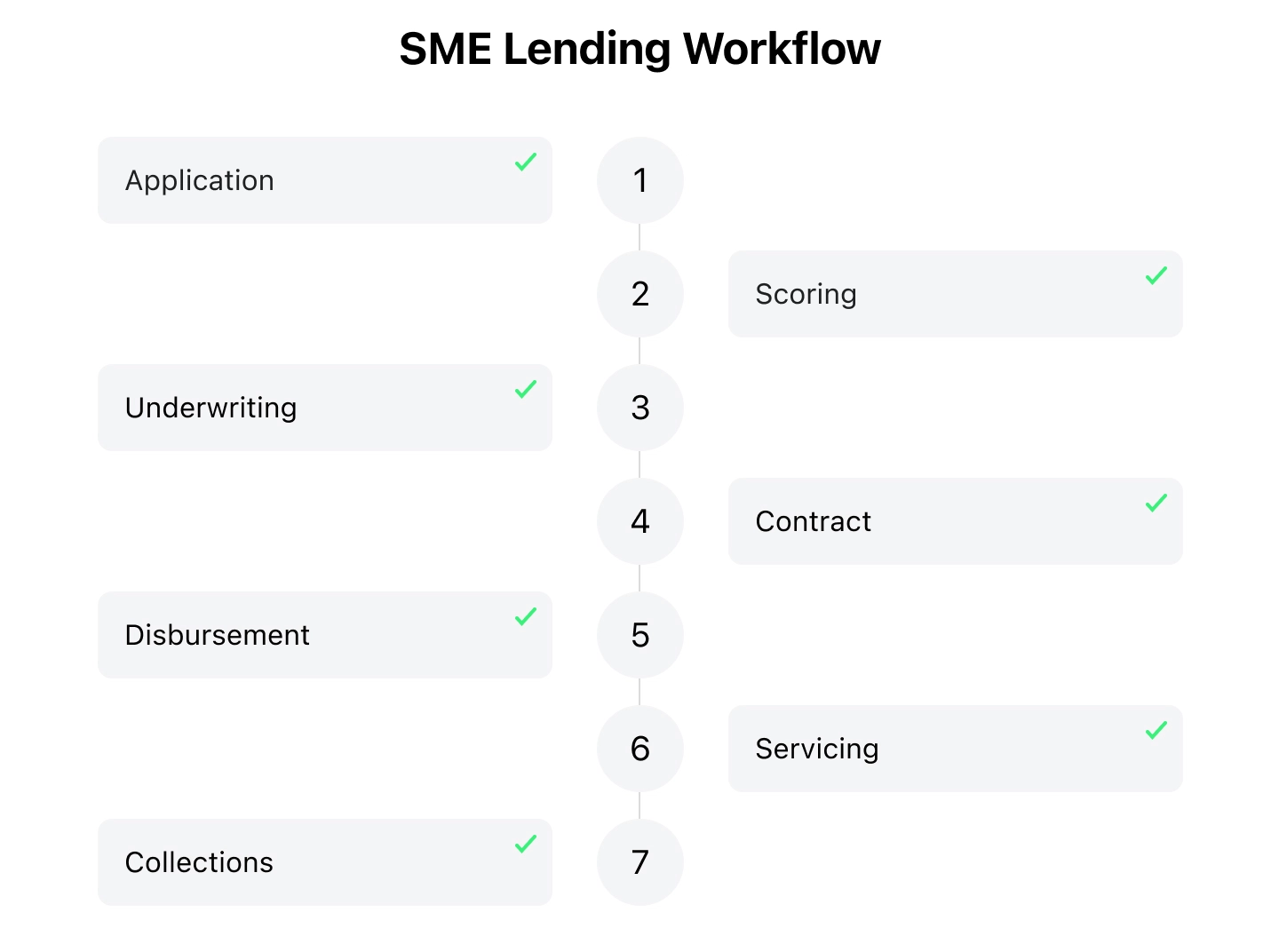
At the top of the flow, platforms handle application intake, capturing and validating borrower and business data via APIs or UI components.
This is followed by scoring and underwriting, where credit policies are executed using rule-based logic, external data integrations, and, in some cases, manual review workflows.
Once a decision is made, platforms support offer generation and contracting, including terms configuration, document generation, and e-signature flows.
After contract execution, disbursement and servicing modules manage payouts, interest calculations, repayment schedules, and lifecycle events such as early repayment or restructuring.
Finally, collections and recovery functionality tracks delinquencies, triggers collection actions, and maintains audit-ready activity logs.
Capabilities such as reporting, access control, and integrations usually span all stages to support operational continuity throughout the loan lifecycle.
What Are the Types of SME Lending Platforms
SME lending software supports various lending models, loan types, business sizes, and industry needs. These platforms are divided into a few main categories.
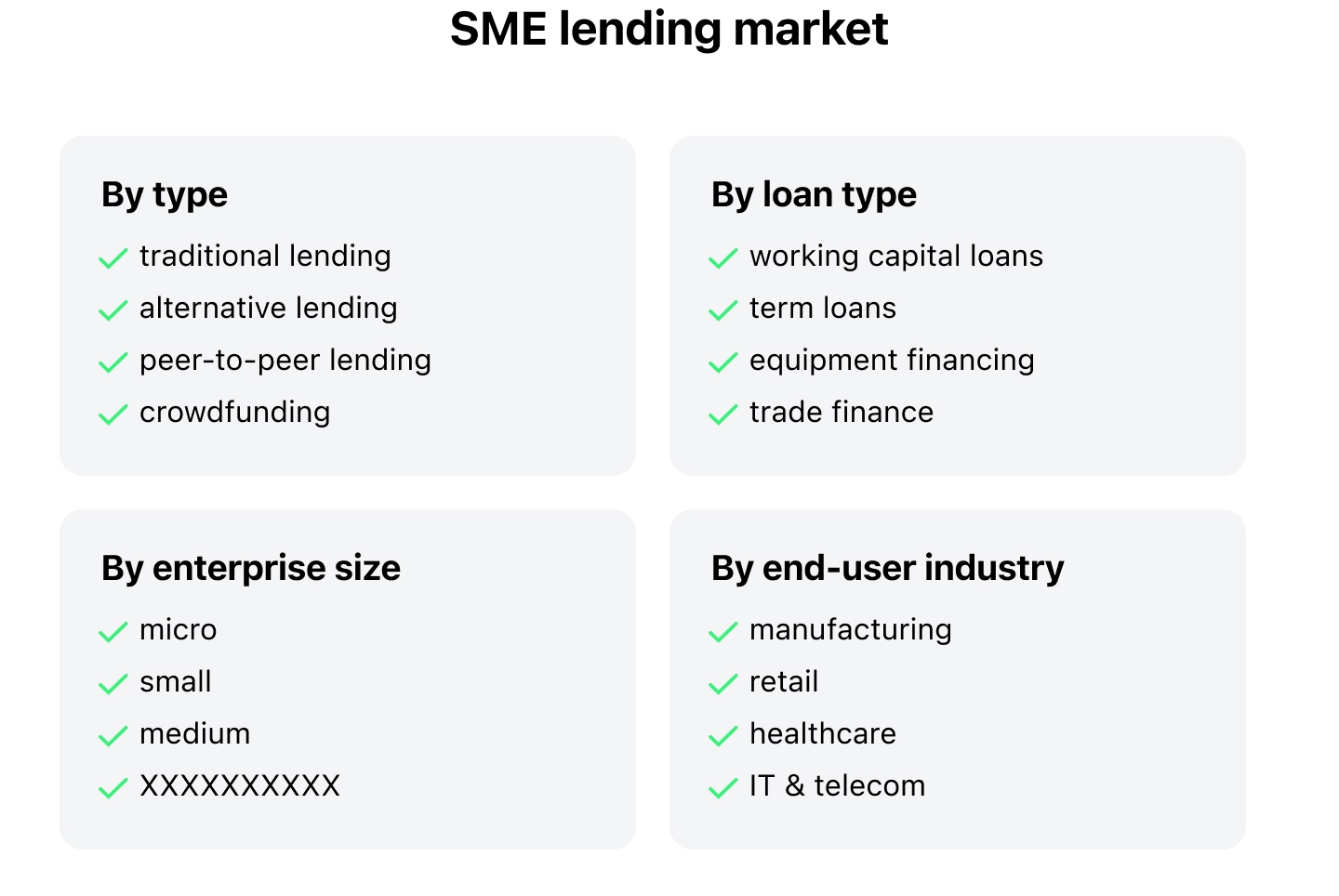
By Lending Type
- Traditional lending platforms are made for banks and regulated financial institutions. They focus on structured credit processes, compliance, and risk management.
- Alternative lending platforms are built for fintech lenders. They offer faster, data-driven credit decisions and flexible underwriting models.
- Peer-to-peer (P2P) lending systems let investors lend directly to SMEs. These systems include tools for assessing borrowers and managing investors.
- Crowdfunding platforms help SMEs raise funds from groups of contributors. They often include features for managing campaigns and supporting compliance.
By Loan Type
- Working capital loan systems help with short-term financing and offer flexible repayment schedules.
- Term loan platforms manage long-term loans and can offer fixed or variable repayment plans.
- Equipment financing software is used for asset-backed lending. It includes features like equipment valuation and tracking the equipment’s lifecycle.
- Trade finance solutions help finance cross-border trade, invoices, and supply chain transactions.
By Enterprise Size
- Micro-enterprise lending systems are lightweight platforms that provide easy onboarding and automated decisions.
- Small business lending platforms combine automation with customization to support growing businesses.
- Medium enterprise lending solutions provide advanced risk assessment, analytics, and management of multiple loan products.
By End-User Industry
- Manufacturing platforms support financing for asset-heavy businesses and help manage longer cash conversion cycles.
- Retail platforms focus on inventory financing and handling large numbers of transactions.
- Healthcare platforms address regulatory requirements and manage specialized cash flow structures.
- IT and telecom platforms deliver flexible financing models for fast-growing, service-based businesses.
How We Evaluate SME Lending Platforms
This comparison is based on independent research conducted in 2026 and reflects publicly available data on the platforms covered. We began with what each vendor publishes about itself, then looked for places where outside evidence either supports that or does not: category listings and user reviews on Capterra and G2, vendor case studies, buyer commentary on Gartner Peer Insights, and published pricing where any exists. Reviews were read for recurring specifics rather than scored.
Key evaluation criteria for SME lending platforms
- Lifecycle coverage. How much of the loan the platform carries, from onboarding and origination through servicing and collections, inside one system.
- Configurability. How far a lending team can change products, workflows, and credit policy without custom development or a vendor ticket.
- Decisioning and explainability. Whether the platform produces reason codes and an audit trail a risk officer can defend, not just an approval rate.
- Integration and API ecosystem. Connections to credit bureaus, open banking, payments, accounting, and core systems.
- Deployment. Cloud, on-premises, or hybrid, and who holds the data.
- Compliance readiness. Access control, audit trails, and alignment with the standards that apply in your markets.
- Institutional fit. Which kind of lender the platform assumes: a community bank with a credit committee, an enterprise commercial book, or a non-bank team of fifteen.
- Market validation. Client adoption, published cases, and presence in the SME segment specifically.
How to read what follows. We did not assign scores or weights, because the platforms compared here are not interchangeable: the group spans an end-to-end lending platform, a composable banking core, a Salesforce-based bank workflow layer, a US institutional origination and risk platform, and a servicing and portfolio-management system. Ranking them against each other on a single scale would suggest a precision the evidence does not support. Instead, each “best for” statement describes the buyer profile and operational scenario the platform is built around, drawn from vendor documentation and the segment its published clients occupy. Pros and cons reflect recurring themes in publicly available reviews and vendor materials, not our own testing, and public review volume for these products ranges from a handful of entries to several dozen. Where a figure has no public source we say so instead of printing a number we cannot stand behind, and vendor-published performance figures are identified as such. Review counts track marketing reach more than engineering quality, so a vendor with a large institutional footprint can show fewer reviews than a smaller competitor running an active review campaign.
Disclosure. HES FinTech develops HES LoanBox, which appears first in this comparison. To reduce potential bias, the same evaluation categories have been applied to every platform, vendor-specific claims are identified as such, and each section carries named sources and a date. Limitations of our own product are stated alongside those of the others. Buyers should independently verify product scope, pricing, and implementation terms before making a decision.
Best SME Lending Platforms for Non-Bank Lenders and Mid-Sized Banks
This group covers SME lending platforms that tend to fit mid-sized banks, fintechs, and non-bank lenders. They emphasize modular adoption, configuration over custom development, API-driven integration, and broad lifecycle coverage.
HES LoanBox by HES FinTech: API-first modular platform, best for non-bank lenders and mid-sized banks
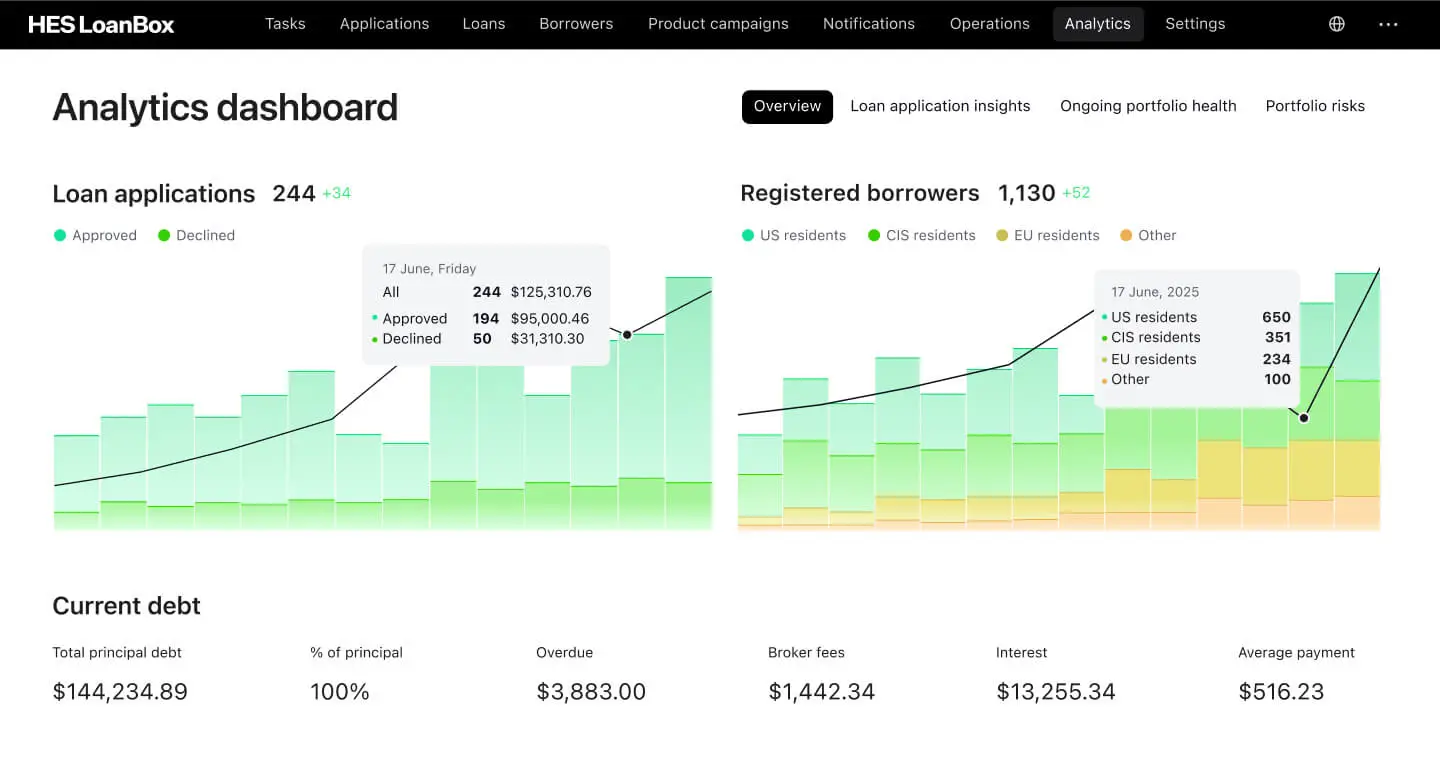
HES LoanBox is a deployment-flexible lending platform available in cloud, on-premises, and hybrid configurations, covering every stage of a loan from application and credit checks through servicing and collections in one system. It is developed by HES FinTech, a provider of ready-to-deploy lending technology, and it is built so that a lender can either deploy the full end-to-end product or connect selected microservices to what it already runs.
Best for: banks, fintech lenders, and non-bank institutions offering business loans that need configurable coverage across onboarding, origination, servicing, and collections, particularly where workflows, product logic, or integrations are specific to the business.
| Overview | |
|---|---|
| Impact and decision quality | Up to 2.5x faster processing and 3.5x higher decision accuracy compared to conventional setups. |
| Security | Bank-grade security approach supported by ISO/IEC 27001 certification and a completed SOC 2 examination covering the relevant control environment, with support for AML and KYC processes, audit trails, role-based access, and 2FA. |
| Customization & implementation flexibility | Configurable underwriting logic, approval rules, product engines, and borrower journeys. Composable architecture allows a phased module rollout or a full end-to-end deployment. Projects can start from 3 to 4 months depending on complexity. |
| Supported lending models | SME lending, BNPL, merchant cash advance, auto, consumer, mortgage, microfinance, and embedded lending. |
| Tech stack, vendor independence & scaling | Connects with 100+ APIs, including credit bureaus, CRMs, payment gateways, ACH and card rails, and accounting systems. Built on open-source technologies such as Java and Camunda, which reduces dependency on a single provider. Optional developer license with code access, subject to commercial agreement. |
Key features
- Self-service borrower portal with online sign-up, application submission, automated identity verification, and KYC/AML checks
- Application and document management with e-signatures, configurable templates, and centralized document storage
- Configurable workflows supporting task tracking and customizable processes for multiple lending products
- Loan servicing and transaction management covering disbursement, repayment schedules, dynamic schedule adjustments, and payment processing
- Collections functionality for delinquency tracking, omni-channel communication workflows, restructuring, and recovery
- AI-powered credit decisioning for scoring, fraud detection, and risk segmentation
- 10+ analytical dashboards with insights on portfolio performance and operational KPIs
- Open APIs for embedded lending and third-party integrations across credit bureaus, open banking, and fraud-prevention tools
Pros
- Covers the entire lending cycle in one place
- High configurability and modularity, with the option to set up an end-to-end product or integrate selected microservices
- Deployment flexibility across cloud, on-premises, and hybrid environments
- Reduced vendor dependency, with an optional developer license available for deeper control
Cons
- Customization is needed to match local regulations and data sources
- Pricing fits mid-size and large lenders better than very small institutions
- Extensive flexibility increases the need for change control and documentation to avoid configuration sprawl
What users say
On Capterra, where HES LoanBox leads the loan servicing software category, reviewers often describe the platform as a turnkey out-of-the-box solution and highlight ease of configuration and integrations. It also ranks second in the loan management category on G2 by user count and rating, with users pointing to flexibility, multi-entity and multi-currency capabilities, and connections to local banks and data vendors. Some clients report challenges with complex custom reporting and with customizing dashboards and user roles at the start of deployment, which needed extra planning and coordination between the in-house team and the vendor.
Demo and trial period: free demo and trial available.
Notable clients: ID Finance, Wa’ed, ALM Securities, Tavan Bogd Group, Fintuity, Alraedah.
Pricing: license starts from $39K a year, depending on business type. Typically a fixed subscription with no limits on users, products, or applications. Custom enterprise licensing available for multi-entity deployments.
Sources: HES FinTech documentation, Capterra, G2. Last checked July 2026.
Mambu: composable lending core for digital banks and embedded finance
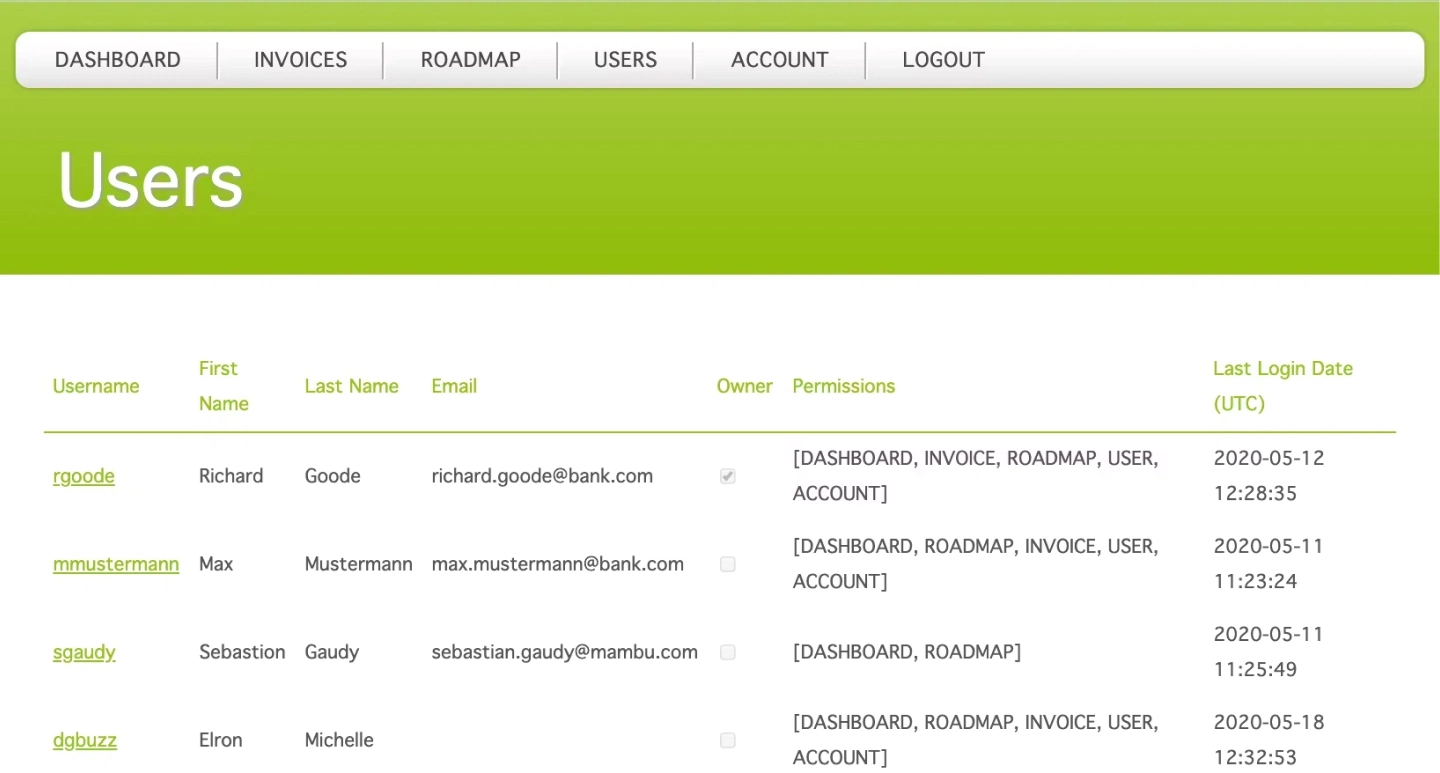
Mambu is a SaaS cloud-native banking platform built for flexibility and scale. Its modular setup allows lenders to assemble their own financial products, including SME lending solutions, and to connect decisioning, payments, and analytics from third parties rather than run them natively.
Best for: banks, fintechs, and digital lenders operating across different markets that prefer a composable architecture over a heavily integrated native platform.
| Overview | |
|---|---|
| Impact and implementation speed | Rapid product launches are the vendor’s central claim, with products assembled through configuration rather than custom build. |
| Security | Banking-grade controls, including ISO/IEC 27001 certification, SOC 1 and SOC 2 reporting, and regular penetration testing. |
| Customization & implementation flexibility | Modular architecture with low-code and API-based configuration for product setup, repayment structures, and payment holidays. |
| Supported lending models | SME lending, BNPL, mortgages, business and asset finance, purchase finance, and embedded finance. |
| Tech stack, vendor independence & scaling | API-first and cloud-native, with REST APIs, webhooks, and a broad partner ecosystem for identity, AML, payments, and risk. |
Key features
- Composable modules for loans, deposits, core banking, and product management
- Open API architecture for integration with external systems
- Real-time processing and portfolio oversight
- Multi-currency and multi-country support
- Built-in compliance and security elements
Pros
- Very flexible for designing custom financial products
- Cloud-native structure that grows with business needs
- Faster time-to-market for new offerings
- Broad partner ecosystem and developer tooling
Cons
- Requires technical expertise for setup and API-based integrations
- Usage-based pricing can increase with transaction volume
- Some capabilities depend on partner integrations rather than one native stack
- No on-premises option, which matters for institutions with strict hosting requirements
What users say
Official case studies emphasize rapid launches and IT cost reduction. Public review volume is thin on both G2 and Capterra, each carrying only a handful of entries, so star ratings deserve care here. Where clients do comment, they highlight flexibility and ease of integration, while some report a difficult migration and ask for a better interface.
Demo and trial period: free live demo upon request.
Notable clients: Wio Bank, BancoEstado, Platcorp, My Community Finance.
Pricing: available upon request. Typically subscription-based SaaS pricing with module-based and usage-based components depending on portfolio size and product mix.
Sources: Mambu documentation and press materials, Gartner Peer Insights, Software Advice. Last checked July 2026.
Institutional and Specialist SME Lending Platforms
This group includes platforms selected by larger institutions and by lenders with a specific operational problem to solve. They are associated with higher governance requirements, vendor-led implementations, and deep integration landscapes, and each one assumes a particular kind of buyer.
nCino: CRM-driven lending workflow platform for commercial and SME banking
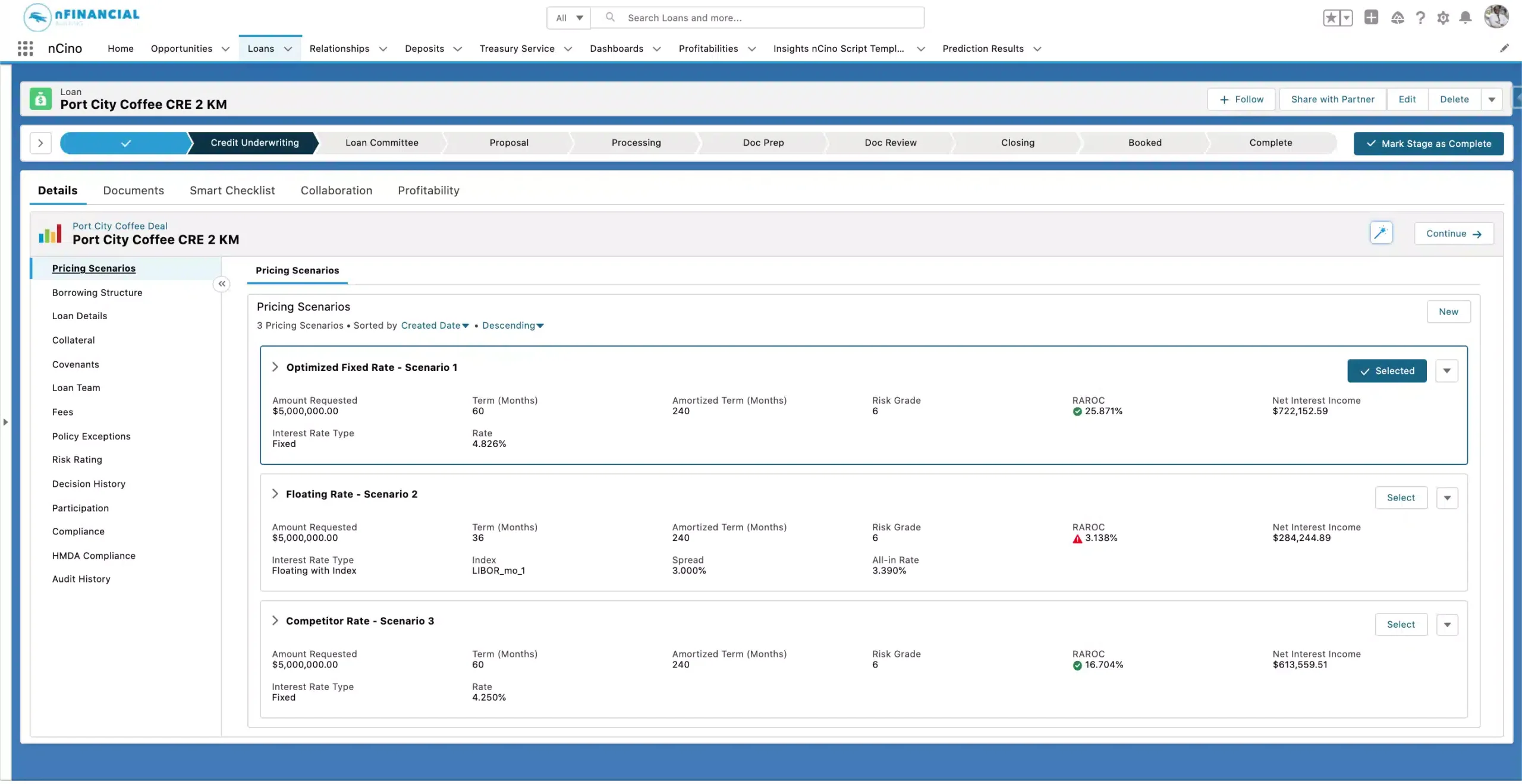
Built on Salesforce, nCino is a cloud platform for commercial and small-business lending and portfolio management. For most of its customers, SME lending is one line inside a much larger commercial book, and the product reflects that: credit analysis, approvals, and portfolio work sit in one operating layer, suited to an institution with a credit committee and an examination cycle behind every decision.
Best for: banks and credit unions, particularly those already standardized on Salesforce, running commercial and small-business lending at scale.
Key features
- Loan origination and underwriting workflow automation
- Portfolio and risk management dashboards
- Compliance and audit trail automation
- Salesforce ecosystem API integrations
- Loan product configuration
Pros
- Integrates natively with Salesforce
- Works well for commercial and SME lending inside banks and credit unions
- Adaptive workflows and real-time reporting
- Wide partner ecosystem and developer support
Cons
- Built on Salesforce, so buyers should confirm whether Salesforce platform costs sit inside the nCino quote or are contracted separately
- Relies heavily on Salesforce infrastructure, which can limit customization flexibility
- Out-of-the-box functionality is narrower for non-commercial loan types
- Configuration changes usually need Salesforce skills in-house or on retainer
Pricing: available upon request, subscription-based. Because the product runs on Salesforce, confirm in writing how platform costs are handled in your proposal, since that treatment affects total cost of ownership.
Sources: nCino documentation, G2. Last checked July 2026.
Baker Hill: business lending and portfolio risk for US community institutions
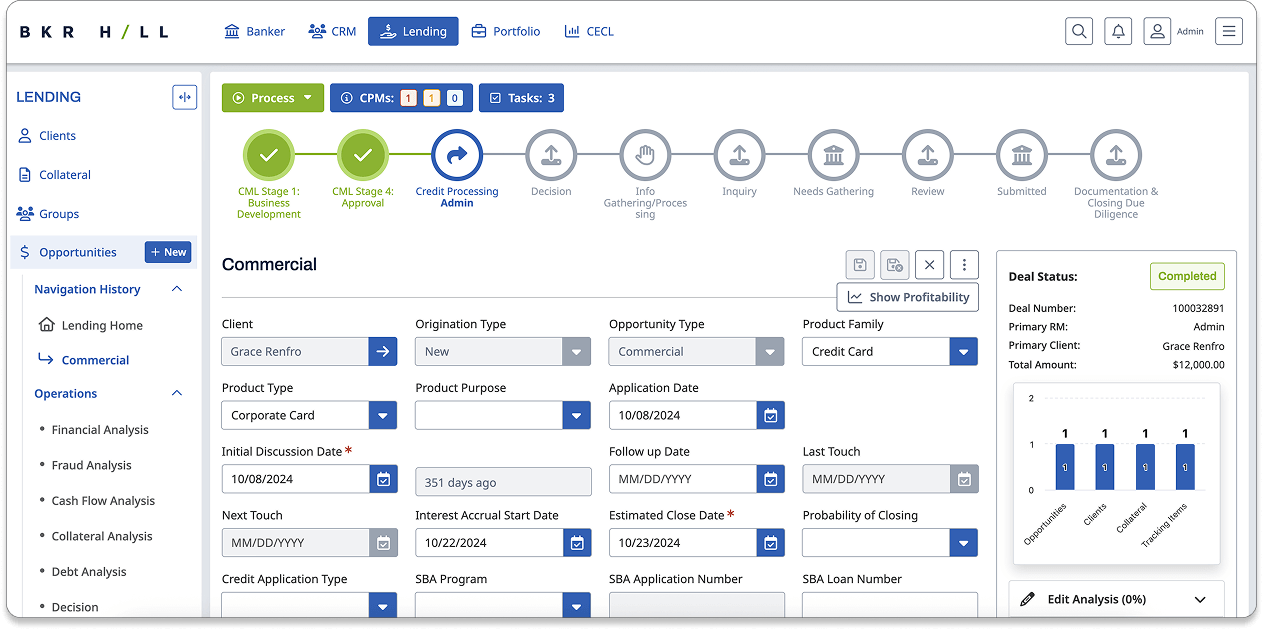
Baker Hill is built around the way US community banks and credit unions underwrite, combining small business, commercial, and consumer origination with portfolio risk monitoring on one platform. The vendor has served this market for four decades, and the product reflects that focus rather than a general-purpose engine adapted to US banking.
Best for: US community and regional banks and credit unions that want business lending origination and portfolio risk in a single system.
Key features
- Small business, commercial, and consumer loan origination
- Configurable credit policy, scoring, and financial spreading
- Portfolio risk monitoring and reporting after booking
- Integrations with US core banking systems, credit bureaus, and financial data sources
- Documented credit decisions and audit trails shaped around US examination expectations
Pros
- Strong fit with the credit process of US community and regional institutions
- Origination and portfolio risk in one platform rather than two
- Long track record in the segment
- Low data-science requirement, since credit policy is configured rather than modeled in-house
Cons
- Focused on the US market, so a poor fit for lenders operating elsewhere
- Limited public review volume compared with cloud-native vendors
- The brand is in transition: Baker Hill launched UN/FY in November 2025 and is retiring the NextGen name during 2026, bringing the LOS suite under one brand. The vendor positions this as an evolution for existing clients rather than a replacement
Pricing: available upon request, quoted by institution size and selected modules.
Watch for: confirm whether the NextGen to UN/FY change is a branding move or whether it carries technical, contractual, or configuration work on your side, and which of the two a given quote covers.
Sources: Baker Hill materials and US banking trade coverage. Last checked July 2026.
QUALCO Loan Manager: servicing and portfolio engine for complex books
QUALCO Loan Manager administers loans across the account lifecycle, from onboarding and disbursement through servicing, restructuring, and termination, with particular depth on portfolios that need active management. It sits inside a wider QUALCO product family, where origination and collections are addressed by separate offerings, so the scope of any given deployment depends on which components are contracted.
Best for: banks and servicers administering large or complex portfolios, where restructuring and post-disbursement control matter more than front-end origination.
Key features
- Full servicing modules across the loan lifecycle
- Advanced tools for restructuring, recovery, and workout strategies
- Automation across servicing tasks, with analytics and machine learning available through the wider QUALCO product family
- Support for consumer, SME, corporate, mortgage, and BNPL products
- Open-API design for integration with origination and core systems
Pros
- Suitable for back-office operations and collections at scale
- Supports many loan types on one system
- Deployment options are arranged with the vendor rather than fixed to a single hosting model
- Strong capabilities for handling complex restructuring scenarios
Cons
- Origination is covered by a separate QUALCO product rather than by Loan Manager itself, so a full front-to-back setup means contracting more than one component
- Implementation generally requires vendor involvement
- Few public software reviews are available
Pricing: custom, quote on request.
Sources: QUALCO documentation. Last checked July 2026.
Other SME Lending Solutions to Consider
These products are widely used in lending but are not always directly comparable to the full lifecycle SME lending platforms above. In most cases they specialize in one layer and are deployed alongside other systems.
Blend sits at the application layer. It fits when borrowers abandon your form rather than when your back office is slow, and it leaves everything after submission to the systems you already run.
LendingPad comes out of mortgage and shows it. Worth a look when SME lending sits alongside a mortgage book, less so when business lending is the whole operation.
MeridianLink is consumer-forward across US community financial institutions, which makes it a reasonable fit when SME lending is one product line among several rather than the main event.
Abrigo pairs lending with BSA/AML and risk tooling, which matters most when compliance staffing rather than origination volume is your binding constraint.
Also weigh: your core banking or origination vendor may already offer a lending module. It is rarely the strongest option, but the integration savings can matter.
If you would rather borrow than build. Some readers arrive here as SMEs looking for credit, not as lenders choosing software. That is a different question, answered by lenders rather than platforms: American Express Business Blueprint and OnDeck for fast US working capital, Fundbox for embedded credit lines aimed at very small businesses, and Funding Circle for marketplace-funded term loans. None of these is software you deploy, and their public reviews reflect borrowers rather than a system a lending team would run.
Common Pricing Models for SME Lending Platforms
Pricing for SME lending platforms varies with deployment scope, implementation complexity, product coverage, integrations, and volume. No single model is universally better, and the quoted license rarely matches what a lender ends up spending.
The most common models include:
Fixed subscription fee. A recurring annual or monthly platform fee, typical of SaaS deployments and often preferred for cost predictability.
Implementation fee. A one-time charge covering setup, configuration, integrations, migration, testing, and go-live support.
Usage-based pricing. Fees tied to consumption, such as application volume, active accounts, processed payments, or API calls.
Per-loan or per-account pricing. Costs linked to originated, serviced, or active loans, which maps easily to portfolio growth.
Module-based pricing. Cost depends on the modules selected, such as onboarding, origination, servicing, collections, or analytics.
Enterprise or custom licensing. Individually structured terms for institutions with multi-entity, governance, or security requirements.
The cost that proposals leave out
A proposal quotes the license, and implementation and integration can be estimated by anyone who has run the project before. What rarely appears in writing is the cost of changing the system once it is live. In SME lending that cost recurs, because product variants and credit policy adjustments are routine work rather than exceptions, and where every change requires a vendor request or a specialist administrator, the operating cost of the platform includes the delay as well as the fee.
In practice, ask each vendor to price the same scope at three volumes, current, planned for next year, and double that, and to specify which configuration changes your own team can make without them. Compare the results across three years, since implementation falls in year one while change costs recur annually. Cost per funded loan at realistic volume is a more reliable basis for the business case than the quoted license.
SME Lending Platform vs Loan Origination, Servicing, and Collections Software
These categories overlap, but the scope is not identical, and buying the wrong one is a common and expensive mistake.
Loan origination software covers the pre-disbursement stage: application intake, document collection, underwriting, approvals, and loan setup. It helps a lender decide whether to issue a loan and on what terms.
Loan servicing software executes active agreements. It handles repayment schedules, billing, interest calculations, payment processing, account updates, and borrower communication through the repayment period.
Debt collection software takes over when accounts become delinquent, supporting reminders, segmentation, recovery strategies, restructuring, and follow-up.
An SME lending platform sits above these layers. It may include all three as modules, but its purpose is broader: to run SME loans as portfolio assets, coordinate workflows across the lifecycle, and keep borrower data, decisions, repayments, and collection actions connected in one operational system. In practice, lenders choose between assembling separate specialist tools or deploying a unified platform. The right answer depends on portfolio complexity, integration appetite, and how tightly the stages need to connect.
Migrating from a Legacy LOS or LMS
Most buyers of an SME lending platform are not buying their first system. They are replacing an origination or loan management platform that has grown slow to change, and that is where projects stall. A staged approach keeps the risk contained.
Start by mapping what you actually run: products, credit policies, data, and the integrations that feed them. Then rebuild the target flow from configurable components rather than porting the old process one screen at a time. Run the rebuilt flow in parallel on real volume, so you can compare its decisions and servicing behavior with the live system before a customer sees anything. Then move a single product line across, a working-capital product for example, and leave the rest until that one is stable. A phased migration of this kind shortens the initial rollout compared with a full-book cutover, though the timeline still depends on data quality, integration work, and regulatory testing.
Four issues determine how that sequence actually runs, and none of them is visible in a product demonstration.
In-flight loans. A book in mid-lifecycle does not pause for a cutover. Decide early whether live loans move across with full history, run to maturity on the old system, or convert on a fixed date. Each answer changes the integration work and the reconciliation burden.
Audit trail continuity. Examiners ask about decisions made years ago on a system you no longer run. If historical decisions, documents, and reason codes cannot be reproduced from the new platform, you keep the old one alive as an archive and keep paying for it.
Integration re-certification. Bureau, KYC, and payment connections rarely lift and shift. Each is a contract, a test cycle, and sometimes a fresh certification, on the counterparty’s schedule rather than yours.
Credit policy drift. Rules that accumulated as exceptions get rebuilt as though they were deliberate policy. Migration is the one moment when someone can ask which of them were ever intended.
Two questions separate vendors here more sharply than any feature discussion: who carries the cost while both systems run in parallel, and how many customers moved a complete book in the last twelve months. Ask for names.
Compliance and Model Governance for SME Lending
Wherever you lend, an automated credit decision made by an SME lending platform has to be explainable to a regulator, an auditor, and a declined applicant. That shapes which platform is safe to build on.
One practical lesson from our deployments is that decision traceability often creates more compliance rework than a missing report. A lender may need to reconstruct why a particular application was declined months or years after the decision. If the scorecard, rules engine, data inputs, and manual overrides cannot reproduce that path, the underlying logic may have to be rebuilt under audit or examination pressure. Designing the audit trail from the outset is considerably less costly.
The SME-specific problem is adverse action. Where ECOA and Regulation B apply, a declined applicant is entitled to the principal reasons for the decision, stated specifically enough to be meaningful. The difficulty with cash-flow and transaction data is not that it cannot be used, but that the platform has to trace a decision back to reasons that reflect the actual decision logic. Whether and how these requirements apply to a given SME facility depends on the borrower, the credit structure, and the regulatory perimeter, which is worth confirming with counsel rather than assuming.
United States: Which Rules Actually Govern Business Credit?
Generic lending-software marketing often groups TILA, RESPA, and HMDA under a single compliance label. For SME lending, that can mislead buyers. TILA primarily applies to consumer credit, while RESPA focuses on federally related residential mortgage transactions. Business-purpose credit is generally outside those regimes.
HMDA is narrower but can still cover certain business-purpose loans when they are secured by a dwelling and qualify as home-purchase, home-improvement, or refinancing transactions. Mortgage-compliance functionality may therefore be relevant to only a limited part of a business lender’s portfolio.
The requirements more commonly relevant to SME lending include:
- ECOA and Regulation B. Regulation B applies to business as well as consumer credit. Its notification requirements vary according to the applicant and transaction. For businesses with gross annual revenue of $1 million or less, creditors generally follow the more detailed adverse-action notification requirements. For larger businesses and certain forms of trade or factoring-related credit, written reasons may be provided upon a timely written request. Where reasons are required, they must be specific and reflect the factors actually considered in the decision.
- Section 1071 of the Dodd-Frank Act. Implemented through Regulation B, Section 1071 establishes data-collection and reporting requirements specifically for small-business lending. The CFPB issued a reconsideration final rule on May 1, 2026, effective June 30, 2026. It raised the institutional coverage threshold, streamlined the required data set, and established January 1, 2028 as the initial compliance date. Coverage generally centers on institutions that originate at least 1,000 covered credit transactions for small businesses in each of 2026 and 2027. Data collected for 2028 would generally be submitted by June 1, 2029.
- Provisioning standards. Depending on the institution and applicable accounting framework, IFRS 9 or CECL requires expected-credit-loss calculations to be based on risk inputs, assumptions, and model outputs that the lender can reproduce and defend.
The practical consequence of Section 1071 for SME lending platform selection is data architecture. Institutions likely to meet the origination threshold need application-level information captured in a structured, reportable form well before the compliance date. This is a systems and workflow question, not only a policy question.
Model governance and the EU timeline
For US banking organizations subject to federal supervision, the revised interagency guidance issued in April 2026 as SR 26-2, which supersedes SR 11-7, expects institutions to document, validate, monitor, and govern material models used in credit decisions, with expectations scaled to size and model risk profile. Non-bank lenders sit outside that supervisory perimeter, though the same practices are widely treated as a reasonable benchmark by counterparties and funders. Provisioning under IFRS 9 or CECL depends on defensible risk inputs. In the UK, the FCA’s Consumer Duty applies principally to retail customers, and whether particular micro-enterprise or small-business products fall inside its perimeter depends on the regulatory scope that applies to them.
In the EU, the AI Act treats credit scoring as high-risk where it evaluates the creditworthiness of natural persons, a category that reaches sole traders and individual guarantors in SME portfolios but does not automatically capture every corporate underwriting model. Under the amended timeline, obligations for stand-alone high-risk systems generally apply from December 2027, and the core duties on risk management, data governance, human oversight, and record-keeping remain in place.
Across all three jurisdictions the practical requirement converges: a decision that can be explained, with reason codes and an audit trail behind it, is defensible in a way a black box is not, whatever the compliance date. When comparing platforms, weight audit trails, role-based access, and reason-code output as heavily as automation coverage.
Where SME Lending Platform Decisions Go Wrong
Three patterns account for most regretted SME lending platform purchases, and none of them is a missing feature.
Buying for the wrong institution. A platform shaped around a community bank’s credit committee will feel like paperwork to a twelve-person non-bank lender, and a platform built for rapid configuration will feel thin to an institution with an examination cycle. Segment mismatch is harder to fix afterwards than any capability gap, because it is built into how the software assumes decisions get made.
Missing that the vendor is mid-transition. Software companies replace their own products, and buyers inherit the timing. When a vendor’s stack is in motion, ask which product the quote covers, how long the outgoing one stays supported, and whose budget carries the move.
Reading review scores as quality scores. Review volume tracks marketing reach, not engineering. A vendor with a large institutional footprint can show fewer reviews than a smaller competitor running an active review campaign. Read reviews for recurring specifics, who struggled with what, and treat the star average as the least informative number on the page.
One clarification on capabilities that dominate vendor marketing. Cash-flow and alternative data, automated decisions within hours, and open APIs are supported across every platform in this comparison. They are baseline expectations in 2026 rather than points of differentiation, and a shortlist built on them will not narrow.
How to Choose the SME Lending Platform That Fits Your Business
The checklist below can help you assess which SME lending platform fits your business. Two questions deserve more weight than buyers typically give them: who can change a workflow after the system goes live, and how the platform will handle loans already in flight during migration. Buyers often focus on functionality during product demonstrations, while these issues surface only after implementation is underway.
Functional coverage
- Does the platform handle the complete loan process, from sign-up and credit checks through underwriting, repayments, compliance, reporting, and collections, or does it offer specific modules?
- Can it support the loan types you need, such as working capital, invoice financing, and equipment loans?
- Is it available on web, mobile, and through APIs?
Risk management and credit scoring
- Does it support advanced models and extra data such as bank transactions or sales history?
- Is there fraud protection at sign-up and payment?
- Can it adjust interest rates by risk level or macrofinancial factors?
Compliance and security
- Does it meet AML, KYC, and GDPR requirements?
- Is data encrypted and stored securely?
- Does it keep full logs for reporting and examination?
Integration
- Can it link to banks for account checks and transfers?
- Does it connect to accounting tools such as QuickBooks and Xero, or to ERP systems?
- Can it automate repayments?
User experience
- Is the application process simple for SMEs and available in multiple languages?
- Can users track loans, see payment schedules, and get support?
- Does it offer both automated and human assistance?
Analytics and reporting
- Can you see default rates, recoveries, and profitability?
- Does it forecast risk and customer churn?
- Does it show cash flow and credit health?
Scalability and performance
- Is it cloud-based and able to grow as your business expands?
- Does it run continuously with backup systems?
- Are decisions and payments processed quickly?
Cost and licensing
- Is pricing subscription-based, usage-based, or a one-time payment?
- Can you adjust workflows without significant additional cost?
- Are there extra charges for APIs or upgrades?
Vendor reputation
- Does the provider have verified experience in SME lending?
- Are there case studies or references you can check?
- Do they provide training and onboarding for your team?
What We Have Learned Building SME Lending Platforms
HES FinTech has delivered lending software since 2012, completing more than 160 projects across 32 countries. That work spans banks, non-bank lenders, fintech companies, and microfinance institutions, including SME lending platform implementations. Although markets and regulatory environments differ, several operational challenges recur across projects.
These four observations apply to any SME lending platform, not only ours.
SME underwriting often slows down before scoring begins. Lenders frequently assume that they need a more advanced credit model. In practice, the delay may sit earlier in the process: financial statements arrive as scans, bank data requires manual reconciliation, and analysts spend hours assembling an application file before a model can evaluate it. Automating intake, verification, and data structuring may shorten the cycle more than replacing the scorecard alone.
Product variation is a practical test of configurability. SME portfolios often accumulate numerous variants: seasonal working-capital facilities, equipment finance, invoice-backed lines, sector-specific terms, and bespoke repayment structures. If every new variant requires vendor development, the vendor’s delivery roadmap can become a constraint on the lender’s own product strategy.
Branch and role structures are easy to underestimate. SME lending is not always centralized. Regional teams, delegated approval limits, credit committees, and segregation of duties between origination, approval, and disbursement need to exist in the platform rather than only in a policy document. Retrofitting these controls later can affect nearly every workflow.
Many implementations replace an existing system, and the legacy platform rarely disappears immediately. Data quality in the old system can influence the migration timeline as much as the capabilities of the new one. For that reason, parallel operation should usually be planned as part of the migration strategy rather than treated only as a contingency.
Reported Outcomes from HES FinTech Lending Deployments
The examples below come from HES FinTech’s published client case studies. They are vendor-published deployment results rather than independent benchmarks. Each describes a specific implementation and should not be interpreted as a promise of comparable performance. Outcomes depend on the lender’s starting processes, portfolio, data quality, integrations, and implementation scope.
A Canadian SME lender reported reducing application-processing time from 24 hours to four hours after automating intake, verification, and workflow routing. The result is relevant because the improvement came from operational automation rather than solely from introducing a new scoring model.
ALM Securities replaced Excel-based workflows with a cloud-hosted platform delivered in six months and reported moving to fully digital loan processing. The case illustrates what can be achieved when the starting operation is heavily dependent on spreadsheets, although the implementation timeline should not be generalized to more complex legacy environments.
Tavan Bogd Finance reports managing a portfolio of more than $63 million and serving over 268,000 customers through the platform. Its implementation includes branch-level management, role-based permissions, multiple lending products, and automated restructuring workflows. This makes it a useful example of how organizational structure and delegated responsibilities influence SME lending platform design.

HES FinTech developed our lending software and predictive analytics. Their expertise delivered automation, clear UI/UX and customer portal.”
One longer-term data point concerns ID Finance, which has used HES technology for more than a decade while expanding across products and markets. The published case describes more than three million users and over 400,000 loans issued through the platform. This is a consumer-lending deployment rather than an SME case, so its operating metrics are not directly transferable. Its relevance is instead in demonstrating long-term platform continuity through sustained business growth.
Conclusion
The operational case for these platforms is consistent across lender types: applications move digitally, documentation is captured once, and decisions arrive in a timeframe borrowers now expect. Underwriting that draws on cash flow, sales, and invoice data alongside bureau records also widens the population a lender can assess with confidence, which matters in a segment where thin files are common rather than exceptional.
All five platforms reviewed above cover important stages of the lending process. Still, there is no single best SME lending platform, and the choice depends on many factors: whether your business needs a full end-to-end system or separate modules, how much customization is required, the country you operate in and its regulatory requirements, and the size and complexity of the loan work.
FAQ
What is an SME lending platform?
Software that runs some or all of the small-business loan lifecycle: application intake, credit decisioning, disbursement, servicing, and collections. Some platforms cover the full cycle, while others focus on one stage and integrate with the rest.
Is an SME lending platform the same as SME lending software?
For deployable systems the terms are used interchangeably. Watch one distinction: some products marketed as lending platforms are direct lenders or marketplaces that SMEs borrow from, not systems a lending team runs. Which one you need depends on whether you are lending or borrowing.
How long does it take to launch an SME lending platform?
Timelines vary by vendor and scope. A straightforward configuration on a modern platform is often quoted in the range of three to six months, while complex products, heavy customization, or multi-market compliance requirements extend that. Replacing a legacy system is usually staged one product line at a time rather than switched over at once.
How much does an SME lending platform cost?
It depends on the pricing model. Licensed platforms can start in the tens of thousands per year and scale with scope, usage-based models track transaction volume, and enterprise or community-bank systems are quoted per institution. Compare three-year total cost rather than the sticker price.
Do SME lending platforms use AI for credit decisions?
Many use AI or machine learning on alternative and cash-flow data to score thin-file borrowers. Under the EU AI Act, credit scoring is classified high-risk, so explainability, reason codes, and audit trails matter as much as raw accuracy.
Can an SME lending platform integrate with core banking or payment systems?
Most modern platforms are API-first and connect to core banking, credit bureaus, open banking feeds, payment processors, and accounting systems. What differs is how much of that is prebuilt versus custom work, which is worth confirming against your specific stack before you sign.