Consumer loan origination software carries a consumer loan application from intake through verification checks and underwriting to a credit decision. Depending on the product, it can also handle contract signing and disbursement.
In our work at HES FinTech, lenders usually reach the limits of their origination system before the limits of their scoring model, whether that model runs inside the loan origination system (LOS) or comes from an external provider. The trigger is typically a business change, such as a new loan product or a manual review step that the credit policy now requires. Each such change lands in the credit policy rules, data connections and application workflow that the LOS holds. That is why we put one question first when choosing an LOS: which of these changes can the lender's own team make after go-live, and how long does each one take?
Why Consumer Loan Origination Matters More in 2026–2027
Record US Personal Loan Originations as Banks Keep Standards Tight
US lenders originated a record number of unsecured personal loans in the second quarter of 2026. TransUnion's Q3 2026 Credit Industry Insights Report, which reports originations one quarter in arrears, counted 8.41 million new loans, up 22.7% year over year. Fintech lenders accounted for 49.4% of them, up from 41.2% a year earlier.
The Federal Reserve's July 2026 Senior Loan Officer Opinion Survey (SLOOS) found bank standards for credit card, auto and other consumer loans at the tighter end of their historical ranges. In the October 2026 survey, banks left those standards basically unchanged, with one targeted change: for credit card and other consumer loans, they tightened the extent to which they grant loans to applicants below their credit score thresholds.
What New Credit Rules Mean for Origination
Across the EU, the revised Consumer Credit Directive (Directive (EU) 2023/2225) reaches lenders through each member state's national law, applicable from November 20, 2026. Under Article 18(8), where a creditworthiness assessment involves automated processing of personal data, the consumer can request and obtain human intervention from the creditor. For an origination system, that means a review path for automated consumer credit decisions. National transposition is running late in places: the Dutch House of Representatives passed the implementing act on October 6, 2026, and Loyens & Loeff expected its publication no earlier than December 17, 2026.
In the UK, the FCA has regulated Deferred Payment Credit (DPC), its term for buy now, pay later agreements that previously sat outside regulation, since July 15, 2026. Merchants that lend their own credit remain exempt. DPC lenders must carry out proportionate checks that the customer can afford to repay, which puts an affordability step into the checkout flow.
Annex III high-risk obligations now start on December 2, 2027, after the EU AI Omnibus, in force since July 27, 2026, moved them back. Point 5(b) of that annex names AI that assesses a person's creditworthiness or produces a credit score and leaves fraud detection systems out, which brings the scoring step of origination into scope.
In the US, the CFPB's 2024 open banking rule under Section 1033 governs how a borrower authorizes a third party, a lender included, to pull data from their bank account, and that feed is how transaction histories reach underwriting. A federal court in Kentucky has enjoined the CFPB from enforcing the rule while the Bureau reconsiders it. OIRA received the reconsideration proposal on August 4, 2026 and lists it as pending review, so the terms of that data access may still change.
Take the EU human-review requirement as a test for any vendor. A lender that automates consumer credit decisions in an EU market needs a way for the borrower to request a review and a record that shows both the automated outcome and the reviewer's decision. Before signing, ask the LOS vendor who would configure that review path, how long it would take, and whether your team could change the routing after go-live without waiting for a vendor release.
How We Compared Consumer Loan Origination Software Vendors
We ran desk research on consumer loan origination software in November 2026. Sources were vendor product pages and factsheets, SEC filings where they exist, Capterra and G2 profiles, and regulator publications. We did not test competitor products hands-on.
The review covers loan origination system vendors that sell consumer origination as a product line in its own right. We left out mortgage-only systems and platforms that sit on top of a lender's existing system rather than serve as its core loan origination system. In our view, comparing them with full origination platforms would not be like-for-like, so we plan to cover these alternatives in a separate article. Every platform was assessed against the same criteria: markets served, consumer products, decisioning and data, compliance and audit trail, deployment, integrations, implementation time, pricing model, user reviews and points to check.
HES LoanBox is our own product. We include it on the strength of its consumer origination functionality and user feedback (rated 4.9/5 on Capterra across 40 reviews and 4.9/5 on G2 across 33), and we assess it against the same criteria as every other platform in this review. The platforms are not ranked; they are grouped by the type of lender each one fits.
The vendor data comes from publicly available sources: materials the vendors publish themselves and third-party sources. It goes into considerable detail but cannot be exhaustive. Details are accurate as of November 2026, and for an in-depth evaluation we recommend confirming them directly with each vendor before you run a detailed comparison.
TL;DR: Consumer Loan Origination Software Shortlist by Lender Type
The six consumer loan origination platforms fall into two groups, depending on the type of lender each was built for. Within each group, the platforms differ in ways worth checking vendor by vendor.
Banks and credit unions: MeridianLink Consumer, nCino, Temenos Onboarding and Origination. These platforms are built around bank and credit union workflows. Before shortlisting, check which markets each vendor serves and how complex implementation will be alongside your core banking system:
- MeridianLink Consumer: US community banks and credit unions with direct and indirect lending. Pricing: an annual base fee plus a fee for every consumer application, approved or declined.
- nCino: banks and credit unions that want consumer, commercial and mortgage lending on one platform, with customers in the US, Canada, the UK, Ireland, Australia and New Zealand. Pricing: a subscription based on the asset size of the lines of business it supports.
- Temenos Onboarding and Origination: banks that want account opening and loan origination from their core banking vendor, delivered as SaaS. Pricing: not published.
Mid-size banks and non-bank lenders of any size: HES LoanBox, LoanPro, TurnKey Lender. All three cover more than origination: each runs servicing and collections on the same platform and supports consumer products across several lending verticals. Compare them on the details:
- HES LoanBox: modular architecture, products and workflows the lender configures itself, a choice of cloud, on-premises or hybrid hosting, and no vendor lock-in, plus the option to license the source code. Pricing: a platform license with no per-user fees and an optional fixed price.
- LoanPro: an API-first core for US and Canadian lenders that build their own front end. Pricing: a monthly fee per billable account, plus membership and usage fees.
- TurnKey Lender: pre-configured consumer products, a fit for smaller non-bank lenders. Pricing: licensing that scales with portfolio size and the modules switched on.
Consumer Loan Origination Software Comparison at a Glance
| Platform | Main features | Consumer products | Deployment | Price and source | Capterra | Gartner Peer Insights |
|---|---|---|---|---|---|---|
| MeridianLink Consumer | Direct and indirect channels in one workflow; rules-based decision engine; core banking integrations | Personal, direct and indirect auto, HELOC, credit cards, small business | Cloud-based | From $17,000 (Capterra listing); annual base fee plus a fee per consumer application | 4.7 (17) | Not listed |
| nCino | Consumer, commercial and mortgage lending on one platform; headless APIs | Personal loans, credit cards, car loans, overdrafts | SaaS built partly on the Salesforce Platform | About $56,700 per year (Vendr); $50,000–$150,000+ per year (Moxo estimate) | 4.3 (8) | 3.9 (21) |
| Temenos Onboarding and Origination | Rules and scoring; external decision models; open APIs | Consumer and small business loans and accounts | Temenos SaaS | Not published | Not listed | Not listed |
| HES LoanBox | API-first; 100+ integrations; no-code configuration; custom development; no vendor lock-in; optional fixed price | Personal, installment and short-term loans, revolving credit, POS and BNPL, auto loans, HELOCs | AWS, Google Cloud, on-premises or hybrid | $40,000–$80,000 per year plus a one-time customization fee (HES FinTech) | 4.9 (40) | 4.8 |
| LoanPro | API-first; 40+ webhooks; 100+ data connections (vendor figure) | Installment and personal loans, credit lines, credit cards, auto, BNPL, healthcare financing | Cloud-native platform | $15,000–$75,000 per year (Moxo estimate) | 4.8 (76) | 4.0 (3) |
| TurnKey Lender | Pre-configured products; built-in AI scoring; lender-set rules | Personal, payday, P2P, embedded and POS, BNPL, auto, cards and overdrafts, leasing | Cloud-based SaaS | $20,000–$75,000 per year (Moxo estimate) | 4.6 (36) | 4.5 (7) |
Compiled from vendor materials, SEC filings, Vendr and review platforms (Capterra, Software Advice, Gartner Peer Insights). The HES LoanBox price is HES FinTech's own figure. The other prices come from the source linked in each cell: a directory listing, Vendr data or a July 2026 Moxo comparison that does not name its data source. None of the five competitors publishes a price list, so treat these figures as orientation, not as quotes. Ratings show the score and, in brackets, the number of reviews as of November 2026. The nCino ratings refer to nCino Cloud Banking Platform, not to its consumer lending product alone, and the HES LoanBox Gartner Peer Insights figure is the vendor-level rating Gartner shows for HES FinTech. "Not listed" means we found no listing for the product. Check current terms with each vendor before relying on them.
6 Consumer Loan Origination Platforms in Detail
MeridianLink Consumer: Direct and Indirect Lending for US Community Banks and Credit Unions
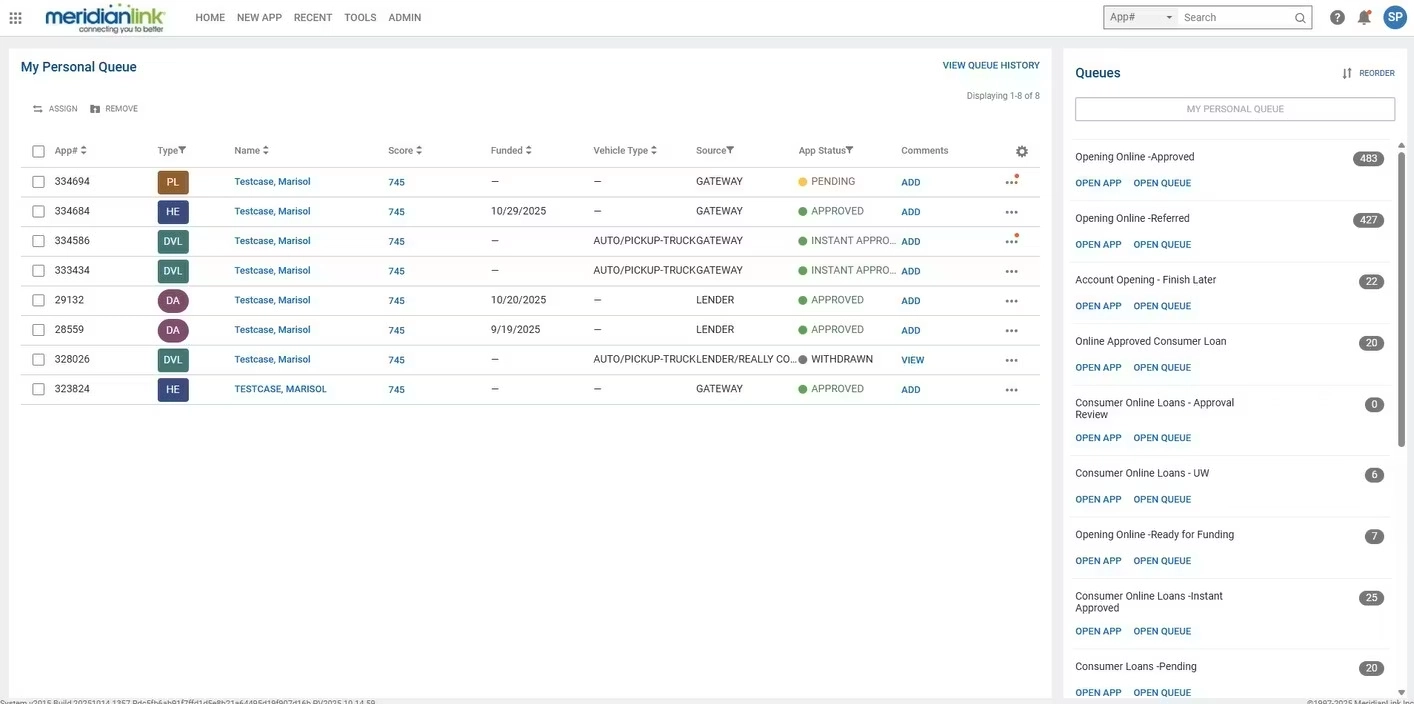
Sold as LoansPQ until MeridianLink renamed it, MeridianLink Consumer handles consumer origination for US banks and credit unions. Direct and indirect applications share one workflow and one automated decision engine. The product's scope ends at funding, when the loan syncs to the lender's core banking system, and MeridianLink sells collections as a separate product, MeridianLink Collect.
| Overview | |
|---|---|
| Best for | US community lenders, both banks and credit unions, with direct and indirect consumer lending |
| Markets | United States |
| Key clients | Bangor Savings Bank, MidFirst Bank, Campus USA Credit Union, Space Coast Credit Union |
| Consumer products covered | Personal and auto loans, HELOCs, credit cards, small business loans; indirect lending |
| Decisioning & data | Rules and visual logic trees drive automated underwriting; instant decisions with AI-assisted options (vendor description) |
| Compliance & audit trail | Built-in controls and an audit trail; fraud and identity checks run through partner integrations |
| Deployment | Cloud-based |
| Integrations & APIs | Several hundred partner connections; open APIs into core, digital banking and fintech systems |
| Implementation time | Not published; the vendor says timelines vary |
| Price | Annual base and platform partner fees plus a fee per consumer application, approved or declined, against a minimum revenue commitment (FY2024 annual report, Form 10-K); Capterra, Software Advice and GetApp list a $17,000 starting price without a consistent billing period; no public range |
| Free demo and trial | Demo booked through the vendor; no trial offered |
| What users say | 4.7/5 on Capterra (17 reviews) and 4.3/5 on G2 (34 reviews); one G2 reviewer called the interface clunky |
| Watch for | US only; declined applications are billed too, so cost follows application volume rather than funded loans |
Sources: meridianlink.com; MeridianLink FY2024 annual report (Form 10-K); Capterra; Software Advice; G2. Accurate as of November 2026.
nCino Consumer Lending: One Platform for Consumer, Commercial and Mortgage Lending
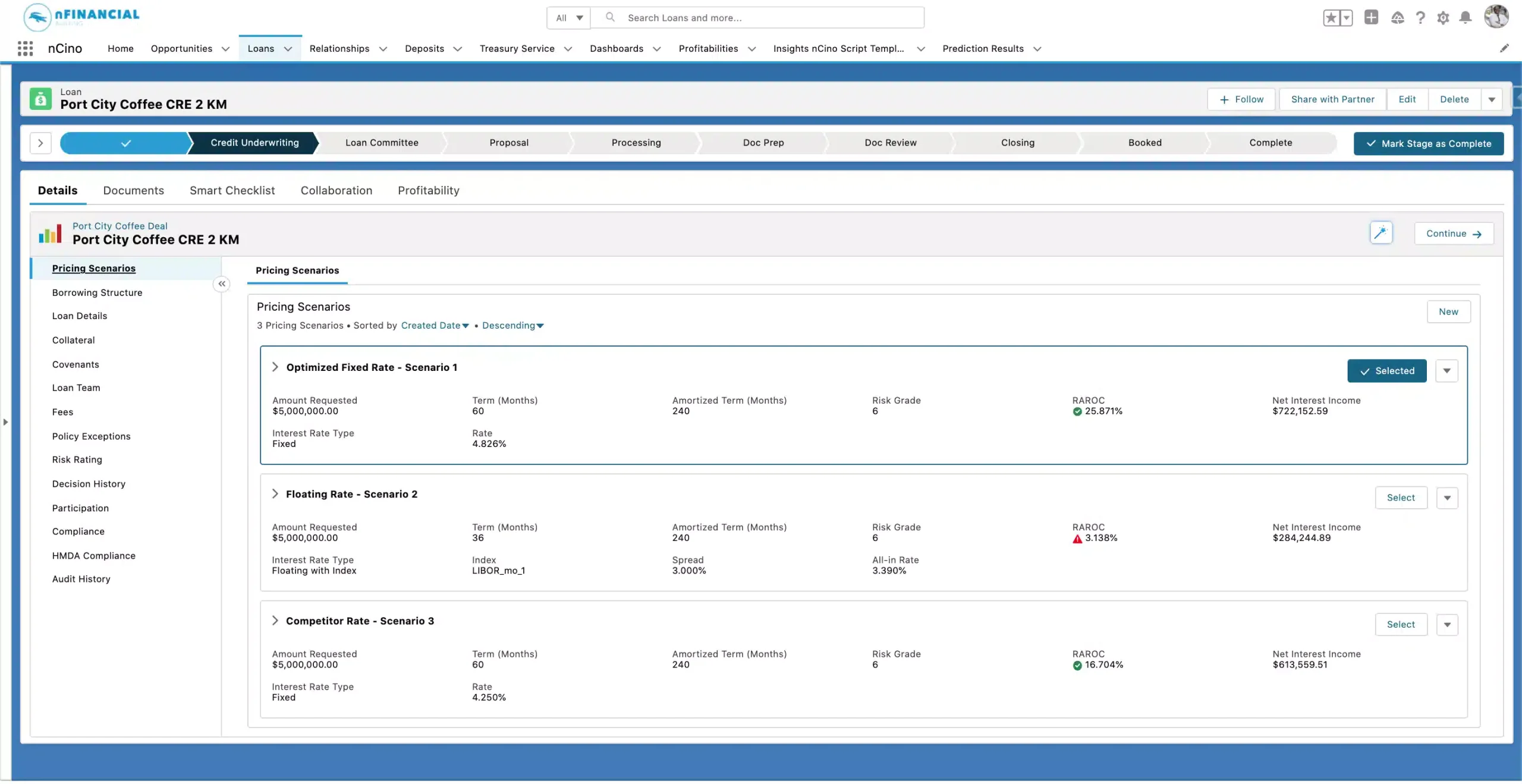
For nCino, consumer lending is one module of a bank platform that also handles commercial, small business, mortgage and indirect loans. Core parts of it sit on the Salesforce Platform. The lending workflow stops at funding and leaves servicing to other systems, while deposit account opening is available as a separate nCino solution on the same platform.
| Overview | |
|---|---|
| Best for | Banks and credit unions consolidating consumer, commercial and mortgage lending on a single platform |
| Markets | US, Canada, UK, Ireland, Australia, New Zealand and other markets |
| Key clients | U.S. Bank, Barclays, Santander, TD Bank, Summerland Bank (Australia) |
| Consumer products covered | Personal loans, credit cards, car loans, overdrafts; indirect auto lending |
| Decisioning & data | Product-level credit policies; real-time answers on dealer-originated auto applications; nCino says qualified consumer applications get approved within seconds |
| Compliance & audit trail | The vendor lists support for CECL, HMDA, TRID, fair lending and BSA/AML; audit trail kept for the full loan lifecycle |
| Deployment | SaaS; fundamental elements built on the Salesforce Platform |
| Integrations & APIs | Core and dealer platform connections (DealerTrack, RouteOne, AppOne); custom links through its Integration Gateway; headless APIs |
| Implementation time | Not published |
| Price | Subscription priced primarily on the asset size of the lines of business nCino supports, which replaced seat-based pricing in fiscal 2025; certain solutions include a Salesforce Platform subscription (FY2026 annual report, Form 10-K); Vendr lists about $56,700 per year, and a 2026 Moxo comparison estimates $50,000–$150,000+ per year |
| Free demo and trial | No free trial listed; demos through the sales team |
| What users say | 4.3/5 on Capterra (8 reviews), 4.2/5 on G2 (14 reviews) and 3.9/5 on Gartner Peer Insights (21 ratings), all for the nCino Cloud Banking Platform rather than consumer lending alone; one G2 reviewer found it versatile but heavy on customization |
| Watch for | Ask how the asset-based fee changes as your balance sheet grows and whether you will need Salesforce administration skills in-house; consumer is one of several product lines, so compare its depth with specialists |
Sources: ncino.com; nCino FY2026 annual report (Form 10-K); FF News; Vendr; Capterra; G2; Gartner Peer Insights. Accurate as of November 2026.
Temenos Onboarding and Origination: Account Opening and Lending From a Core Banking Vendor
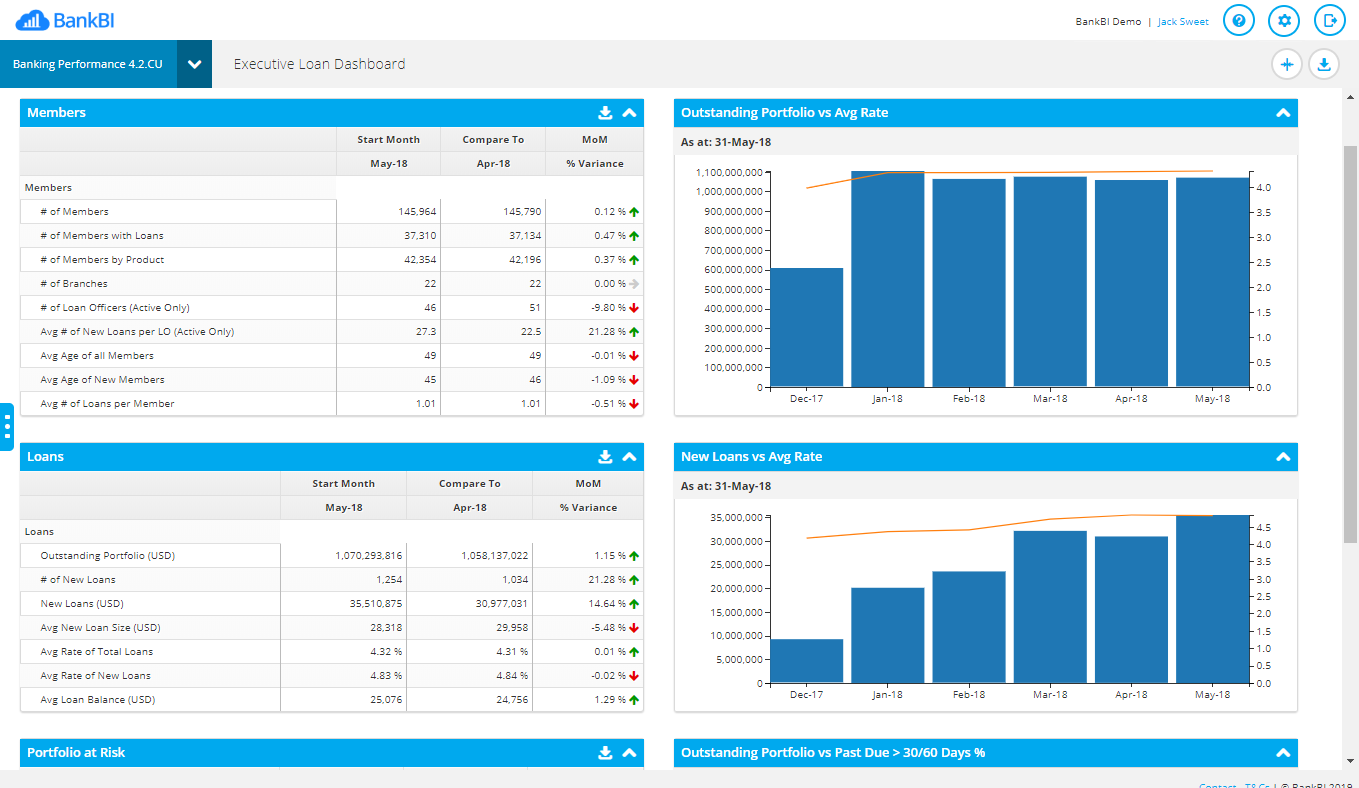
Temenos packages account opening and loan origination for consumers and small businesses as one product, delivered as Temenos SaaS. It descends from Temenos Infinity, a line built for North American banks and credit unions. The product ends once the account or loan is fulfilled; servicing and collections are not part of it.
| Overview | |
|---|---|
| Best for | Banks that want account opening and loan origination from their core banking vendor, delivered as SaaS |
| Markets | Sold through Temenos SaaS, which Temenos says runs in 30+ regulated jurisdictions; the consumer origination heritage is North American |
| Key clients | Stanford Federal Credit Union, Centris Federal Credit Union |
| Consumer products covered | Consumer and small business loans and accounts; the 2026 factsheet does not list specific loan types |
| Decisioning & data | Built-in rules and scoring for instant decisions; can call outsourced decision models |
| Compliance & audit trail | Automated checks and verifications (2026 factsheet); role-based data access and change limits by role and application status (earlier North American factsheet) |
| Deployment | Temenos SaaS; on-premises is not mentioned for this product |
| Integrations & APIs | Ready partner connectors plus open APIs for extensions |
| Implementation time | Not published; the factsheet credits configurable workflows with shortening new product launches |
| Price | Not published; we found no directory listing or third-party estimate for this product |
| Free demo and trial | Personalized demo on request; Temenos runs a sandbox for Temenos SaaS, but we found no free trial for this product |
| What users say | 4.5/5 on G2 for Temenos Infinity (13 reviews, mostly enterprise users, covering the wider digital banking suite); no Capterra or Gartner Peer Insights listing for this product |
| Watch for | SaaS only for this product; if your core is not Temenos, ask which integrations are already built for it |
Sources: temenos.com factsheets, product and success story pages; casestudies.com; G2. Accurate as of November 2026.
HES LoanBox: Configurable Consumer Origination With Deployment Choice
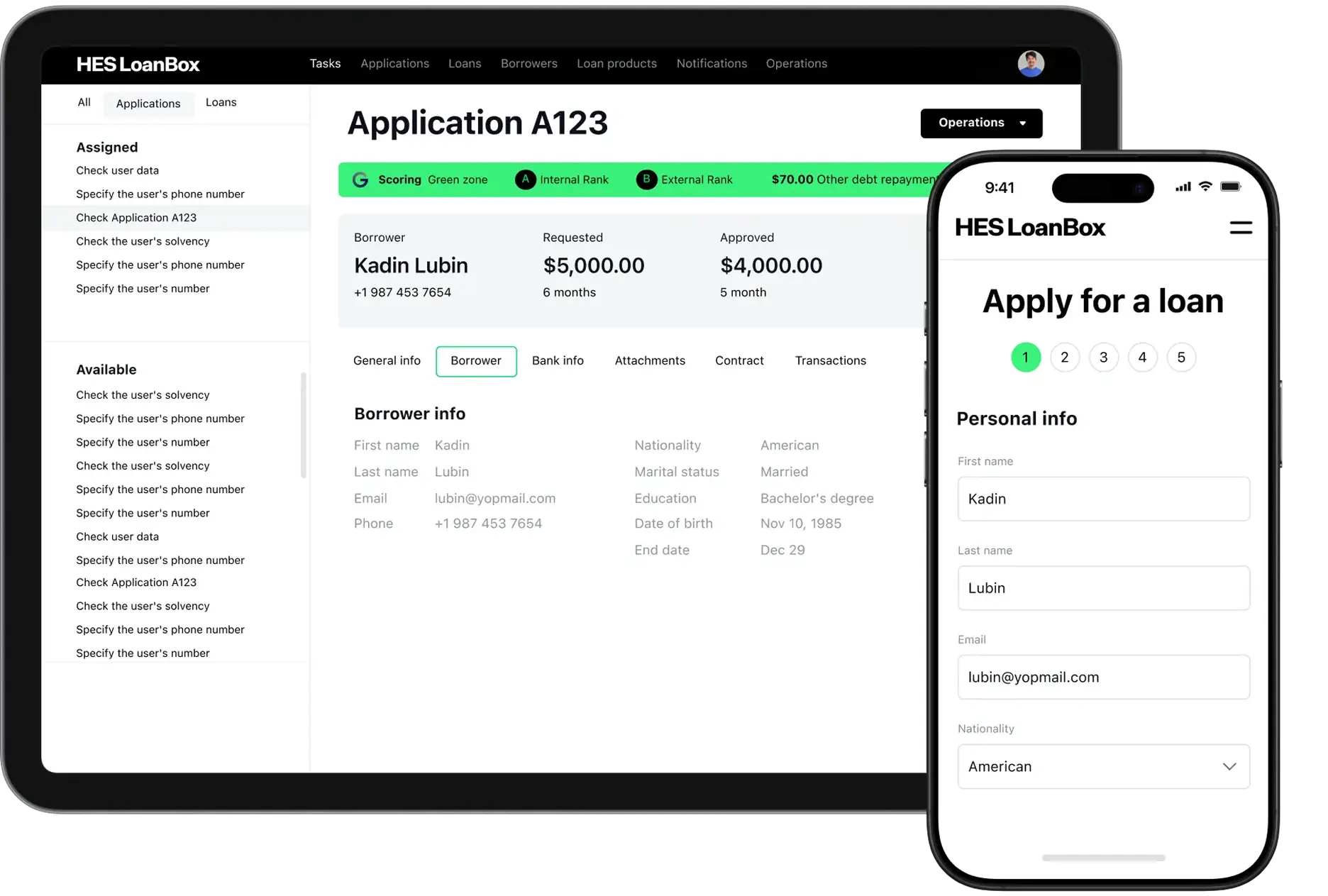
HES LoanBox puts origination, servicing, payments and collections in one modular system, and lenders set up products, application forms and workflows on their own. HES FinTech, the company behind it, was founded in 2012.
| Overview | |
|---|---|
| Best for | Mid-size banks and non-bank lenders that want a modular platform with products and workflows they configure themselves, a choice of hosting and no vendor lock-in |
| Markets | Deployed in 32 countries for 160+ businesses |
| Key clients | ID Finance (MoneyMan), Idea Bank, Wa'ed, Alraedah Finance, Fintuity, etc |
| Consumer products covered | HELOCs, auto loans, POS and BNPL, revolving credit, personal, installment and short-term loans |
| Decisioning & data | Rule-based decisioning in configurable decision tables; external scoring models can be added through customization; data connections include Equifax (US, Canada) and Plaid (North America, Europe) |
| Compliance & audit trail | Role-based access, 2FA, activity logs and encryption; KYC, KYB and sanctions screening through identity providers such as Ondato or Jumio; ISO 27001 certified; HES FinTech has completed an independent SOC 2 examination |
| Deployment | Cloud (AWS or Google Cloud), on-premises or hybrid; optional source code license |
| Integrations & APIs | API-first; 100+ integrations; open API to add the services a lender needs |
| Implementation time | Three months at the earliest; three to six months for most clients, longer for complex deployments. The Canadian lender went live in six months with custom requirements |
| Price | $40,000–$80,000 per year depending on scope, plus a one-time fee for customization; platform license with no per-user fees; optional fixed price based on an estimate HES FinTech puts at up to 95% accuracy |
| Free demo and trial | Demo by appointment; no free trial |
| What users say | 4.9/5 on Capterra (40 reviews), 4.9/5 on G2 (33 reviews) and 4.8/5 on the HES FinTech vendor page on Gartner Peer Insights; one G2 reviewer asked for more prebuilt integrations with fraud detection and open banking vendors |
| Watch for | The published integration list leans toward fintech data providers; US banks should confirm core banking connectivity during scoping |
Sources: hesfintech.com product, integration and client case pages; casestudies.com; Capterra; G2; Gartner Peer Insights. Accurate as of November 2026.
LoanPro: Origination for Fintech Lenders
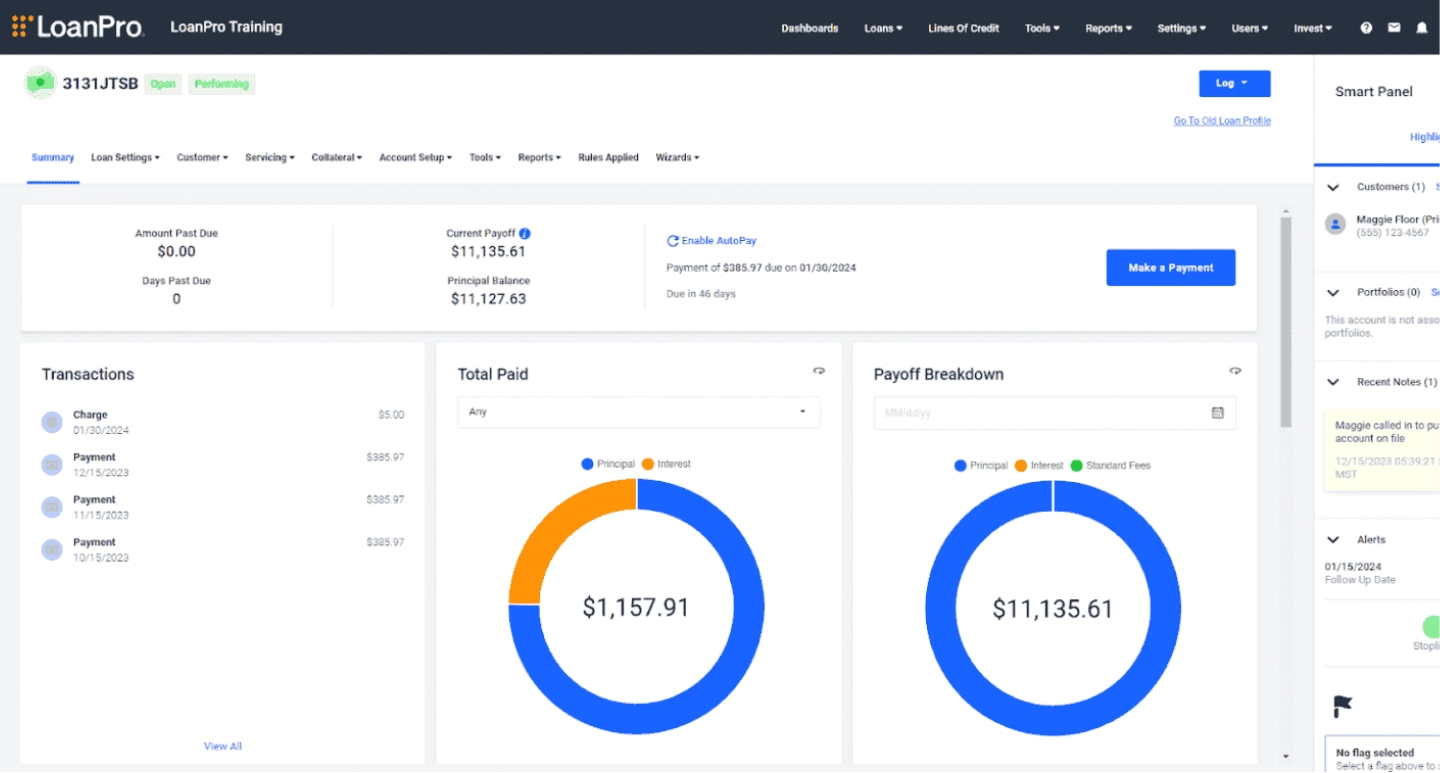
LoanPro builds its lending platform around a single core for the whole loan lifecycle. The Origination Suite takes an application from intake to funding, and the same core then services the loan, processes payments and runs collections.
| Overview | |
|---|---|
| Best for | US and Canadian lenders that build their own front end |
| Markets | US and Canada |
| Key clients | SoFi, Chime, Intuit, Best Egg, WaFd Bank |
| Consumer products covered | Installment and personal loans, credit lines, credit cards, auto loans, BNPL, healthcare financing |
| Decisioning & data | Webhooks can send new applications to an external decisioning platform; more than 100 native connections to credit bureaus, fraud tools and KYC providers (vendor figure) |
| Compliance & audit trail | TILA-compliant document generation; 50-state compliance in the servicing suite; PCI DSS Level 1 and SOC 2 (vendor description) |
| Deployment | Cloud-native platform |
| Integrations & APIs | Public API and 40+ webhooks; native support for Visa DPS, Lithic and Galileo |
| Implementation time | Four to eight weeks for simple deployments, three to six months for enterprise migrations (vendor figures) |
| Price | Monthly fee per billable account, mostly live loan accounts, plus a membership fee and usage fees (LoanPro billing documentation); rates are not published, and the package depends on account volume and support level; a 2026 Moxo comparison estimates $15,000–$75,000 per year |
| Free demo and trial | Personalized demo on request; no free trial or sandbox mentioned |
| What users say | 4.8/5 on Capterra (76 reviews, listed under loan servicing), 4.3/5 on G2 (38 reviews) and 4.0/5 on Gartner Peer Insights (3 ratings); one Capterra reviewer said it needed third-party providers and in-house work to match the sales pitch |
| Watch for | Plan for your own front end and, in many setups, an external decisioning tool; Visa's partner directory describes the platform as specializing in servicing |
Sources: loanpro.io; LoanPro developer docs and help center; Retail Banker International; Capterra; G2; Gartner Peer Insights; Visa partner directory. Accurate as of November 2026.
TurnKey Lender: Pre-Configured Consumer Lending for Smaller Non-Bank Lenders
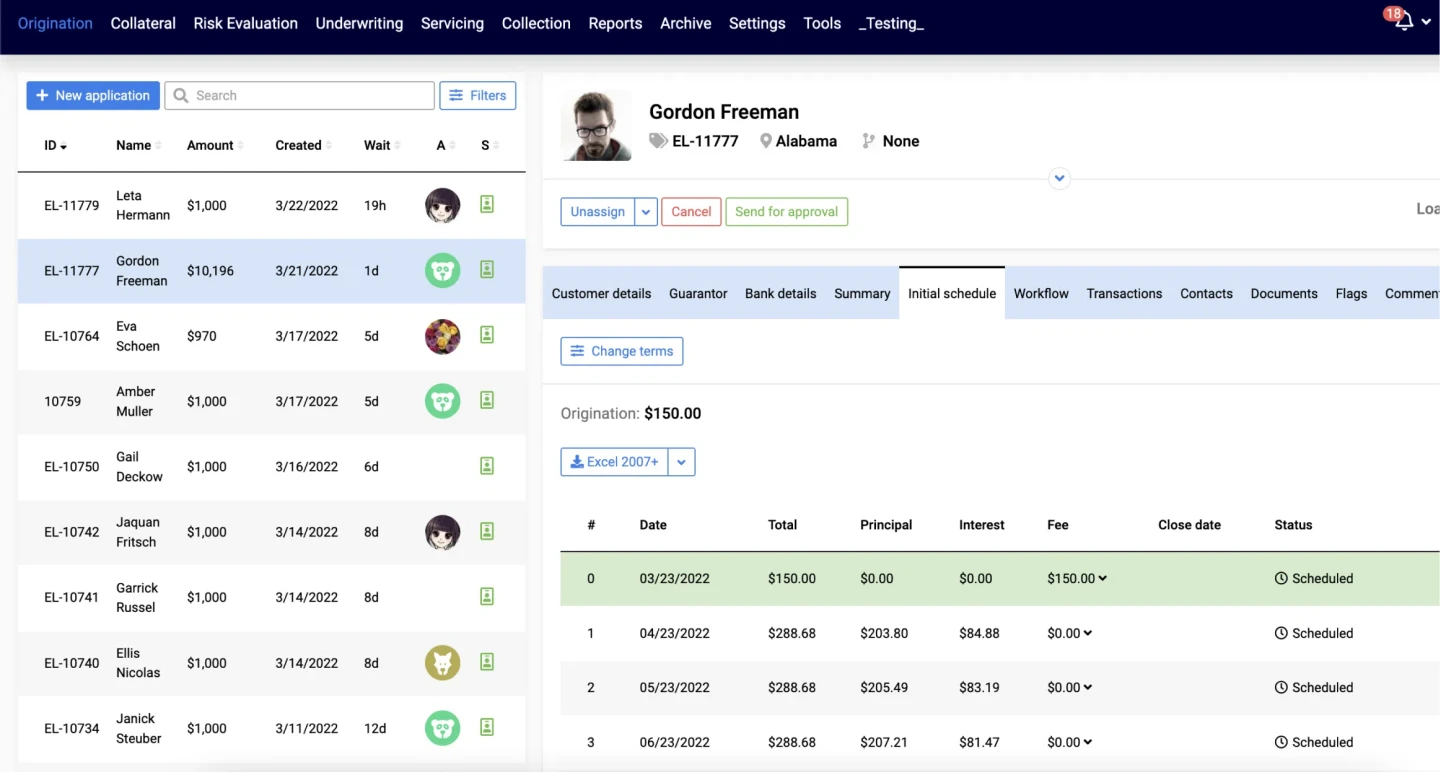
TurnKey Lender ships its cloud lending platform with consumer products already set up, from personal loans to medical credit. Scoring runs in TurnKey's own decision engine, and the same platform then handles servicing, scheduled repayment charges and collections.
| Overview | |
|---|---|
| Best for | Smaller non-bank lenders that want pre-configured consumer products and licensing tied to portfolio size |
| Markets | 50+ countries (vendor figure), including the US, UK, Ireland and Australia |
| Key clients | H&R Block, BigPay by AirAsia, Globe Telecom, National Iron Bank |
| Consumer products covered | Personal and payday loans, P2P, embedded and POS financing, BNPL, auto financing, credit cards and overdrafts, leasing, telecom and medical credit |
| Decisioning & data | Proprietary decision engine with AI-based scoring; lender-controlled criteria and rules; automatic or staff approval |
| Compliance & audit trail | Not itemized on the consumer product page |
| Deployment | Cloud-based SaaS |
| Integrations & APIs | API for front ends and data providers; preset connectors cover payments, a credit bureau and borrower messaging by SMS and email |
| Implementation time | The vendor says a new credit product can be launched in minutes; G2 reviewers report about two months on average |
| Price | Fees tied to the performance of the lender's loan portfolio; licensing options differ by portfolio size and modules (vendor description); a 2026 Moxo comparison estimates $20,000–$75,000 per year |
| Free demo and trial | Demo or intro call on request; no free trial on the vendor's site |
| What users say | 4.6/5 on Capterra (36 reviews), 4.7/5 on G2 (19 reviews) and 4.5/5 on Gartner Peer Insights (7 ratings); reviewers flag limits in document automation and advanced customization |
| Watch for | The vendor's own pages give different country counts (50+ and 58); test bespoke product logic before you sign |
Sources: turnkey-lender.com; Retail Banker International; G2; Capterra; Gartner Peer Insights. Accurate as of November 2026.
Other Consumer Loan Origination Systems to Consider
- FICO Origination Manager: consumer and small business origination from FICO; its originations page features case studies from UK lenders such as Vanquis Bank and Nationwide Building Society.
- LendFoundry: a cloud SaaS origination platform for alternative lenders, covering personal and auto loans with 80+ third-party connections.
- Fiserv and Jack Henry: consumer loan origination from two large US core banking providers, worth a look if your institution already runs one of their cores (Fiserv, Jack Henry).
Key Features to Look for in a Consumer Loan Origination System
A typical demo of consumer loan origination software walks through the application form and ends at an instant approval. Most of the differences between vendors show up after that point.
Start with the rules. Ask the vendor to change an approval cutoff during the demo, run the new rule against last month's applications and publish it, then note how long that took and who had to be in the room. If the answer involves a ticket to the vendor's developers, every regulatory change described above will follow the same path.
The rest of the checklist is more familiar:
- One intake for every channel. Web, mobile, branch, broker and point-of-sale applications go through the same rules, and borrowers can save and resume.
- Identity, sanctions and fraud checks inside the flow, with the results stored on the application rather than in a separate tool.
- Credit bureaus for every country you lend in, plus bank transaction data for affordability. Adding a new source should not require a rebuild.
- Pricing and offers from the same rules engine as the approval.
- Agreements generated per product and jurisdiction and signed through the e-signature provider you already use.
- An underwriter workspace with queues, referral reasons and a record of every manual decision.
- An exportable audit trail. Each decision carries the rule version, the data sources used and any override, so an auditor can replay it.
- A clean handoff to servicing, so funded loans are not re-keyed.
- References and volume limits. Ask for two reference customers with a similar product mix and market, and for the application volume the platform supports in the deployment option you plan to use.
How Much Does Consumer Loan Origination Software Cost?
Few vendors of consumer loan origination software publish list prices, and in our experience the pricing model affects the total more than the headline figure. Five models appear among the platforms in this comparison, and a sixth, per-seat pricing, is common in the wider loan origination market.
| Pricing model | How it works | Example | What to ask |
|---|---|---|---|
| Base fee plus per-application fees | Annual base and platform partner fees, then a fee for every consumer application, approved or declined, against a minimum revenue commitment; a higher commitment lowers the per-application rate | MeridianLink (FY2024 annual report, Form 10-K) | Size of the minimum, the per-application rate at your volume, how duplicate and declined applications are billed |
| Per-account pricing | A monthly fee for each billable account, mostly live loan accounts, plus a membership fee and usage fees; the per-account rate is set in the contract | LoanPro (billing documentation) | How billable accounts are counted, the rate at your volume, which usage fees apply |
| Asset-based subscription | Fee follows the assets of the lines of business the platform supports; nCino moved to this from seat-based pricing in fiscal 2025, and certain solutions include a Salesforce Platform subscription | nCino (FY2026 annual report, Form 10-K) | Which assets count, how the fee moves as the balance sheet grows, how the Salesforce layer renews |
| Portfolio-based licensing | Several licensing options keyed to portfolio size and the modules a lender switches on | TurnKey Lender (vendor FAQ) | How the price changes at each portfolio threshold |
| Platform license without per-user fees | Scope-based license with no charge per user or per borrower | HES LoanBox | Which modules the license covers and which work is quoted separately |
| Per-user subscription | Monthly fee per seat | LendingWise, $149 per user per month on Software Advice | Cost at your headcount in year three |
Public price points are scarce. HES LoanBox costs $40,000 to $80,000 per year, depending on scope, plus a one-time fee for customization.
For the other five platforms, the closest figures come from directories and third-party estimates. Directory listings start MeridianLink Consumer at $17,000, and Vendr puts nCino at about $56,700 per year. A July 2026 comparison by Moxo estimates $50,000 to $150,000+ per year for nCino, $15,000 to $75,000 for LoanPro and $20,000 to $75,000 for TurnKey Lender, without naming its data source. We found no public figure for Temenos Onboarding and Origination, and none of the five competitors publishes a price list on its website.
License fees are only part of the total cost. Budgets also need room for implementation and configuration services and for per-use fees from credit bureaus, identity checks and e-signature providers. Data migration from the old system, change requests after go-live and, if you host the platform yourself, infrastructure add to that. The most useful figure to ask each vendor for is a three-year total at your expected application volume, with third-party data costs included.
Consumer Loan Origination Features That Matter Most in 2026–2027
The rules covered earlier point to five capabilities in consumer loan origination software that we would weigh above the baseline checklist.
Under CCD2, a borrower can ask for a person to look at an automated creditworthiness assessment. The platform then has to send that case to a reviewer together with the reasons behind the original decision, in a form the reviewer can act on.
Affordability checks need more than a bureau score. The FCA now expects proportionate affordability checks for Deferred Payment Credit, and CCD2 tightens creditworthiness assessment in the EU, so bank transaction data has to reach the decision.
Lenders active in more than one market need a separate rule set for each. EU member states are transposing CCD2 on different timelines and with different national options, UK and US rules differ again, and one platform should hold all of these without forking the codebase. Data sources need the same freedom: in the US, the Section 1033 rewrite may change the cost and terms of consumer data access, which argues against tying decisioning to one aggregator.
From December 2, 2027, AI Act obligations apply to high-risk AI systems used in credit assessment. The required documentation starts with a record of which rule or model version produced each decision, so both need version control.
Finally, the channels. Fintechs now originate close to half of US unsecured personal loans and BNPL lending is regulated in the UK, so checkout and embedded flows need the same decision logic as the lender's own website.
Loan Origination Software vs. Loan Management and Loan Servicing Software
Vendors use these terms loosely, so it helps to separate the stages before comparing products.
| Loan origination software | Loan servicing software | Loan management system | |
|---|---|---|---|
| Covers | Application, checks, decision, offer, signing, funding | Repayment schedules, payments, statements, arrears, payoff | Usually the full lifecycle: origination plus servicing, often collections |
| Main users | Credit officers, underwriters, sales and digital teams | Operations, finance, collections | All of the above |
| Core data | Applicant data, bureau and bank data, decision reasons | Balances, transactions, delinquency status | Both, in one record |
Look first at whether origination and servicing share one data model. When they do not, every funded loan crosses an integration between two systems, and that handoff can become a source of data errors and reconciliation work. HES LoanBox, LoanPro and TurnKey Lender run both stages in one platform. With bank-focused systems, ask where funded loans are serviced and how they get there.
FAQ
What is a fair price for consumer loan origination software?
There is no single fair figure, because vendors charge by license, application or account volume, asset or portfolio size, or seat. A fair price is one you can predict: a three-year total at your expected application volume, including minimums, overage rates and third-party data fees. Ask every shortlisted vendor to quote the same volume scenario, then compare totals rather than starting prices.
Which integrations does a consumer loan origination system need?
At minimum: the credit bureaus in each market you lend in, identity and sanctions screening, bank transaction data for affordability, e-signature, a payment or disbursement provider, notifications by SMS and email, and your servicing system or core. Check how the vendor adds a new provider, because your list will change over time.
How can you check whether a loan origination platform will keep you compliant?
Compliance stays the lender's responsibility; the platform's part is to keep the evidence. Ask for a decision log that shows rule versions and data sources, a route for human review of automated decisions, configurable data retention, and security evidence such as an ISO 27001 certificate or a SOC 2 report. Then replay a few test applications and check that an auditor could follow each decision.
What are the common pitfalls when choosing loan origination software?
The most common one is choosing on a feature list instead of a timed demo of rule changes. Others: underestimating integrations and data migration, signing pricing that looks cheap at today's volume, accepting rules that only the vendor can change, and having no exit plan for your data. We would add skipping reference calls with lenders in your own market.
How long does it take to implement a loan origination system?
Nobody publishes a reliable industry average. LoanPro quotes four to eight weeks for simple deployments and three to six months for enterprise migrations, and G2 reviewers of TurnKey Lender report about two months. For HES LoanBox, projects start from three months, most clients go live in three to six months, and the Canadian BNPL and consumer lender mentioned above went live in six with custom requirements. Integrations and data migration usually set the pace.
Is consumer loan origination software different from bank loan origination software?
Consumer loan origination software and bank loan origination software overlap, but the terms describe different things. "Consumer" refers to the loan types: personal, auto, cards, BNPL. "Bank" refers to the buyer, and bank systems add core banking connections, branch workflows and deposit cross-sell. MeridianLink, nCino and Temenos are built around banks and credit unions; HES LoanBox, LoanPro and TurnKey Lender also serve non-bank lenders.