
![Top 10 Commercial Loan Underwriting Software [2026]](https://hesfintech.com/wp-content/uploads/2025/10/blog_Top-9-Commercial-Loan-Underwriting-Software-1.webp)
Commercial loan underwriting software has become a cornerstone of modern lending. Fintech businesses, banks, credit unions, and other financial institutions are turning to these platforms to handle the growing volume and complexity of business loan applications.
Given the convenience and multiple benefits of these systems, it’s no surprise that their adoption is accelerating. The global commercial loan software market is projected to reach $16.9 billion by 2034, which reflects how essential these tools have become in the underwriting process.
Still, with so many vendors and products available, finding the right underwriting platform for your business can be challenging.
To make the process easier and help you make an informed decision, we’ve evaluated the best business loan underwriting platform solutions for 2026 and zeroed in on their key features, strengths, and weaknesses.
Read on for our picks and a practical guide to choosing the tool that best fits your team’s needs and goals.
Key Takeaways
- Commercial loan underwriting software varies in both operational depth and features. Some platforms automate specific underwriting tasks, while others manage the full lending process, offering customizable decision-making, system integration, reporting, compliance, and ongoing support.
- The value of these platforms lies in the business outcomes they help unlock: faster underwriting, fewer manual errors, stronger process consistency, better visibility into borrower risk, and a smoother path to scale.
- Rather than focusing only on product claims, this article provides a side-by-side comparison of the top loan underwriting platforms to help readers understand which capabilities matter most, where the leading platforms differ in practice, and which solutions may be better aligned with the realities of commercial lending operations.
How We Approached This Rating
To create this list, we reviewed a wide range of commercial loan underwriting software providers using publicly available sources: product documentation, vendor websites, case studies, and user feedback from trusted review platforms.
In our evaluation, we considered several key areas: ability to support different types of commercial lending products, underwriting capabilities, supported products, flexibility of risk models, level of automation, scalability, modularity, and integration options with core systems.
What Is Commercial Loan Underwriting Software?
Commercial loan underwriting software is a platform that empowers financial institutions to assess, evaluate, and manage business loan applications with greater precision and efficiency.
Beyond replacing manual reviews and paperwork, it introduces automation, advanced data analysis, and smarter workflow management that reduces manual effort. The result is fewer errors in the lending process, improved consistency, and accelerated credit decisioning.
Where possible, we cross-referenced vendor claims with real customer experiences. However, since capabilities can vary depending on configuration, region, and deployment model, this ranking should be viewed as a structured market overview rather than a definitive benchmark.

Typically, a leading automated commercial underwriting tool covers the full lending lifecycle and supports tasks such as:
- Loan origination and application intake—collecting borrower information and structuring applications for review
- Automated credit scoring and risk assessment—analyzing credit data to assess borrower reliability
- Document ingestion and data extraction—digitizing, organizing, and validating large volumes of loan documents
- Collateral and covenant management—tracking pledged assets and borrower obligations
- Regulatory compliance and audit trails—maintaining records and workflows in line with legal and industry requirements
- Portfolio monitoring and loan servicing—overseeing loan performance, repayments, and ongoing borrower relationships
Loan Underwriting Solutions: Comparison Table
| Platform | Key strengths | Scalability | Modularity | Flexibility | Product breadth |
|---|---|---|---|---|---|
| HES LoanBox | Modularity and configuration flexibility, end-to-end automation | Strong | Excellent | Excellent | Strong |
| nCino | Designed for long-term extensibility | Strong | Strong | Strong | Excellent |
| Kolena | Configurable AI agents for underwriting and document-heavy workflows | Strong | Strong | Strong | Strong |
| TurnKey Lender | End-to-end automation, configurable workflows and credit policies | Strong | Strong | Strong | Strong |
| MeridianLink | Strong for underwriting + credit risk + compliance-heavy banking workflows | Strong | Medium-strong | Strong | Strong |
| Abrigo | Strong for underwriting + credit risk + compliance-heavy banking workflow | Strong | Medium-strong | Strong | Strong |
| LendingPad | Strong UX-led mortgage LOS | Medium-strong | Medium | Medium | Medium |
| Calyx by Path | Practical mortgage LOS option | Medium | Medium | Medium | Medium |
| Fundingo | Attractive if your organization is deeply Salesforce-centric | Medium | Medium-strong | Strong | Medium-strong |
| Flinks | Outstanding underwriting data infrastructure | Strong | Strong | Strong | Narrow for full LOS |
Top 10 Commercial Loan Underwriting Software: Deep Dive
1. HES LoanBox by HES FinTech
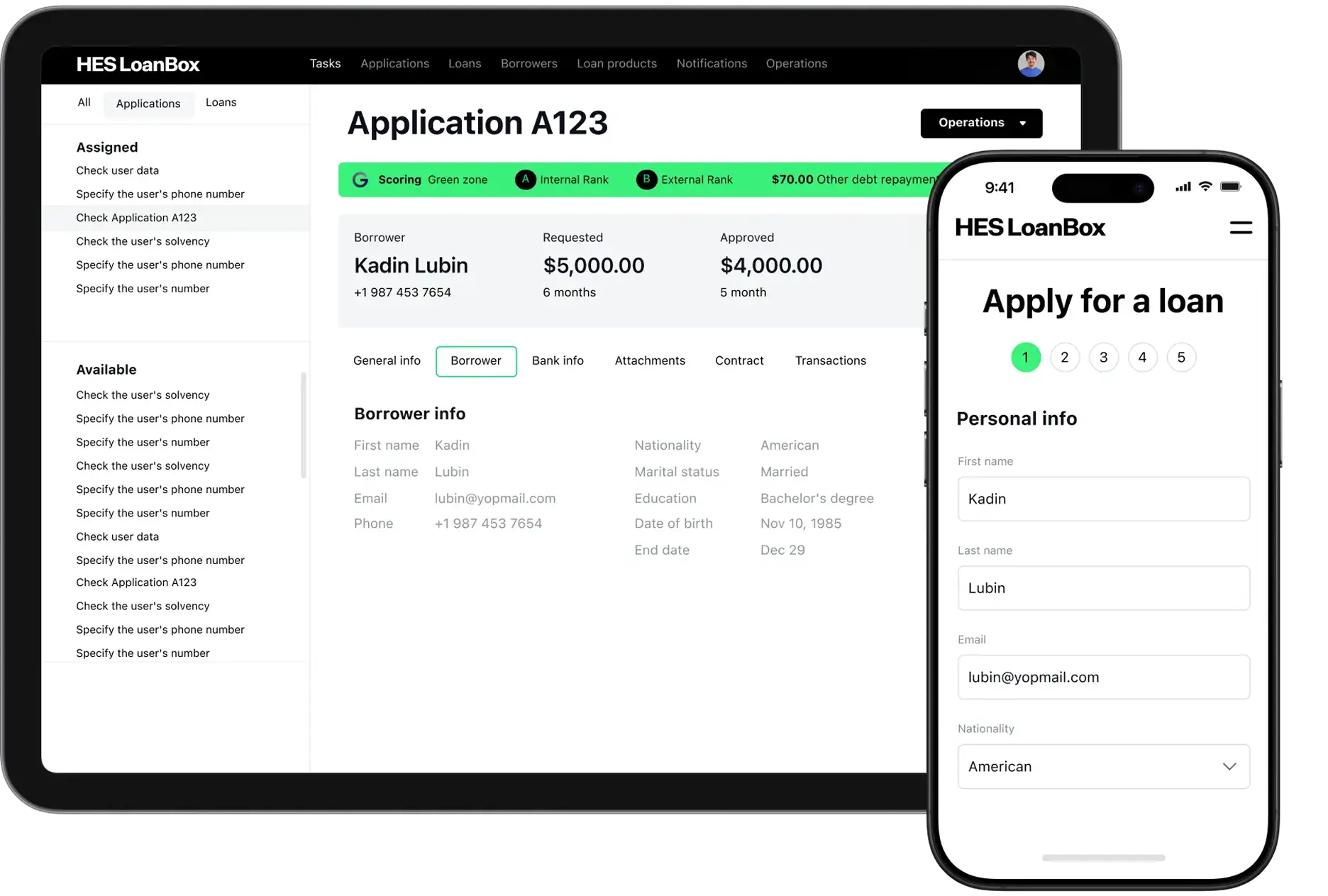
HES FinTech offers white-label commercial loan software built on over 20 modular components covering the entire lifecycle, from loan origination to repayment and collections.
The HES LoanBox platform is designed for a wide range of lenders, from fintech firms and non-bank institutions to large banks, and can be configured to fit different business models and regulatory environments across multiple regions.
Its sophisticated features such as automated loan processing and decisioning, AI-powered underwriting, role-based access, and robust reporting with BI integrations streamline operations, reduce risks, and provide actionable insights for more efficient underwriting.
Key Features and Functionalities:
- AI-based credit scoring and transparent AI credit decisioning accelerate risk evaluation, shorten decision times, and ensure explainable outcomes for regulatory compliance.
- Flexible integration options and robust API management allow businesses to easily connect with banks, payment providers, CRMs, and other systems while maintaining complete control over data flows.
- Comprehensive fraud prevention and security enhance protection through KYB/AML checks, biometric verification, OWASP-compliant infrastructure, and ISO 27001 certified development.
- Highly configurable workflows and product engine adapt the platform to businesses' unique lending processes with quick product creation and rule-based automation.
- Dedicated borrower portal offers clients full transparency, self-service capabilities, and a smoother loan experience throughout the entire lifecycle.
- Unified back-office platform includes task management dashboard, automated decision-making, calculation engine, scoring system, user roles management, and advanced BI tools.
- Multi-region compliance support ensures adherence to GDPR, CCPA, PIPEDA, UK DPA, and other regional regulations.
Pros:
- Rapid deployment (≈3 months) with out-of-the-box functionality and minimal disruption
- Highly customizable to fit diverse lending models across consumer and commercial lending
- Strong automation capabilities (up to 90%) minimize manual intervention and operational costs
- Robust advanced reporting and analytics with BI integrations enable data-driven decisions
- Scalable modular architecture supports varied loan volumes and quick product creation without system overhauls
- Enterprise-grade security with ISO 27001 certification and GDPR compliance built-in
- Flexible deployment options: cloud, on-premise, or hybrid based on your security requirements
- No vendor lock-in: The Code Development License available for complete ownership and control over source code
Cons:
- Initial setup may require technical expertise for optimal configuration of advanced features
- Advanced reporting and BI tools may have a learning curve for new users
- Integration with certain legacy or regional systems may require additional customization
Overall rating: 4.8/5
👉 Explore HES LoanBox Solution
2. nCino
nCino is a Salesforce-native cloud banking platform for commercial, consumer, onboarding, portfolio monitoring, and compliance workflows. Its commercial lending operating system unifies onboarding, loan origination, and compliance within a single system.
By bringing borrowers, front-line staff, and back-office teams onto one platform, nCino helps institutions reduce redundancies and accelerate credit decisioning.
Key Features and Functionalities:
- Client Lifecycle Management (CLM) supports KYB, KYC, AML, fraud checks, and full audit trails.
- Integration Gateway connects 14+ core banking platforms and 50+ financial services solutions out of the box.
- Consumer Banking solution supports omnichannel onboarding, digital-first applications, and configurable retail loan origination workflows.
- An integrated document repository can incorporate all the business's policies and provide a visual audit trail for auditors and teammates.
- The deal management features help access and manage overall deals of clients' loan and treasury products in real time.
- Automated workflow tools streamline approvals, documentation, and compliance checks, reducing bottlenecks in multi-step processes.
- Real-time reporting and early warning indicators provide better portfolio performance tracking and portfolio management.
Pros:
- End-to-end workflow automation reduces duplication of effort and minimizes loan processing delays
- Automates pre-qualifications and credit approvals based on the institution's policy rules
- Strong compliance and audit-trail features support effective risk management
- Identifies parameters where a loan should be automatically approved, declined, or flagged for manual review
Cons:
- The approval process can become cumbersome when technical issues arise, as reported by some users
- Flexibility and customization are more limited compared to standalone systems, which can frustrate loan officers
- Expanding certain product modules can be slower than expected for specific industries
Overall rating: 4.3/5
3. Kolena
Kolena is an AI-powered underwriting automation platform that differs from traditional loan origination systems by focusing on configurable AI agents for underwriting and document-heavy workflows. Rather than offering a rigid LOS, Kolena enables lenders to build custom underwriting agents using natural language instructions, tailored to their policies and risk models.
Designed for financial institutions, real estate firms, and enterprise teams handling complex loan packages, Kolena excels at extracting, validating, and analyzing unstructured data from documents such as pay stubs, bank statements, and contracts, turning them into structured, decision-ready insights.
Its transparent, citation-backed AI outputs and strong document automation capabilities make it especially valuable for organizations looking to reduce manual underwriting effort while maintaining auditability and compliance.
Key Features and Functionalities:
- AI underwriting agents can be created using natural language instructions, allowing teams to define credit policies, risk checks, and workflows without heavy coding.
- Automated document extraction and analysis leverage OCR and AI to process complex financial documents, including PDFs, scans, and emails, with high accuracy.
- Built-in validation and discrepancy detection identify inconsistencies across borrower documents and flag risks early in the underwriting process.
- End-to-end workflow automation handles intake, data extraction, reasoning, and report generation, reducing manual review time significantly.
- Transparent AI outputs provide reasoning, citations, and confidence scores for every decision, ensuring audit-ready compliance and explainability.
- Seamless integrations connect with cloud storage, CRMs, and internal systems to automate data ingestion and synchronize workflows.
Pros:
- Highly flexible AI-driven underwriting allows customization without extensive development
- Strong document automation capabilities significantly reduce manual processing time
- Transparent, explainable AI outputs support compliance and audit requirements
- Fast deployment with pre-built agents and minimal setup time
- Handles unstructured data effectively, improving underwriting accuracy
Cons:
- Not a full end-to-end loan origination system like traditional LOS platforms
- May require process redesign to fully leverage AI-agent-based workflows
- Less focused on front-office borrower experience compared to some competitors
Overall rating: no rating so far.
4. TurnKey Lender
Key Features and Functionalities:
- AI-driven underwriting and decision-making use both regular and alternative data to automatically score credit, assess risk, and approve loans based on adjustable lending rules.
- End-to-end lending lifecycle automation supports application intake, borrower evaluation, loan origination, underwriting, servicing, collecting payments, and reporting all in one place.
- Configurable workflows and credit rules give lenders the ability to customize underwriting logic, approval hierarchies, and product parameters without having to do a lot of development.
- Alternative data integration and scoring allow lenders integrate alternative data to evaluate borrowers with little credit history.
- Tools for portfolio monitoring and reporting give lenders real-time information about how loans are doing, how underwriting is going, and how risky your portfolio is.
Pros:
- End-to-end automation reduces manual effort and accelerates underwriting and decision-making processes.
- Strong AI-driven decisioning capabilities support more accurate risk assessment and improved approval rates.
- Flexible configuration options allow lenders to adapt workflows and credit policies to different products and markets.
- Supports both consumer and commercial lending use cases within a unified platform.
Cons:
- Platform breadth may result in longer implementation and configuration timelines compared to point solutions.
- Public documentation provides limited transparency on enterprise-grade security certifications compared to some competitors.
- Customization flexibility may require technical expertise to fully leverage advanced capabilities.
Overall rating: 4.6/5
5. MeridianLink
MeridianLink's solution offers a configurable loan origination platform.
With over 1,000 configuration points, hundreds of third-party integrations, a robust underwriting and pricing engine, and support for a full suite of loan products, the platform adapts to varied workflows while allowing for efficient and consistent loan processing.
Key Features and Functionalities:
- A single loan origination platform centralizes all loan processes for efficiency and consistency.
- Web-based SaaS delivery with frequent updates ensures compliance and reliable performance.
- Digital document collection and review
- Smart decisioning engine powers automated pre-approvals, decisioning rules, and configurable underwriting flows.
- Digital borrower platform expands reach by letting borrowers open accounts online, improving acquisition and onboarding.
- Multi-channel digital intake centralizes applications from online, mobile, branch, and indirect channels into one workflow.
- Data reporting functionalities deliver actionable insights to optimize lending operations and inform strategic decisions.
- High ecosystem connectivity thanks to the partner network for AI, identity verification, fraud protection, and consumer engagement.
Pros:
- Robust underwriting and pricing engine streamlines decision-making while reducing risk and errors
- Smart decisioning algorithms leverage extensive data points to accelerate approvals and improve accuracy
- Modular yet integrated, allowing institutions to connect other vendors' products into a single platform
Cons:
- New users may require time to get comfortable with the system
- Customization and integration can be complex, requiring extra technical support
- Full implementation may be challenging due to the platform's breadth of functionality
Overall rating: 4.8/5
6. Abrigo
Abrigo provides an integrated credit risk and loan management solution that optimizes the entire lending lifecycle, from underwriting to closing, for banks and credit unions. Commercial credit analysis, small business lending, and credit defensibility are the key activities to implement with this solution.
With one-time data entry, automated credit spreading, risk rating, and servicing, the platform minimizes delays, enforces consistent policy application, and improves team collaboration.
Key Features and Functionalities:
- Credit analysis features help lenders spread and analyze proposed loans quickly, reduce manual processes, and improve documentation.
- Small business lending software standardizes credit analysis, risk rating, and approval workflows within a single platform.
- Lending Assistant leverages generative AI to generate credit narratives faster, validate documents, and extract key data from unstructured files.
- Portfolio risk suite includes several Current Expected Credit Loss (CECL) models, adds-on, and advisory support.
- Asset/liability management (ALM modeling) supports balance-sheet risk and profitability analysis.
Pros:
- Helps make informed decisions that capture the true cost of making a loan
- Built-in tools help institutions stay compliant with evolving regulations
- Risk- and target-based pricing scenarios, coupled with key benchmarks, help validate the loan-pricing strategy
- Access to expert support ensures guidance and troubleshooting when needed
- Abrigo offers additional financial crime monitoring via AML/BSA and fraud tools.
Cons:
- New users may face a learning curve with some of the platform's advanced features
- Some workflows and navigation elements can feel unintuitive
- Customization of user roles and permissions is limited in certain areas
Overall rating: 4.6/5
7. LendingPad
LendingPad is a comprehensive lending solution mostly focusing on mortgage LOS for lenders, banks, and credit unions.
Its Lender Edition expands capabilities with features like automated underwriting, customized pricing and eligibility rules, real-time pipeline monitoring, and unlimited user management.
Key Features and Functionalities:
- Simultaneous multi-user processing and cross-department workflow support lender operations, fulfillment, and third-party channel teams work in parallel.
- Built-in compliance support tools help lenders stay aligned with regulatory requirements.
- Real-time pipeline monitoring provides lenders with current visibility into loan flow across channels.
- Customizable workflows and configurations let lenders adapt LendingPad to internal processes without replacing the core LOS.
- Dedicated server resources, performance monitoring, SLAs, and data transfer/migration support for scalability and operational continuity.
Pros:
- Dedicated servers and performance monitoring help maintain fast and reliable platform performance for uninterrupted lending operations
- Cloud accessibility enables users to access the platform from anywhere
- Flexible and customizable workflows let lenders grow without needing major system overhauls
- Insightful oversight provides actionable visibility into loan pipelines and team performance
Cons:
- The platform appears more specialized in mortgage lending than around broad commercial lending operations.
- Some aspects of the platform may feel unintuitive, especially for new users navigating complex workflows
- Repetitive data entry can be required for certain fields, which may slow down application processing
- Initial setup and configuration can be time-consuming due to workflow customization requirements
Overall rating: 4.7/5
8. Calyx by Path
Calyx by Path is an enterprise-level, cloud-based loan origination system designed to maximize production, mitigate risk, and automate compliance. It primarily focuses on mortgage lending operations.
With customizable workflows, agile compliance tools, and scalable technology, it streamlines the underwriting process while helping lenders maintain high borrower satisfaction
Key Features and Functionalities:
- Built-in point-of-sale lets borrowers start their application through a secure and mobile-friendly portal.
- Advanced API access empowers smooth connections to other systems and enables data to move effortlessly where it's needed.
- Color-coded pipeline gives teams a clear visibility into loan status and workflow progression.
- Agile compliance tools (Advanced Compliance Summary Screen, audit trails, fee history tracking, and rules engine capabilities embed policy checks and rules directly into workflows.
Pros:
- The system lets businesses customize fields and workflows on demand, giving teams control without waiting on developers.
- Built-in POS and cloud delivery strengthen borrower intake and platform accessibility.
- An intuitive interface enables teams to pick it up quickly and focus on closing loans rather than extended training.
- Strong compliance tooling helps reduce manual steps and keep deals moving.
- Cloud performance and configurability combine for a platform that grows with lending needs.
Cons:
- While the interface is clean, first-time users may need some time to understand the deeper customization options
- A few integrations may require manual adjustments when data mapping may not align perfectly, adding extra workload
- There's a library of tutorials, but some users wish for more hands-on onboarding or richer documentation
Overall rating: 3.8/5
9. FUNDINGO
Fundingo takes the friction out of loan processing by bringing all data, workflows, and decisioning into one environment.
It's built to replace scattered spreadsheets and emails with an organized, automated system that helps lenders move faster while keeping accuracy and compliance intact.
Key Features and Functionalities:
- The centralized loan hub gives staff one reliable place to find and manage every detail of an application.
- The Offer Wizard and Pricing Matrix automatically generate borrower-specific pricing and term options aligned with lender policies.
- Credit and data integrations connect directly to third-party providers, allowing quick pulls of reports and statements.
- Intelligent routing directs applications to the most suitable underwriters, balancing risk profiles and team expertise.
- Application completeness checks scan submissions for missing items and request them from applicants without manual intervention.
Pros:
- Teams appreciate the efficiency gains from consolidating information into one platform
- Automated offer generation and routing features cut down on repetitive tasks for underwriters
- Applicants benefit from a smoother experience with fewer delays caused by missing or incomplete data
- Strong integrations with outside data providers reduce verification bottlenecks.
Cons:
- The user interface, while functional, could be more intuitive in places
- Rolling out new features may take time, given the shared environment and update cycles
- Reporting options could be expanded for teams that want deeper customization
Overall rating: 4.5/5
10. Flinks
Flinks is an embedded finance and financial data infrastructure platform built around connectivity, enrichment/intelligence, document processing, and payments. It provides a secure platform that streamlines the commercial loan underwriting process with automated gathering, standardizing, and enriching borrowers' financial statements and banking data, making it easy for lenders to interpret and act on.
Key Features and Functionalities:
- Advanced document fraud detection uses AI to flag and interpret tampered documents, thus speeding up reviews and reducing risk.
- Income and employment verification automates validation of earnings across all employment types, cutting processing time and lowering default risk.
- Multi-source data ingestion is possible not only with aggregated bank data via Flinks Connect, but also with verified uploaded documents and CSV/JSON files from external providers such as Plaid, transforming raw banking data into actionable insights.
- Cash-flow trend analysis can help process up to 12 months of transaction history, categorize income sources, expenses, liabilities, and fees, and surface insights such as income consistency, balance trends, days with negative balances, and loan breakdowns.
- Integrated reporting features make it possible to access detailed lending reports through the dashboard or API for CRM, LMS, or LOS.
- No-code dashboard access enables customers who are not API-ready to explore financial insights in depth.
Pros:
- Provides real-time financial data from 4500+ institutions to connect from
- Data enrichment engine (Flinks Enrich) delivers deep borrower insights (over 6,000 attributes), enhancing risk models and decision accuracy
- Sophisticated fraud controls, including AI-backed document validation, minimize manual effort and onboarding risk
- Innovative payment handling improves conversion and borrower experience
Cons:
- Generating specific reports can sometimes be challenging and require careful setup to get the most accurate insights
- The reliance on bank screen-scraping may occasionally result in incomplete or slightly inconsistent data
- Some users have noted minor usability hurdles when navigating certain workflows
- While coverage of Canadian financial institutions is strong, the list of supported banks and credit unions is still somewhat limited
Overall rating: 4.4/5
What Are the Benefits of Commercial Loan Underwriting Software?
The benefits of a commercial underwriting software solution extend far beyond process automation.
At its core, it enables financial institutions to transform a traditionally complex and error-prone process into a reliable, transparent, and data-driven practice.
By embedding structured workflows and intelligent automation, lenders achieve faster and more consistent credit decisions while strengthening risk management and regulatory compliance. Detailed audit trails enhance transparency and accountability, while scalability allows institutions to handle higher loan volumes without proportional increases in staffing.
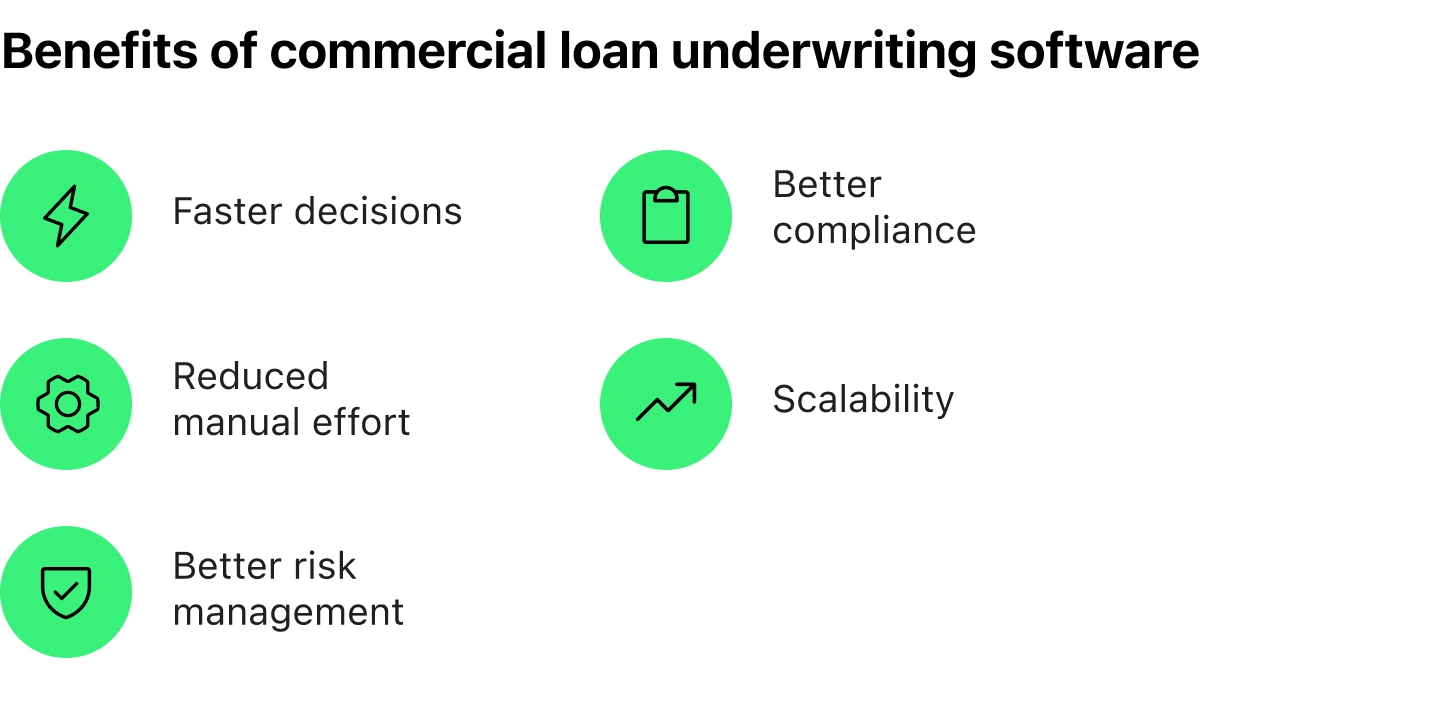
Moreover, when artificial intelligence is layered on top, these advantages become even more significant. According to McKinsey, AI-driven underwriting can increase credit analyst productivity by 20% to as much as 60% and accelerate decision-making by around 30%, helping institutions serve clients more efficiently while keeping risks under control.
No single solution perfectly fits every lender. Yet, understanding some key considerations can help narrow the field and point you toward the most suitable platform.
Remember that the commercial loan underwriting software should complement and give a boost to your workflows, support your team's strengths, feel straightforward for borrowers to use, and adapt as your institution evolves.
7 Aspects to Look at When Choosing Commercial Underwriting Software for Your Business
What Matters Most in Commercial Loan Underwriting Software
| Aspect | Advice |
| Fit with workflows | Make sure the software sits naturally within your current processes to minimize operational disruptions |
| Cost and value | Look beyond the license fee and account for setup, training, and ongoing maintenance costs |
| Usability | Ensure that the software provides an intuitive experience for both your team and borrowers |
| Scalability | Check if the platform can handle growth in loan volumes and new products without strain |
| Integration | Verify seamless and robust connections with your banking, CRM, and reporting systems to prevent silos |
| Security and compliance | Opt for software that provides strong data protection and supports regulatory compliance |
| Vendor support | Make sure that the vendor provides proactive updates and offers responsive assistance |
Below, we'll look into the seven core aspects worth weighing when evaluating commercial underwriting software.
1. Fit with Existing Workflows
Start by asking how the platform will sit inside your current process. That first check often separates helpful tools from disruptive ones.
Software that allows subtle adjustments while still fitting into familiar routines can raise efficiency and accuracy without overwhelming staff. In other words, the closer the system aligns with your current lending processes, the more time it saves and the less frustration it creates.
2. Commercial Underwriting Software Price
The real price of loan management software goes beyond the licensing fee. Implementation, training, maintenance, and upgrades all shape the total cost of ownership.
That way, comparing platforms through the lens of long-term value, not just upfront expense, will help you avoid budget surprises, especially as loan volumes grow or business needs shift.
3. Team Acceptance and Usability
Small details like intuitive navigation, well-labeled reports, and clear dashboards often make the difference between a system that feels natural and one that feels like a burden.
That's why you need to make sure that the underwriting software boasts a user-friendly design, as this will directly impact how well your team performs.
4. Capacity to Grow
Lending needs rarely remain static. Increases in loan volume, expansion into new markets, or the introduction of additional products and features can strain a limited platform.
Therefore, choose a powerful tool that is built to expand and cope with higher throughput and new product types. This way, you'll save both money and headaches if/when your business scales.
5. Seamless Integration
As you know, underwriting platforms don't operate in isolation. They need to connect with core banking tools, CRMs, and reporting systems, often through robust API management to ensure trouble-free data flow and interoperability.
When integration is smooth, data flows where it needs to without constant intervention. Without it, you risk silos, manual workarounds, and slowdowns that quietly drain efficiency.
6. Security and Compliance
In lending, protecting sensitive data and meeting regulatory standards is mandatory.
Commercial credit underwriting software with strong encryption, audit trails, and compliance features reduces both legal risks and reputational concerns. With these safeguards in place, your team can focus on lending decisions instead of worrying about gaps in protection.
7. Vendor Support and Reputation
Implementing commercial underwriting software also means entering into a relationship with the vendor behind it, so make sure they bring both reliability and experience to the table.
A vendor that provides regular updates, responsive support, and a proven track record can turn inevitable setbacks into manageable events instead of business-stopping crises.
Which Commercial Underwriting Software Solution Is the Best for Your Business?
A perfect commercial loan underwriting solution that ticks every box may not exist. What really matters is identifying the factors that will have the greatest impact on your business, whether that's usability, workflow alignment, compliance support, integration, scalability, or long-term vendor reliability.
For most fintech businesses, all of these elements are likely essential for achieving efficient, accurate, and sustainable lending operations. So, the key is to select a solution that addresses as many of these priorities as possible.
The smartest approach is to collaborate with your key stakeholders, carefully weigh all priorities, and evaluate how each platform aligns with both your current processes and future growth plans.
Once you've shortlisted a solution and feel confident it fits your needs, engaging with the vendor is essential. Use this opportunity to ask detailed questions, explore possible customizations, understand the implementation roadmap, and confirm that the platform will integrate well with your existing infrastructure.
Conclusion
Ultimately, the right underwriting system should not only optimize individual steps. Its task is to strengthen the entire lending lifecycle, from application intake to portfolio monitoring.
If you'd like to discuss how our commercial loan underwriting software can fit your business or learn more about its possibilities, contact our HES FinTech team.