HES CollectionAgent is the AI-driven collections product in the HES lineup. It provides recovery teams with a strategy for borrower outreach across voice, email, messaging, and push notifications and sets how each portfolio is worked rather than routing every account through one fixed sequence.
Its voice channel has now reached full production. Live calls follow the same decisioning framework that already works for email, messaging, and push.
Voice automation in collections must address two distinct requirements. AI systems need effective oversight, traceability, and operational controls. At the same time, the rules governing debt collection calls vary by jurisdiction, portfolio, and creditor.
HES CollectionAgent is designed to help lenders manage both. Teams define the rules under which the agent operates, determine which actions can run automatically, and retain a record of activity for subsequent monitoring and review.

Control and Configuration
Strategy Rules Engine. Contact logic is configured per creditor, which lets each portfolio run its own strategy without code changes. A servicer managing several portfolios can apply different contact rules, escalation paths, and channel sequences to each one through configuration instead of a development cycle.
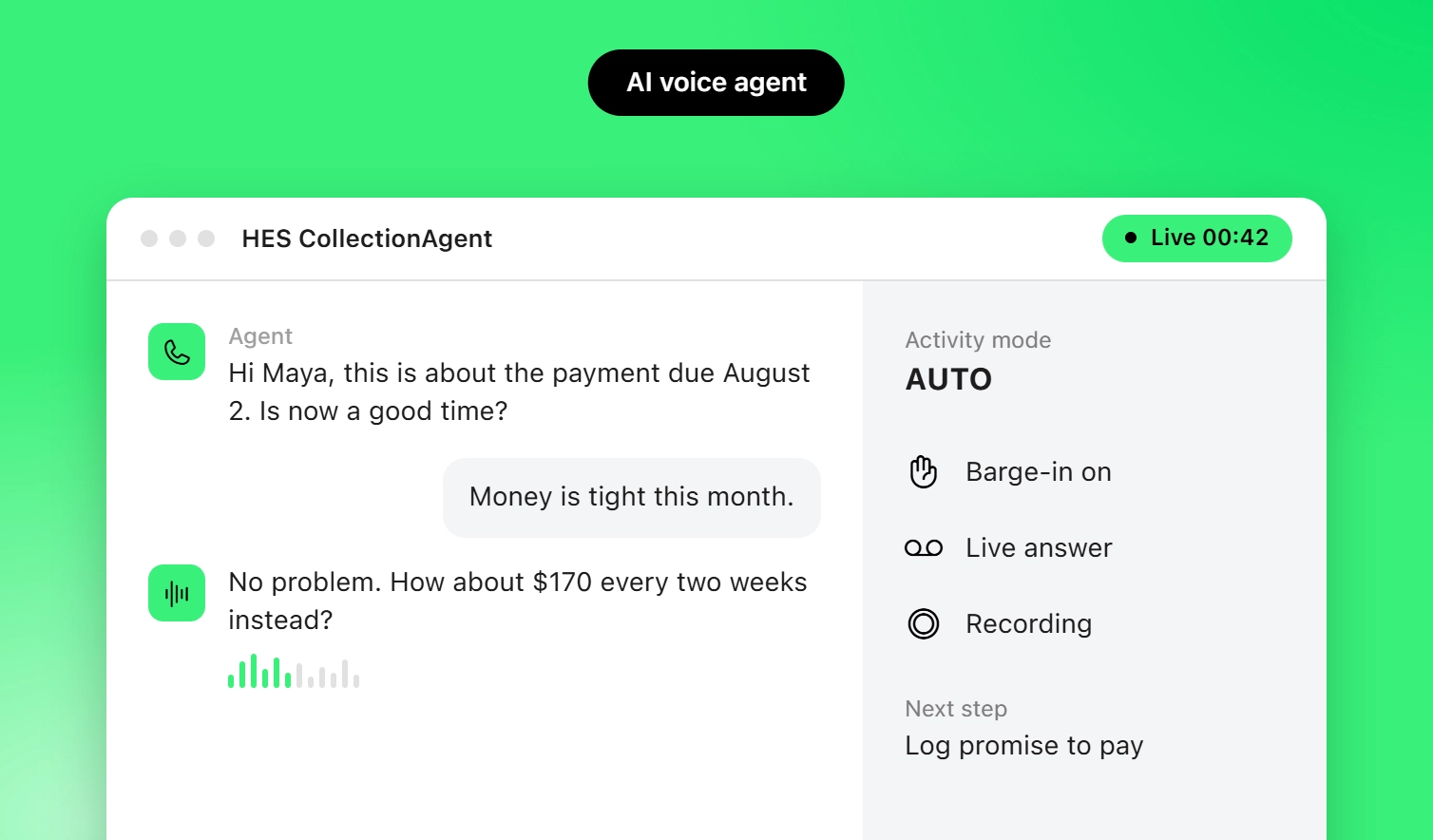
AUTO and MANUAL activity modes. Each step either runs on its own or requires operator approval. Routine outreach can remain automated, with sensitive actions or exceptions reserved for a human review.
Task management. When an activity requires human involvement, the system creates a tracked task, such as placing a call or logging a promise to pay. Cases that leave the automated path remain visible as a task record.
Prompt caching. Reusable prompt context is cached, which cuts both response latency and processing costs of repeated interactions. At portfolio scale, this leads to more predictable operating costs.
AI Voice Capabilities

Instant barge-in. The agent stops talking the moment the debtor speaks over it. This makes the exchange feel more natural and prevents the borrower from being forced through a fixed script.
Session pre-warming. The session is prepared before the line connects, reducing the delay before the agent’s first response.
Answering machine detection. The system distinguishes voicemail from a live answer and follows the appropriate handling logic instead of continuing with a live-conversation flow.
Voice matched to the debtor. The platform can select a voice based on available borrower attributes and the lender’s configured communication approach.
What the Voice Channel Changes for Collection Operations
Voice calls run on the same logic as email, messaging, and push notifications. The decisioning engine determines whom to contact, when to make contact, and which channel to use according to the lender’s configured rules and account-level data. It moves to a call when an account's score says a spoken conversation will be more effective than another message.
With HES CollectionAgent, calling capacity no longer depends entirely on human dialing, so teams can extend voice outreach without increasing manual workload at the same rate. Yet, human oversight remains part of the operating model. Every call runs inside the lender's rules and is logged, giving teams the possibility to review activity, investigate exceptions, and maintain an audit trail.

The most direct way to assess the voice agent is to receive a test call. Enter your number on the product page, and the agent will call you within seconds, listen to your responses, and adapt as the conversation develops. To hear it first, there are recorded sample calls across three scenarios, from a cooperative borrower to a difficult one.