Two digital lending trends have been running side by side through 2026. Banks became more selective about whom they lend to, while the time needed to approve an application kept falling where the process had gone digital.
In the European Central Bank's October survey, a net 14% of euro-area banks reported tighter standards for consumer credit in the third quarter. US banks told the Federal Reserve they had cut credit card limits and raised minimum credit scores for auto loans. In Italy, time-to-yes fell 25% between the first quarters of 2025 and 2026, according to the Osservatorio Digital Lending 2026. With fewer applications turning into funded loans, each funded loan carries the review cost of more declined applications, so the cost and speed of a credit decision show up directly in margin.from the application stage to conditions around the decision.
This article sets the credit data behind current digital lending trends next to automation benchmarks by lifecycle stage. Also, it adds HES FinTech’s client results, so they can be used for comparison.
Digital Lending Statistics at a Glance
The six figures below summarize the data behind the digital lending trends covered in this article. They come from central banks, regulators, a credit bureau, and an Italian market study, and each one applies only to its own market and period. The Italian share of digital credit, for example, describes Italy and should not be read as a figure for Europe as a whole.
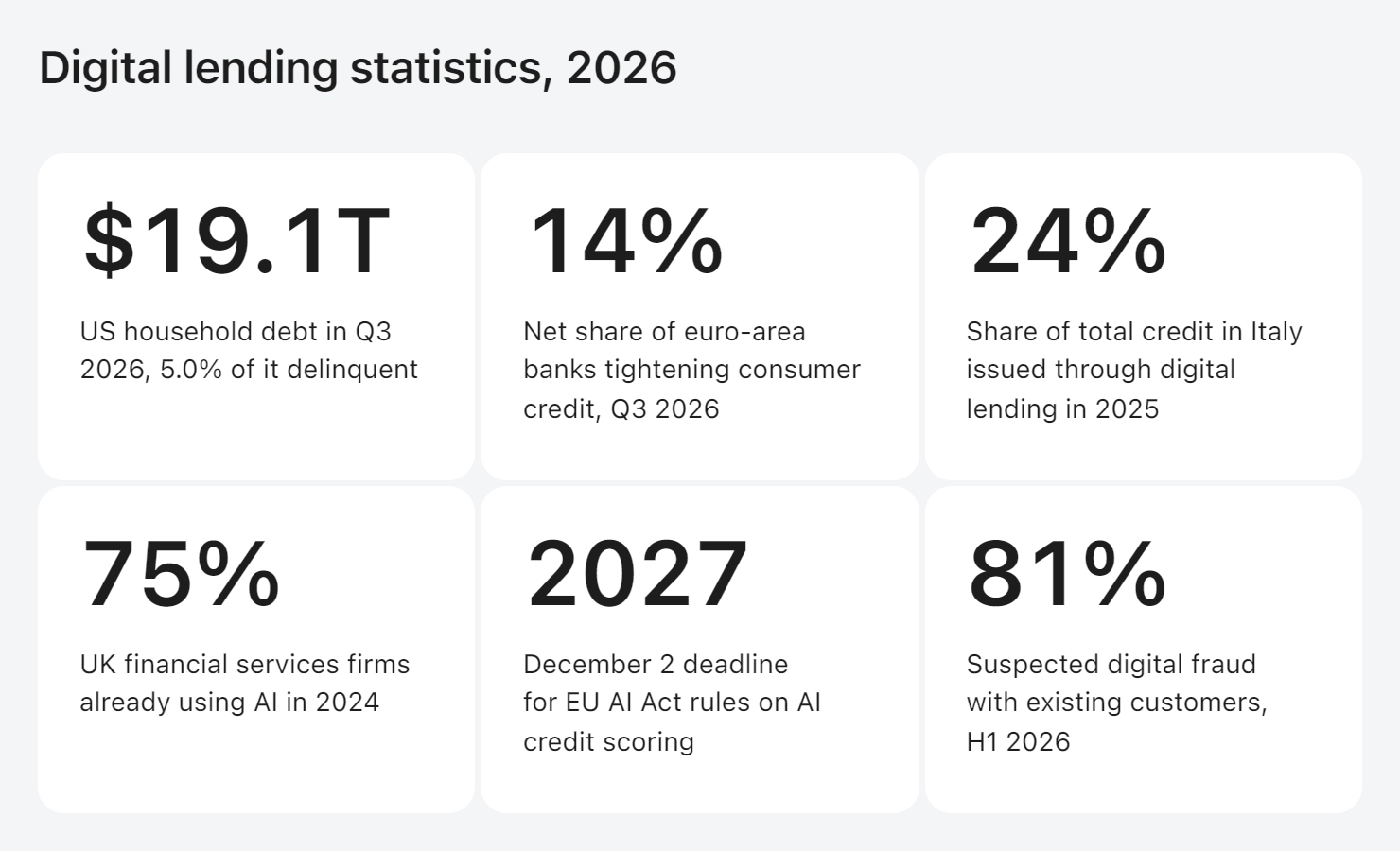
- US household debt stood at $19.1 trillion at the end of Q3 2026, with 5.0% of it in some stage of delinquency (New York Fed).
- A net 14% of euro-area banks tightened standards for consumer credit in Q3 2026 (ECB).
- Digital lending accounted for 24% of total credit in Italy in 2025 (Monitor Deloitte, Experian and CeTIF).
- 75% of UK financial services firms were already using AI in 2024 (Bank of England and FCA).
- EU AI Act obligations for AI systems that score individuals' creditworthiness apply from 2 December 2027 (European Commission).
- 81% of suspected digital fraud worldwide in H1 2026 occurred in interactions with existing customers (TransUnion).
The first two figures describe the credit conditions lenders are working in: US household debt and the share of it in delinquency, and euro-area banks applying tighter standards to consumer credit. The other four concern how lending operates, from the digital share of credit in Italy and AI use in UK finance to the EU AI Act timeline for scoring models and fraud in existing accounts. Each returns in one of the five digital lending trends further down. The next section starts with the credit conditions, looking first at US delinquency data and the Fed's bank survey, then at the euro area.
The 2026 Credit Backdrop: Tighter Standards, Thinner Demand
In the third quarter of 2026, euro-area banks tightened standards for consumer credit and expect demand for it to fall again in the fourth quarter. US banks kept their overall consumer lending standards largely unchanged but tightened specific terms, including card limits and minimum credit scores for auto loans. The data below show where the tightening is concentrated and what it changes for lenders.
United States: Delinquencies Edge Up and Banks Tighten Credit
In the October survey, banks described two changes at the approval stage of consumer lending: tighter credit card limits and a higher minimum credit score for auto loans. They are also more selective about who gets approved, being more favorable towards card applications from prime and super-prime borrowers and less likely to approve subprime applicants.
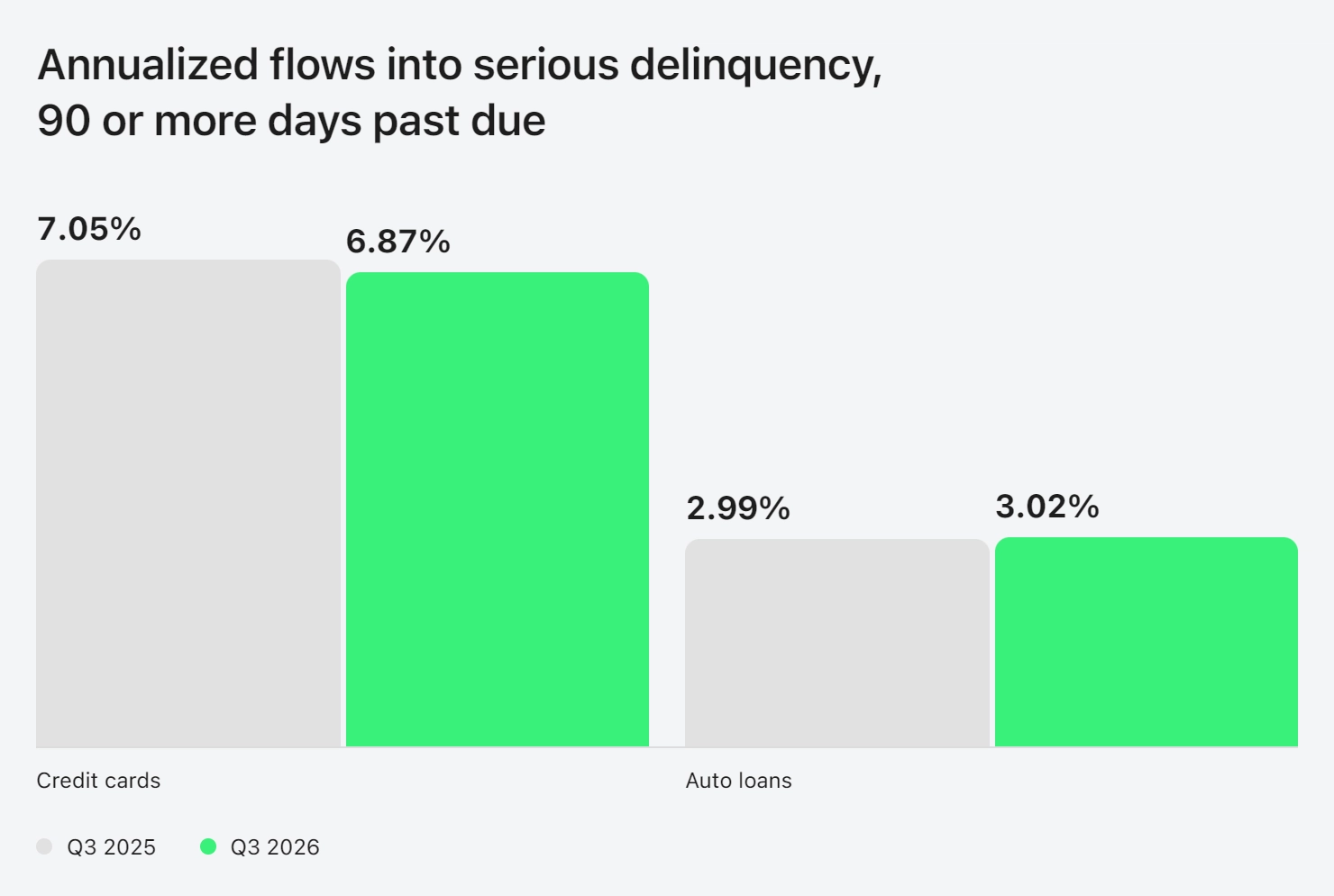
The October survey also tracks commercial lending trends: banks tightened standards for commercial and industrial (C&I) loans to small firms and for every category of commercial real estate (CRE) loan. They also tightened standards on all types of loans to nondepository financial institutions (NDFIs), a group that includes many nonbank lenders.
Euro Area: Banks Tighten Consumer Credit and Expect More
In the ECB's bank lending survey of 159 banks, conducted between 21 September and 6 October 2026, a net 14% of banks tightened standards for consumer credit in Q3 2026. Demand weakened in all three categories, most sharply for housing loans. For Q4, banks expect to tighten further, especially for housing and consumer credit, and expect consumer credit demand to fall again.
What Tighter Credit Means for Lenders
Tighter standards change the economics of every application a lender processes: unit cost, competition for prime borrowers, demand below prime, and funding.
- Each funded loan carries more cost. When fewer applications are approved, the cost of reviewing the declined ones, from bureau checks to analyst time, is spread over fewer funded loans. An easy cost-cutting strategy is to screen out applications that will not fund before they reach manual review.
- Prime borrowers become a contested segment. With US banks leaning toward prime and super-prime card applicants, more lenders compete for the same borrowers on approval speed and price.
- Demand below prime does not disappear. As banks pull back from subprime applicants and small firms, lenders that can assess that risk with better data face less bank competition. With 5.0% of US household debt delinquent and early delinquency still rising for auto loans, lending below prime also means pricing for higher expected losses and tracking missed payments from the first billing cycle.
- Nonbank lenders should review their own funding. Tighter bank standards on loans to NDFIs can reach the credit lines that nonbank lenders use to fund their portfolios.
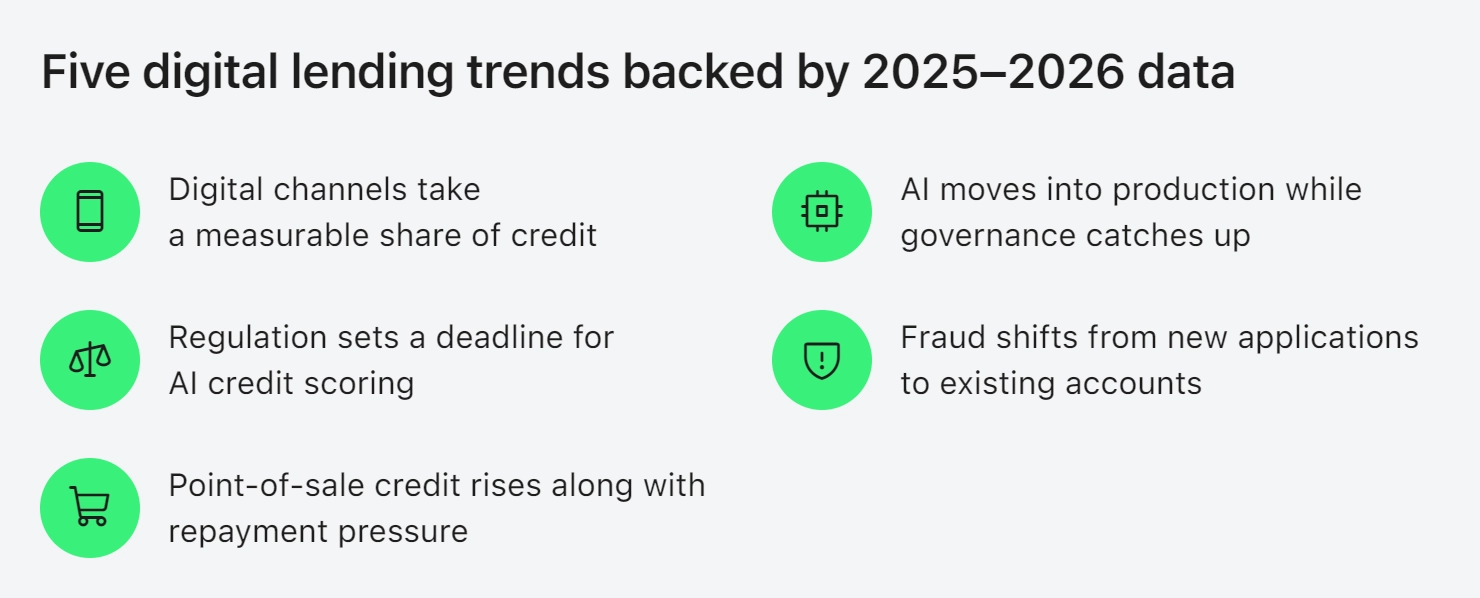
Five Digital Lending Trends Backed by 2025–2026 Data
Each of the digital lending trends below touches a different point in the credit decision workflow, from the application stage to conditions around the decision.
Digital Channels Take a Measurable Share of Credit
In a digital loan, the application, checks and signature happen online, so the data arrives in a form that automated decisioning can use. World Bank's Global Findex 2025 tracks the payment behavior that digital credit builds on. In low- and middle-income economies, 42% of adults made a digital merchant payment in 2024, up from 35% in 2021.
AI Moves Into Production While Model Governance Catches Up
In UK financial services, AI use is already the norm. In the Bank of England and FCA survey published in November 2024, 75% of firms said they were using AI, and a further 10% planned to within three years. The same survey shows where governance trails adoption: a third of use cases were third-party implementations, and 46% of firms reported only a partial understanding of the AI technologies they use. For a lender using a third-party scoring model, that gap matters because the lender remains responsible for the credit decisions the model informs.
Outside the UK, a global IIF and EY survey of 56 financial institutions in eight regions, conducted in mid-2024, found 88% applying predictive AI or machine learning in production. Close to half were running generative AI at full scale. In the United States, a May 2025 GAO report shows where use slows down: institutions are more cautious with AI where reliability or explainability matters.
McKinsey estimated in November 2025 that agentic AI could lower banks' operational costs by 20% or more and reported early use cases that cut manual workloads by 30% to 50%. Agentic AI refers to systems that complete multistep tasks, such as drafting a credit memo, for a person to review.
Regulation Sets a Deadline for AI Credit Scoring
Under the EU AI Act, AI systems intended to evaluate the creditworthiness of natural persons or establish their credit score are classed as high-risk (Annex III, point 5(b)).
The Digital Omnibus on AI, Regulation (EU) 2026/1744, entered into force on 27 July 2026, and the European Commission confirms that rules for these stand-alone high-risk systems apply from 2 December 2027. Lenders that score individuals in the EU have until then to meet the Act's high-risk requirements, which cover risk management, data governance, record-keeping, and human oversight. In practice, this means lenders need to document and show how a scoring model was built, what data it uses, and where a person reviews its output.
In the United States, the CFPB's personal financial data rights rule under Section 1033, the basis for regulated open banking, was finalized in October 2024 and is under reconsideration. The rule sets how consumers can share their bank account data with authorized third parties, the data that cash-flow underwriting depends on.
Fraud Shifts From New Applications to Existing Accounts
TransUnion found that 81% of suspected digital fraud worldwide in H1 2026 occurred during interactions with existing customers. Established accounts carry higher limits and lighter checks, which brings repeat-loan requests and limit changes into scope for fraud checks. The survey also estimated US lenders' exposure to synthetic identities at $2.4 billion as of 30 June 2026.
Point-of-Sale Credit Use Rises Along With Repayment Pressure
More US consumers are paying in installments at checkout. Buy now, pay later is used by over 16% of adults, according to the Federal Reserve’s survey of household economics for 2025. The same survey shows repayment pressure: 11% of BNPL users had a BNPL payment trigger an overdraft or non-sufficient-funds fee from their bank. Small plans taken at different stores can add up, and a lender approving a new plan may not see the others. For lenders offering installment credit at checkout, this is a reason to report early missed payments next to approval volume, so loan stacking becomes visible before it reaches charge-offs.
Lending Automation Benchmarks by Lifecycle Stage
To show how these digital lending trends appear in operating numbers, the table below groups recent verifiable lending automation benchmarks gained from consultancies and case studies by stage and labels each by scope and source type.
| Stage | Reported result | Scope | Source type | Year |
|---|---|---|---|---|
| Origination | Mortgage approval time from 15–20 days to 3–5 days | One Benelux bank | Consultancy case (Deloitte) | 2025 |
| Origination | Manual processing time cut by 70% | One European retail bank | Consultancy case (BCG) | 2025 |
| Origination | Time-to-yes down 25%, time-to-cash down 33% | Italian credit market | Market study (Monitor Deloitte, Experian, CeTIF) | 2026 |
| Credit analysis | Time to draft financial-risk assessments cut by 50% | One financial institution | Consultancy example (McKinsey) | 2025 |
| Credit analysis | 40–80% productivity uplift per use case | Multiagent AI in corporate credit | Consultancy estimate (McKinsey) | 2025 |
| Loan servicing | 20% of auto loan payment calls could be handled by AI without significant risk; 80% needed process and data changes first | One bank, auto loan payment calls | Consultancy analysis (McKinsey) | 2026 |
| Collections | Operating expenses cut by up to 40%; recoveries up about 10% | Gen AI in collections | Consultancy analysis (McKinsey) | 2024 |
Origination and Underwriting
Deloitte describes a Benelux bank that cut mortgage approval times from 15–20 days to 3–5 days. BCG reports a European retail bank that reduced manual processing time across its lending workflows by 70%. A McKinsey impact story reports that, for fully automated applications, time-to-yes fell from 24–48 hours to four minutes; the page carries no publication date. The Italian data add a market-level view, since the 25% and 33% reductions describe the market rather than one bank.
Credit Analysis and Decisioning
McKinsey's December 2025 article on corporate credit gives one example, an institution that halved the time needed for financial-risk assessments with a multiagent system. It also gives one estimate: a 40–80% productivity uplift per use case, which the authors base on their client work rather than on a survey.
Loan Servicing
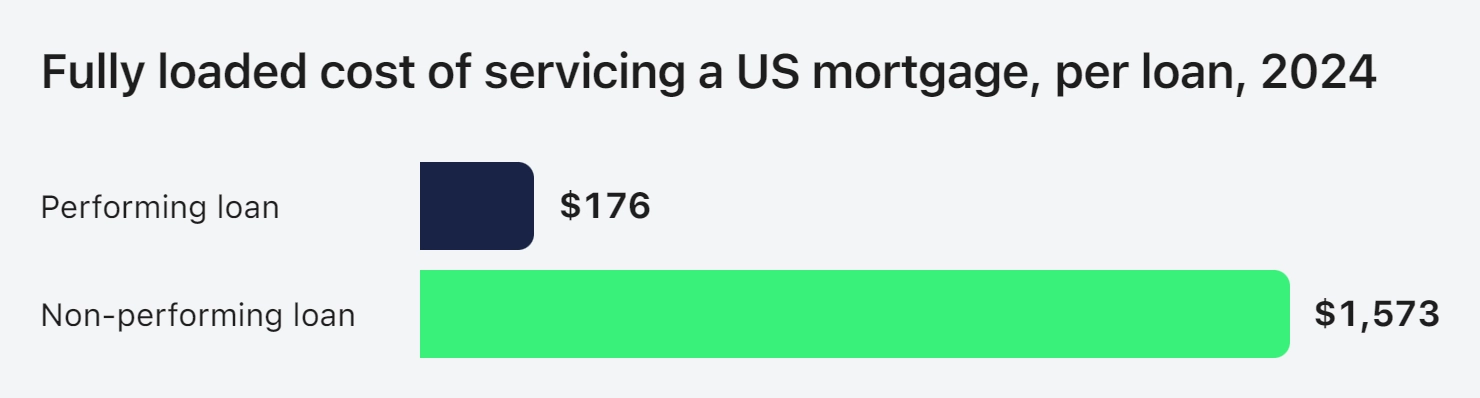
The Mortgage Bankers Association reports that fully loaded costs of servicing a performing US mortgage averaged $176 per loan in 2024, against $1,573 for a non-performing loan. The gap, about $1,400 per loan, is roughly what eight performing loans cost to service.
Research that McKinsey published in April 2026 shows where servicing automation meets its limits. One banking client expected to automate calls about auto loan payments, roughly 3.7% of its call volume, but found that only 20% of those calls could be handled by AI without significant risk. The other 80% needed changes to cross-functional processes and underlying data first. The case covers one institution. What other lenders can reuse is the approach: assess each call type for risk before deciding how much of it to automate.
Collections
McKinsey's June 2024 analysis of gen AI in collections cites up to 40% lower operating expenses and recoveries about 10% higher. It also describes a European credit management company whose payments rose 10% after deployment.
What HES Client Deployments Show
HES LoanBox is the digital lending platform from HES FinTech, which has built lending software since 2012. It covers onboarding, origination, decisioning, servicing, and collections in one configurable system. The figures below come from HES client case studies. Each one depends on the client's scope, data, and starting process. We recommend reading them like the single-bank cases in the benchmark table: as reference points next to the digital lending trends above, each tied to one client’s situation.
Launch Timelines: 2 to 6 Months Depending on Scope
| Client | Market and segment | Reported time to launch |
|---|---|---|
| Ta Meri Finance | Cyprus, auto lending | 2 months |
| Unnamed lender | Australia | 2 months |
| Euro Groshi | Ukraine, online microfinance | 10 weeks |
| Idea Bank | Poland, point-of-sale lending | Under 3 months |
| ID Finance (MoneyMan) | Spain, consumer lending | 3 months |
| Wa'ed | Saudi Arabia, SME lending | 4 months |
| ATM Online | Vietnam | 4 months |
| CashU (Smart Finance) | Kazakhstan, payday loans | MVP in weeks; 4 months of development |
| Fintuity | UK, investment advisory | 4 months |
| SME lender (NDA) | Canada, SME lending | 4 months |
| BNPL and consumer lender (NDA) | Canada, BNPL and consumer lending | 6 months |
The short end of the range covers builds with limited scope. The six-month case, a Canadian BNPL and consumer lender, included AI scoring and several third-party integrations. Heavily customized projects can run six months or longer. When comparing quoted timelines across vendors, ask what each go-live included, such as the number of products, integrations, and data migration.
Decision Speed and Throughput
- Idea Bank (Poland, point-of-sale lending through more than 2,500 retail chains and online stores): a 5x faster application process.
- Wa'ed (Saudi Arabia): decision-making time down 50% and applications doubled; the case does not state a baseline or measurement period.
- Canadian SME lender: application processing cut from 24 hours to 4 hours.
- Canadian BNPL and consumer lender, running HES LoanBox with the GiniMachine scoring engine described below: weekly loan volume up about 40%, time-to-yes down 80% (from 30 to 5 minutes), about 20 minutes saved per application and 12,500 working hours saved in a year. The published cases do not separate the two products' contributions.
- Euro Groshi (Ukraine): new customers apply in no more than 15 minutes; repeat customers get decisions in 5 to 10 minutes.
Credit Quality After AI Scoring
GiniMachine is a separate HES product: an AI credit-scoring engine that trains models on a lender's own historical loan data. For each application it returns a probability of repayment and a recommended resolution, which feed the lender's own decision rules. Here are some case studies with outcomes:
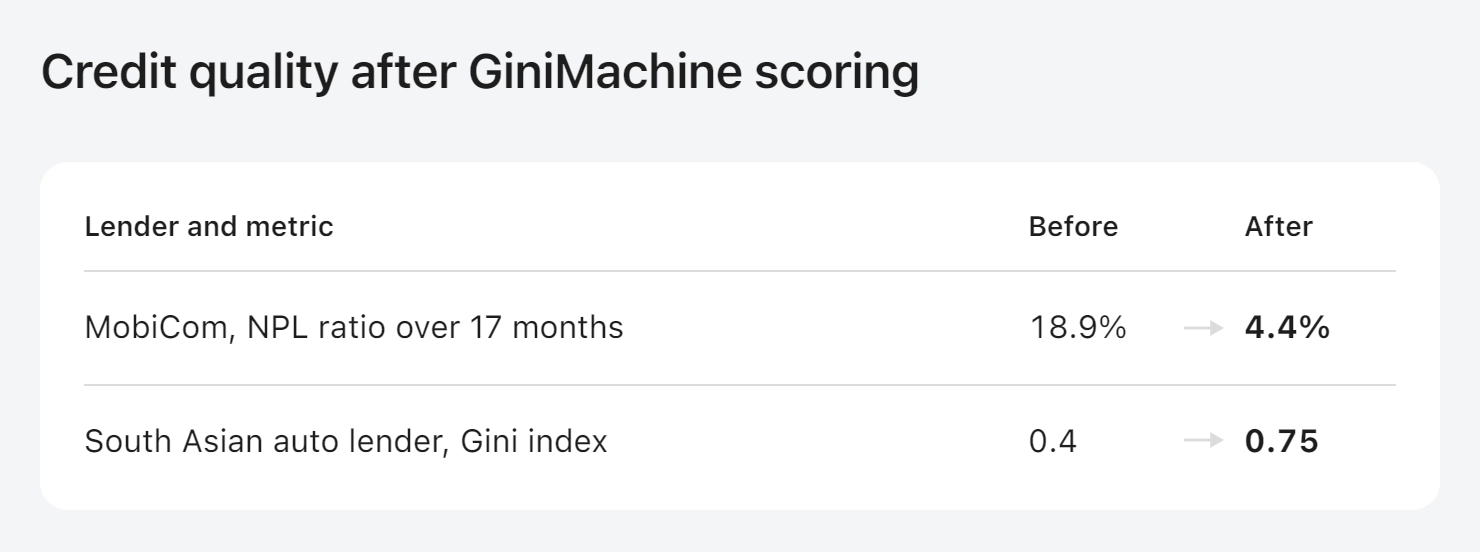
- MobiCom (Mongolia, instant microloans through MonPay): the NPL ratio fell from 18.9% to 4.4% over the 17 months after GiniMachine was deployed, with models reaching a Gini index above 0.6. The case does not isolate other factors, such as policy or portfolio changes.
- An auto lender in South Asia: predictive power improved from a Gini index of 0.4 to 0.75, with ROC-AUC reaching 0.88.
- NEO Finance: the number of loans issued doubled, and 81.01% of loans were repaid or not overdue.
What These Digital Lending Trends Mean for 2027 Planning
For lenders setting 2027 budgets, the figures above suggest where to start, what to measure, which date to plan around and how far fraud controls need to reach.
- Start where handling is most manual. Published gains are largest in origination and collections. Servicing has the fewest published results, so internal measurement matters more there.
- Measure before you automate. Record time-to-yes, cost per decision, and early roll rates, meaning the share of current loans that become 30 days past due, for at least one quarter before go-live. Without that baseline, a later change cannot be attributed to the new system rather than to seasonality or a shift in the applicant mix.
- Plan for 2 December 2027. Lenders that score individuals in the EU need documentation, logging and human oversight for those models in place by that date.
- Extend fraud controls past onboarding. With most suspected digital fraud now occurring in interactions with existing customers, the checks used at onboarding should be applied to credit limit increases and repeat loans as well.
Final Thoughts
For the future of lending operations, the digital lending trends in this article lead to one requirement. A lender needs to change a credit policy, a workflow, or a scoring model quickly, and then show its credit committee and examiners what each change did to approvals, losses, and costs.
Where that work runs on a vendor’s platform, the vendor’s role is to support this cycle. The lender’s own team should be able to make routine policy and workflow changes, and the system should keep a record of each change and its effect, ready for review. A useful question for any vendor, HES included, is which of these changes the lender can make without waiting for a vendor release.
FAQ
What are the main digital lending trends right now?
Data from 2025–2026 point to five: faster digital decisions under tighter credit standards, AI in production, EU rules for AI credit scoring from December 2027, fraud shifting to existing accounts, and growing point-of-sale credit. In Q3 2026, a net 14% of euro-area banks tightened consumer credit standards. TransUnion attributes 81% of suspected digital fraud in H1 2026 to interactions with existing customers.
How much does lending automation reduce processing time?
It depends on the stage and the starting point. Published single-bank cases range from mortgage approvals cut from 15–20 days to 3–5 days (Deloitte, 2025) to a 70% reduction in manual processing time (BCG, 2025). At market level, time-to-yes in Italy fell 25% between Q1 2025 and Q1 2026.
When do EU AI Act rules for credit scoring apply?
AI systems that evaluate the creditworthiness of individuals or establish their credit score are high-risk under Annex III of the AI Act. After the Digital Omnibus on AI, Regulation (EU) 2026/1744, obligations for these systems apply from 2 December 2027. Systems used only to detect financial fraud fall outside this category.
Why do lending automation benchmarks vary so much?
Sources measure different things: one process step or the full journey, one client or a survey, observed results or estimates. The starting level of manual work also sets how large a percentage gain can be. Before comparing two figures, check that they cover the same process steps and start from a similar level of manual work.
How long does it take to launch a digital lending platform?
Timelines depend on scope. In client cases published by HES, launches on HES LoanBox ranged from two to six months, with one MVP live in a couple of weeks; heavily customized projects take longer. These are company-reported figures, so confirm what each go-live included.