


Loan management software helps lenders manage onboarding, origination, servicing, collections, reporting, and compliance within a single environment. By the end of 2025, the loan management and debt collection software industry had been transformed by technological advancements. Now, real-time pipelines, cloud-native, API-first infrastructure, AI decisioning, and mobile-first apps power the modern loan management process and drive business decisions when integrating new tools.
This shift towards innovation isn’t happening gradually. It's accelerating at full speed. Currently valued at $3.1 billion in 2023, it’s projected to reach $7.8 billion by 2031, just 6 years from now.
But the path to digitization isn’t frictionless. The wrong choice of software could introduce significant technical debt or even compliance leading to long-term risks.
Poor integration strains business operations. Rigid workflows limit your capacity. Unreliable or unsafe AI models create compliance risks. Fragmented systems make scaling next to impossible. In a market moving this quickly, making the wrong decision is a strategic vulnerability. That’s why the best loan management software today must operate as hyper-connected engines, and here’s what that means for your business.
Key Takeaways
- Loan management platforms are rapidly evolving as cloud-native infrastructure, API ecosystems, real-time data pipelines, and AI-driven decisioning are becoming industry standards.
- Modern LMS solutions must support the entire loan lifecycle, from onboarding and underwriting to servicing and collections.
- The best platforms combine modular architecture, developer-friendly APIs, AI capabilities, and strong compliance and security frameworks.
- Choosing the right LMS depends on the deployment model, enterprise size, loan types, and regional regulatory requirements.
Loan Management Software Comparison Table
With so many providers on the market, it can be a challenge to find a solution that suits your business needs. This loan management software comparison table brings together providers and offers a clear view of automation, modularity, AI, tools, and more.
| Platform | Modularity | Developer license & APIs | AI/Automation | Core business use | Standout modules | Deployment |
|---|---|---|---|---|---|---|
| HES LoanBox | High | Yes | Yes | Banks, Alt lenders, SME lenders, Fintech | Origination, servicing, collections | Cloud/On-prem |
| ICE Mortgage Encompass | Medium (Salesforce-based configuration) | Yes | Yes | Mortgage lenders (IMBs, banks, credit unions) | Strong submodules in analytics | Cloud |
| nCino | Medium-High | High | High | Banks, credit unions | Portfolio management | Cloud |
| Finastra Fusion Loan IQ | High | Yes (SDK/API) | Workflow automation; limited/no native AI | Large, corporate | Syndicated loans, risk, reporting | Hybrid |
| Mambu | High | Yes | Medium-High | Digital banks, Fintech | Loan, payments, analytics | Cloud |
| Fiserv LoanServ | Medium | Yes (APIs, SDK) | Medium | Mid/Large lenders | Servicing, investor management | Hybrid |
| TurnKey Lender | High | High (AI-led) | High (AI-led) | Banks, fintechs, alt lenders, vertical/embedded lenders, BNPL | Origination, AI scoring, collections | Cloud |
| Temenos | High | Yes | High | Global banks, retail, commercial | Loan origination, risk, compliance | Cloud/On-prem |
| Calyx Software | Medium | Limited | Medium | Mortgage lenders | Mortgage origination | Cloud/On-prem |
| Nortridge Software | Medium | Limited | Low | Specialty finance, consumer | Servicing, payment plans | Cloud |
| LoanPro | High | Yes | Medium | SME, Fintech, consumer | Servicing, payment processing | Cloud |
Best Loan Management Software: In-Depth Comparison
When comparing the strongest loan management solutions on the market, a single “one-size-fits-all” ranking is not always the most accurate approach. These platforms can differ fundamentally in scope, implementation complexity, and the type of institution they are designed to serve. Some products are built as enterprise-grade ecosystems for large banks, with advanced governance, scalability, and deep integration capabilities, while others are optimized for faster adoption and practicality in smaller or mid-sized organizations.
For that reason, we structured this list into two primary groups.
- Loan management software for non-bank lenders and mid-sized banks
- Enterprise banking loan management platforms
Group#1: Loan Management Software for Non-Bank Lenders and Mid-Sized Banks
This group covers platforms that are often validated as a practical fit for mid-sized banks and non-bank financial institutions. They tend to emphasize modular adoption, faster adaptability, API-driven integration, and broad lifecycle coverage, with flexibility for configuration and customization depending on the operating model.
- HES LoanBox—a modular lending platform positioned around loan management with coverage across onboarding/origination/servicing/debt collection, typically aligned with configurable deployments for banks and non-bank lenders.
- Mambu—a cloud-native lending engine used by banks and fintechs to build and run loan products on a composable, API-friendly foundation.
- TurnKey Lender—digital lending automation with loan management/servicing and collections capabilities, often selected by non-bank lenders and mid-market teams.
HES LoanBox
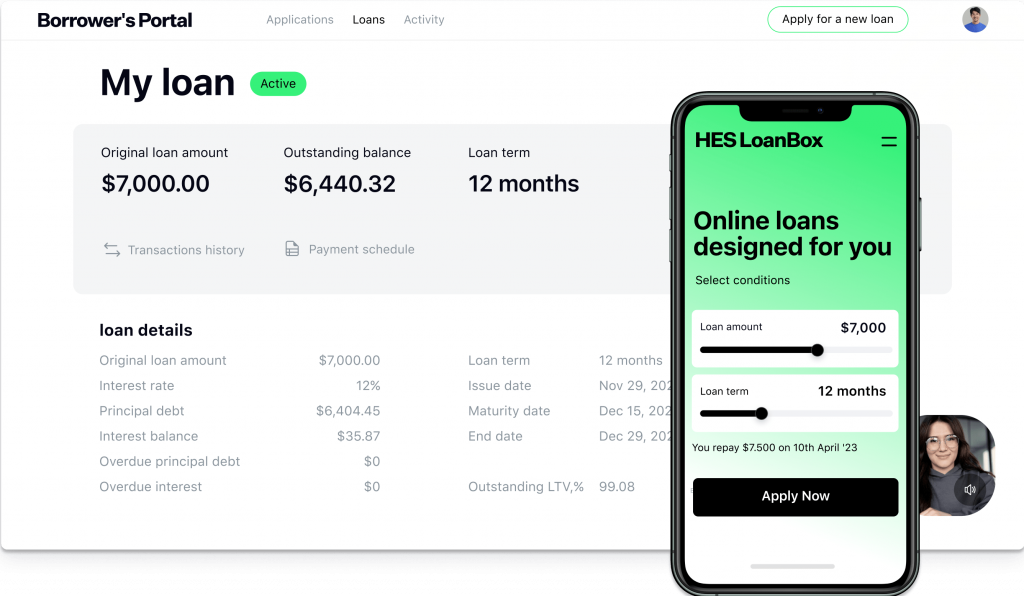
HES LoanBox is an end-to-end loan management software platform that unifies the entire lending lifecycle in one configurable environment—digital onboarding, loan origination, servicing, and debt collection. It helps lenders replace disconnected tools with a single system that maintains consistent workflows, data, decisions, and consumer interactions throughout the loan journey.
Ideal for
Lenders and financial institutions that need end-to-end loan management software with deep configurability across onboarding, origination, servicing, and collections—especially when the project requires complex workflows, unique product logic, or extensive integrations.
| Overview | |
|---|---|
| Impact and decision quality | Up to 2.5x faster processing and 3.5x higher decision accuracy compared to conventional setups. |
| Security | Bank-grade security approach supported by ISO 27001 certification, support for AML/KYC-related processes. |
| Customization & implementation flexibility | The platform is positioned around deep customization across complex projects. Support for non-standard workflows (bespoke underwriting logic, approvals, product rules, and borrower journeys). Composable architecture enabling phased module rollout or full end-to-end deployment. |
| Supported lending models | Supports a broad range of lending models, including SME lending, BNPL, Merchant Cash Advance (MCA), auto lending, and other lending types. |
| Tech stack, vendor independence & scaling | Connect with 100+ APIs, including data providers, CRMs, payment gateways, banking rails, and internal systems. Built on open-source technologies such as Java and Camunda, reduces vendor lock-in and dependency on a single provider. Optional developer license. |
Key features:
- Compliance-ready digital onboarding & KYC/KYB: includes all the tools for collecting borrower data, managing documents, and supporting identity/business verification flows.
- Loan origination management: applications automation, document handling, credit scoring, approvals, and disbursement in one streamlined process.
- AI-powered credit decisioning: advanced and configurable AI models help borrowers align with the credit policy, generate real-time risk scores and decisions.
- Loan servicing module: repayments, rescheduling, delinquency tracking, and automated payment collection managed within a single servicing environment.
- Debt collection automation: AI-driven segmentation, predictive analytics, multichannel outreach, and compliance-aware strategy execution for effective recoveries.
- Configurable product engine: support launch of any loan type with flexible terms, interest rates, fees, and repayment schedules through configuration rather than custom code.
- Self-service borrower portal: gives clients more control and flexibility with tracking their applications, loan terms, payment schedules, applying for restructuring, and other tasks.
- Multi-entity and multi-currency: multiple legal entities, currencies, and jurisdictions can be managed from a single platform instance.
- Security and regulatory compliance: ISO 27001-certified security practices, encryption, access control, and audit trails, plus support for KYC/KYB procedures across deployments.
- Real-time analytics: interactive dashboards and BI integrations for tracking KPIs, loan performance, and portfolio metrics for tracking KPIs, loan performance, and portfolio metrics.
- 100+ integrations via API: Connections with KYC/AML, open banking, credit bureaus, payment systems, e-signature, and other tools.
Main pros
- Projects can start from 3–4 months, depending on complexity, integrations, and customization scope.
- Reduced classic vendor dependency, with developer license (code access) available for deeper control and extensibility.
- Modular rollout (individual modules) or a full end-to-end deployment, including white-label options for customer-facing portals, applications, and digital journeys.
- High level of customization across workflows, products, rules, roles, and UI.
- Automation support for lender- and borrower-facing processes across onboarding, origination, servicing, and collections with no-code tools, multi-workflow support, and role-based access control.
Cons
- Broad platform scope: some niche requirements may require configuration or customization rather than out-of-the-box coverage.
- Implementation effort variability: timelines and workload depend on integrations, data migration, regulatory needs, and product complexity.
- Configuration governance: extensive flexibility increases the need for clear change control, documentation, and testing to avoid configuration sprawl.
What users say
Capterra reviews often describe HES LoanBox as a 'turnkey out-of-the-box solution' and highlight ease of configuration and integrations. Users on G2 emphasize flexibility, including multi-entity and multi-currency capabilities and the ability to connect with local banks and data vendors.
Some clients admit they had challenges with complex custom reporting, customization of dashboards and user roles at the start of deployment, and initial configuration (those activities needed extra development, planning, and coordination of the in-house team and the vendor).
Demo and trial period: free demo and trial available.
Notable clients: ID Finance (unicorn), Fintuinity, Wa’ed, Alraedah, and others.
Price: upon request. Fixed subscription model (no limits on users, products, or applications).
Link to the product: here
Mambu
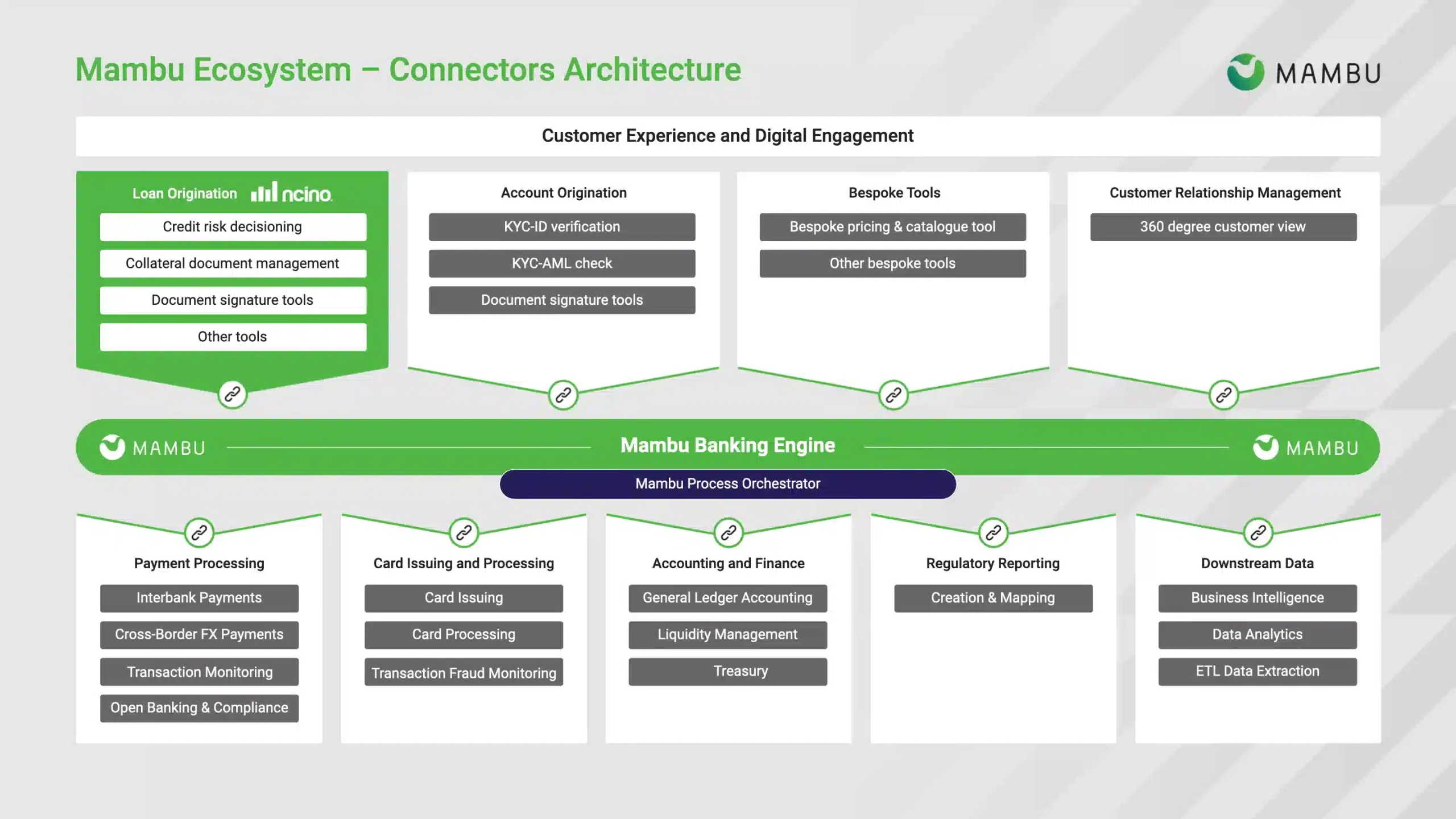
Mambu is a cloud-native, SaaS banking and lending platform built around a composable, API-first architecture. Its configurable engine is suited for creating and managing a wide range of loan products, while allowing numerous third-party integrations for onboarding, decisioning, payments, analytics, and adjacent banking capabilities. Designed with fintechs, digital banks, and fast-scaling lenders in mind, it promotes speed, flexibility, and cloud-first operations.
Ideal for
Banks, fintechs, credit unions, retailers, and embedded-finance providers seek a modern cloud lending core with strong configurability and ecosystem connectivity, particularly when they prefer a composable architecture over a heavily integrated native platform.
| Overview | |
|---|---|
| Impact and implementation speed | 60–80% reduction in time to market, products can launch in 6–12 weeks. |
| Security | Banking-grade controls, including ISO 27001 certification, SOC 1 and SOC 2 compliance, biannual penetration testing, and strong operational resilience. |
| Deployment options | Fully managed in the cloud (supports deployment across AWS, Google Cloud, and Microsoft Azure.) |
| Customization & implementation flexibility | Modular architecture that supports low-code/no-code APIs, various product configurations, and rapid product design without heavy custom infrastructure. |
| Supported lending models | Supports a wide range of lending use cases, including embedded finance, BNPL, mortgages, SME lending, purchase finance, business lending, asset finance across banks, fintechs, retailers, and corporates. |
| Tech stack, vendor independence & scaling | API-first, cloud-native, and composable platform with REST APIs, webhooks, orchestration options, and a broad partner ecosystem for connecting identity, AML, payments, risk, and other services. |
Key features:
- Cloud-native lending engine: allows building and managing multiple loan offerings on a SaaS platform designed for scale and agility
- Composable and API-first product architecture: tailored lending products can be created through configuration, not only custom development.
- Flexible loan product setup: possibilities to configure multiple loan types, payment options, due dates, repayment schedules, payment holidays.
- Low-code workflow and product configuration: products are flexibly launched and updated with low-code tooling and APIs.
- Security and compliance foundation: ISO 27001, SOC reports, embedded security processes, and resilience controls.
- Payments adjacency: for institutions that need broader financial infrastructure, Mambu offers payment orchestration through Mambu Payments.
Pros
- Cloud-native/SaaS positioning with strong security and no legacy-style deployment framing.
- Quick deployment and rapid launch cycles possible to implement in weeks.
- Comprehensive developer tools, API-first composability and partner ecosystem.
- Scalable for fintechs, digital banks, and microfinance orgs that wish to launch and iterate products quickly.
Cons
- Often described as a core/lending engine plus ecosystem: some capabilities may depend on partner integrations rather than one native out-of-the-box stack.
- Architecture, speed, and flexibility win over deeply detailed native operations stack in one place.
- Requires technical expertise for full customization, especially with third-party integrations.
- No on-premise option: may matter for institutions with strict hosting requirements.
What users say
Official Mambu case studies emphasize rapid launches, IT cost reduction, and efficiency gains. Though public reviews are scarce, clients highlight flexibility, scalability, and faster product development. Among the drawbacks, clients mentioned unwieldy migration. Also, some wished for a better interface.
Demo and trial period: free live demo upon request.
Notable clients: Wio Bank, BancoEstado, Platcorp, Esperanza, My Community Finance, Ashman.
Price: Not publicly listed.
Link to the product: here
TurnKey Lender
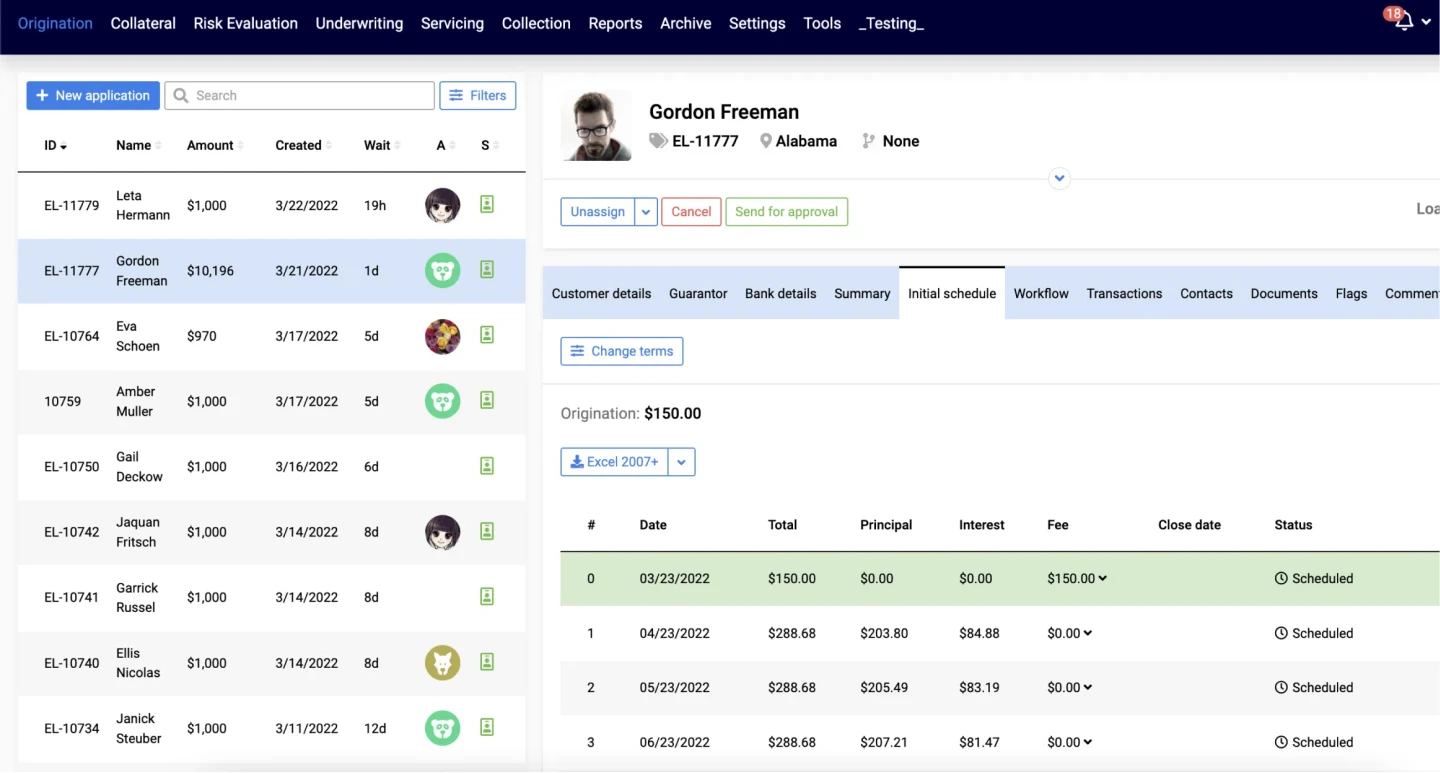
TurnKey Lender is an AI-powered end-to-end lending automation platform designed to automate the entire lending journey in one environment: loan origination, underwriting, servicing, debt collection, and reporting. The company positions it as infrastructure for non-bank, embedded, and traditional lenders, with strong emphasis on configurable workflows, proprietary decisioning, broad automation coverage, and relatively rapid deployment.
Ideal for
Banks, credit unions, consumers, commercial lenders, and embedded lenders that need a single lending operations platform with automation and broad product-type coverage. Turnkey Lender appears suitable for lenders seeking a comprehensive operational scope, encompassing origination, servicing, and collections.
| Overview | |
|---|---|
| Implementation impact | 90%+ automation for lending tasks, 5–12% more approvals, 20–50% more repaid loans. |
| Security | ISO, SOC 2 Type 2, PSI, OWASP-aligned security, fraud prevention, and support for AML/KYC-related processes. |
| Deployment options | Primarily cloud-based (SaaS) with limited reports of on-premises/hybrid options. |
| Customization & implementation flexibility | Configurable application flows, decision rules, credit products, white-label interfaces, modular automation. Separate modules for origination, servicing, underwriting, collection, and enterprise customization. |
| Supported lending models | Supports a range of lending use cases, including consumer, commercial lending, embedded, and bank lending, accounts receivable financing, equipment finance, payday/microfinance, leasing, P2P lending, credit cards, and nonprofit credit. |
| Tech stack, vendor independence & scaling | 75+ preconfigured integrations. Multi-user scalability, multi-currency support, audit trails, white-label portals, and broad API coverage across front-office and payments-related operations. Proprietary AI decision engine. |
Key features:
- End-to-end lending automation: origination, underwriting, booking, servicing, collection, and reporting workflows are covered in one platform.
- AI-powered decisioning: proprietary machine learning credit scoring and decision automation.
- Flexible credit product builder: terms, fees, taxes, schedules, rates, and decision policies can be configured for multiple loan products.
- Loan servicing automation: automated schedules, reminders, fees, collections workflows, and performance tracking.
- 75+ integrations + API management: lenders can connect credit bureaus, KYC/AML, payments, e-signature, notifications, accounting, and other tools.
- Reporting and analytics: dynamic configurable reports and portfolio analytics.
- Multi-currency/multi-language support: the system supports multiple currencies and 10+ country editions.
Pros
- Broad end-to-end lifecycle coverage across origination, underwriting, servicing, collection, and reporting with seamless borrower experiences.
- Wide credit-product coverage: the core platform can support products, which is valuable for lenders with diverse portfolios.
- Modular design: lets the vendor match the specific client’s needs
- Strong operational value: the platform offers automation of payment processing, document management, and borrower communications, leading to reduced manual work and fewer errors.
- Security and compliance posture: the company highlights ISO 27001 and SOC 2 Type II compliance, which is a crucial point for enterprises.
- Fast time-to-market with cloud deployment, claimed as taking a 2-months' time
- Strong integration and scaling capabilities
Cons
- Deployment speed and requirements management appear to vary by package and customization/configuration scope.
- Along with cloud deployment, official materials rarely mention deployment on the lender’s servers.
- Despite open-source foundations and extensibility, the company's public materials hardly mention deep technical transparency.
What users say
Official customer quotes emphasize convenience, automation, and centralized operations, as well as responsive support team, while case studies also cite two-month tailored deployments. Occasionally, users experience poor performance due to a learning curve and some delays in customized feature requests.
Demo and trial period: TurnKey Lender offers a demo/intro call. No information about public demo is available.
Notable clients: Windmill Microlending, Cash Direct, U.S. Black Chambers, Money Managers, Zilingo.
Price: TurnKey Lender offers several licensing models based on portfolio size and platform functionality; pricing is available upon request.
Link to the product: here
Top 4 Enterprise Banking Loan Management Platforms
This group includes platforms typically selected by large banks and enterprise lenders with complex operating models. The solutions here are commonly associated with high governance requirements, large-scale deployments, deep integration landscapes, and support for sophisticated product structures and portfolio servicing at volume.
Finastra Fusion Loan IQ
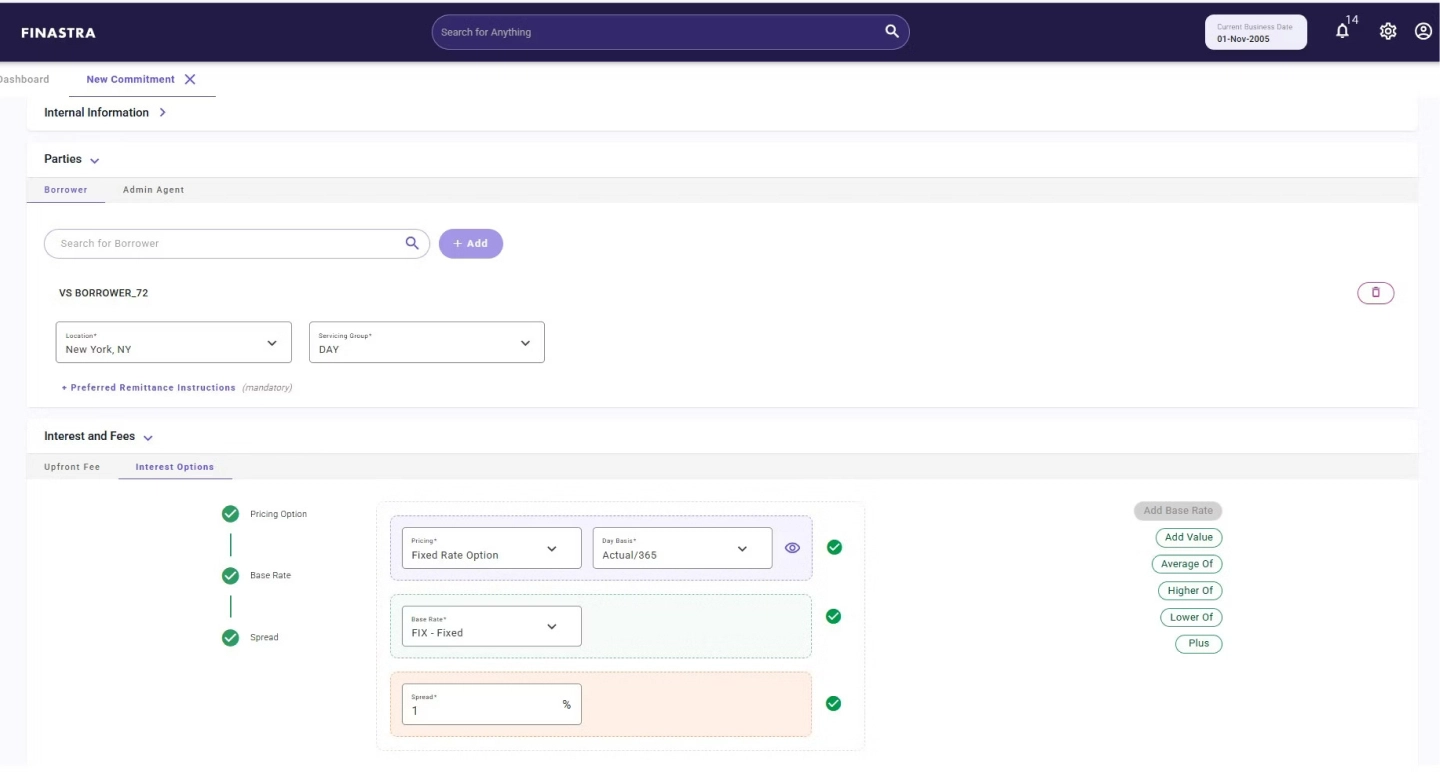
This enterprise-class platform specializes in commercial and syndicated loan portfolio management for multinational banks. It’s built for large institutions to meet their structural capabilities and high-volume servicing needs with rigorous risk management.
Key features:
- Complex loan structuring and servicing
- In-depth risk management and reporting
- Advanced workflow customization with SDKs and APIs
- Tailored support for syndicated and large corporate loans
- Integrations with treasury and accounting systems
Pros
- Can handle the complexity of syndicated and shared loans
- Highly customizable for institutional workflows
- Strong compliance and risk analytics reputation
- Global deployment support
Cons
- Requires a Salesforce platform license, which increases total cost.
- Relies heavily on Salesforce infrastructure, which might limit customization flexibility.
- Out-of-the-box functionality is limited for non-commercial loans, which can limit agility.
Temenos
A full-scale banking platform that offers fairly comprehensive loan origination and servicing capabilities. It has been widely adopted across Europe, Asia, and emerging markets for commercial lending.
Key features:
- End-to-end loan lifecycle management
- Integrated risk and compliance modules
- Multi-channel digital onboarding and servicing
- Advanced analytics and AI for credit scoring
- Core banking integration
Pros
- Strong presence in global markets, especially trusted in Europe
- Highly customizable for a wide range of lending products
- Deep regulatory compliance support across jurisdictions
- Scalable cloud and on-premises deployment options
Cons
- Complex implementation process that requires expertise
- May require significant investment for smaller financial institutions due to cost of ownership
- Mixed feedback on support responsiveness and system bugs
Fiserv LoanServ
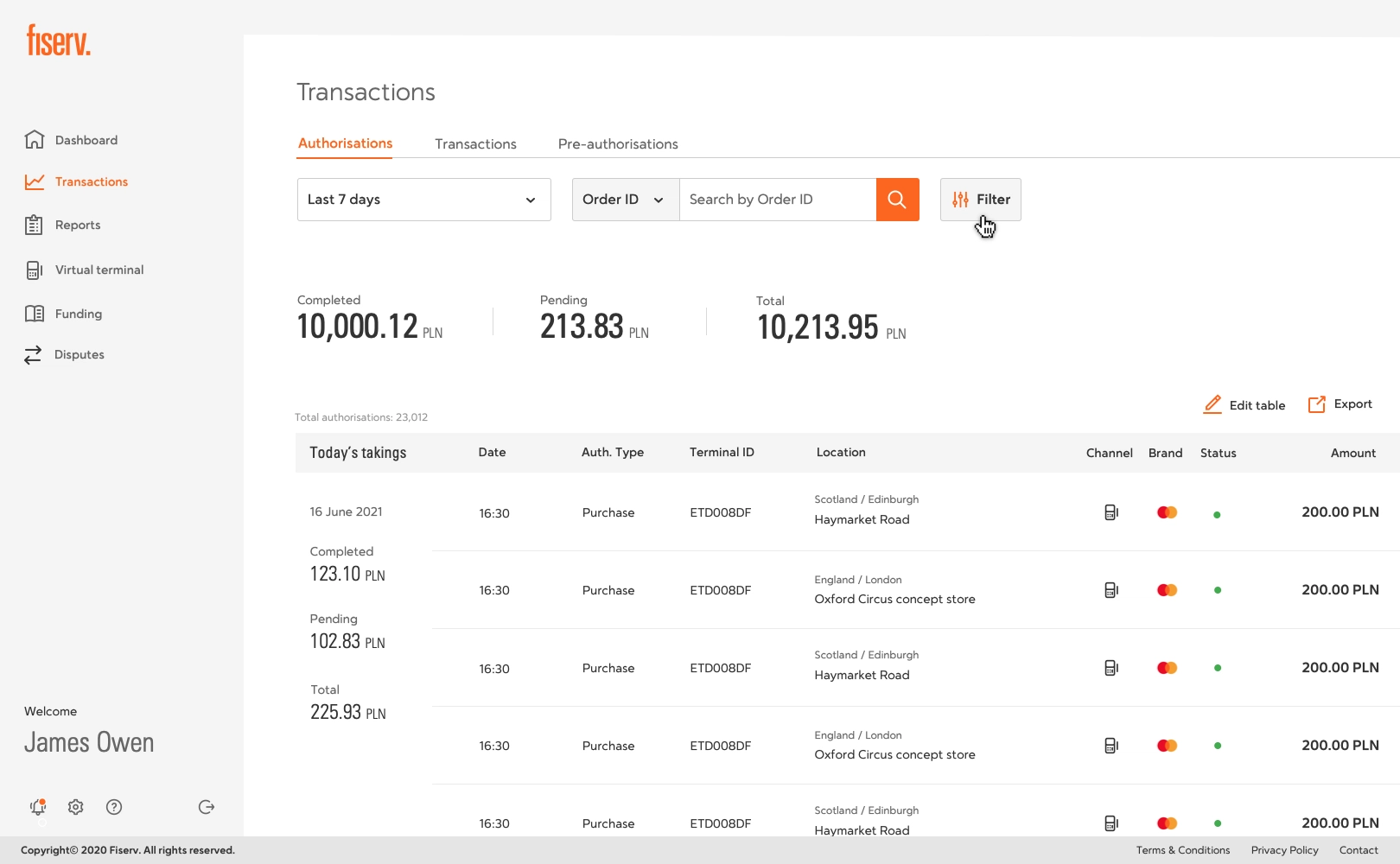
One of the more mature options on the fintech scene, LoanServ is a full-service loan servicing platform that covers consumer, commercial, and multifamily loan portfolios with end-to-end automation. It’s trusted by organizations that need compliance, investor reporting, and reliability.
Key features:
- Full-cycle services for mortgages, consumer loans and more
- Automated servicing and payment processing
- Investor reporting and audit capabilities
- Default and loss mitigation management tools
- Integration with core banking, accounting, and treasury systems
- Configurable business rules and workflow automation
Pros
- Tried and trusted solution for high-volume lenders
- Extensive servicing and collections capabilities
- Supports hybrid cloud and on-premises deployments
- Compliance and investor reporting features
Cons
- The user interface can feel a bit dated and overcomplicated
- Implementation and upgrade cycles may be lengthy and require training
- Mixed sentiment over support features
nCino
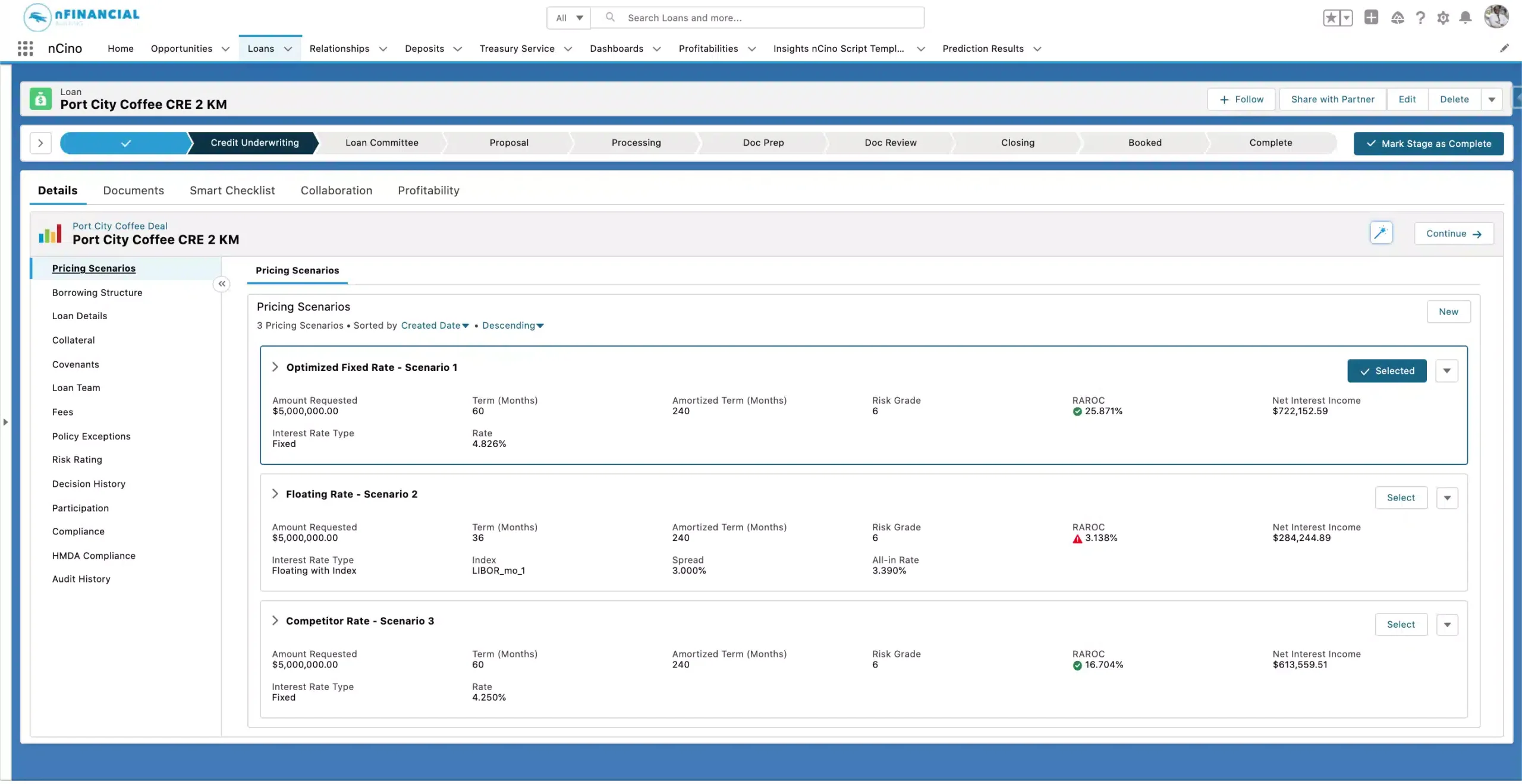
Built on Salesforce, nCino is a cloud-based solution for commercial lending and portfolio management. This platform mainly focuses on enhancing banking CRM and digital workflows and less on being a jack-of-all-trades.
Key features:
- Loan origination and underwriting workflow automation
- Portfolio and risk management dashboards
- Compliance and audit trail automation
- Salesforce ecosystem API integrations
- Loan product configuration
Pros
- Seamlessly integrates with Salesforce
- Works well for commercial and SME lenders
- Has adaptive workflows and real-time reporting
- Wide partner ecosystem and developer support at all stages
Cons
- Requires a Salesforce platform license, which increases total cost.
- Relies heavily on Salesforce infrastructure, which might limit customization flexibility.
- Out-of-the-box functionality is limited for non-commercial loans, which can limit agility.
Common Pricing Models for Loan Management Software
Pricing in this market varies significantly depending on deployment scope, implementation complexity, product coverage, integration needs, and transaction volumes. There is no single pricing model that is universally better—the right option depends on each lender’s operating model, growth plans, internal resources, and expected scale.
The most common pricing models include:
Fixed subscription fee—a recurring monthly or annual platform fee, typically used in SaaS-based deployments and often preferred for cost predictability.
Implementation fee—a one-time charge covering setup, configuration, integrations, migration, testing, and go-live support. This is common for platforms with broader workflow and customization scope.
Usage-based pricing—fees tied to actual platform consumption, such as application volume, active accounts, processed payments, or API usage. This model can align costs more closely with business activity. Account- and transaction-based fees are also widely used in financial software markets.
Per-loan or per-account pricing—costs linked to the number of originated, serviced, or active loans/accounts on the platform. This model is often easier to map to portfolio growth.
Module-based pricing—pricing depends on the specific modules selected, such as onboarding, origination, servicing, collections, scoring, or analytics, rather than the full platform.
Enterprise or custom licensing—individually structured commercial terms for larger institutions with more complex deployment, governance, security, or multi-entity requirements. Subscription-based licensing is also used in enterprise banking technology contracts.
You can also request a rough project estimation based on your business model, loan products, target markets, integrations, and deployment preferences. Even an early estimate can help clarify the likely implementation scope, pricing logic, and the most suitable commercial model for your lending operation.
Other Loan Management Solutions to Consider
This group includes strong products that are widely used in lending but are not always directly comparable to full lifecycle loan management platforms. In many cases, they are specialized primarily in origination (often mortgage-focused) and are typically deployed alongside separate servicing and collections systems rather than replacing the entire loan management stack.
LoanPro
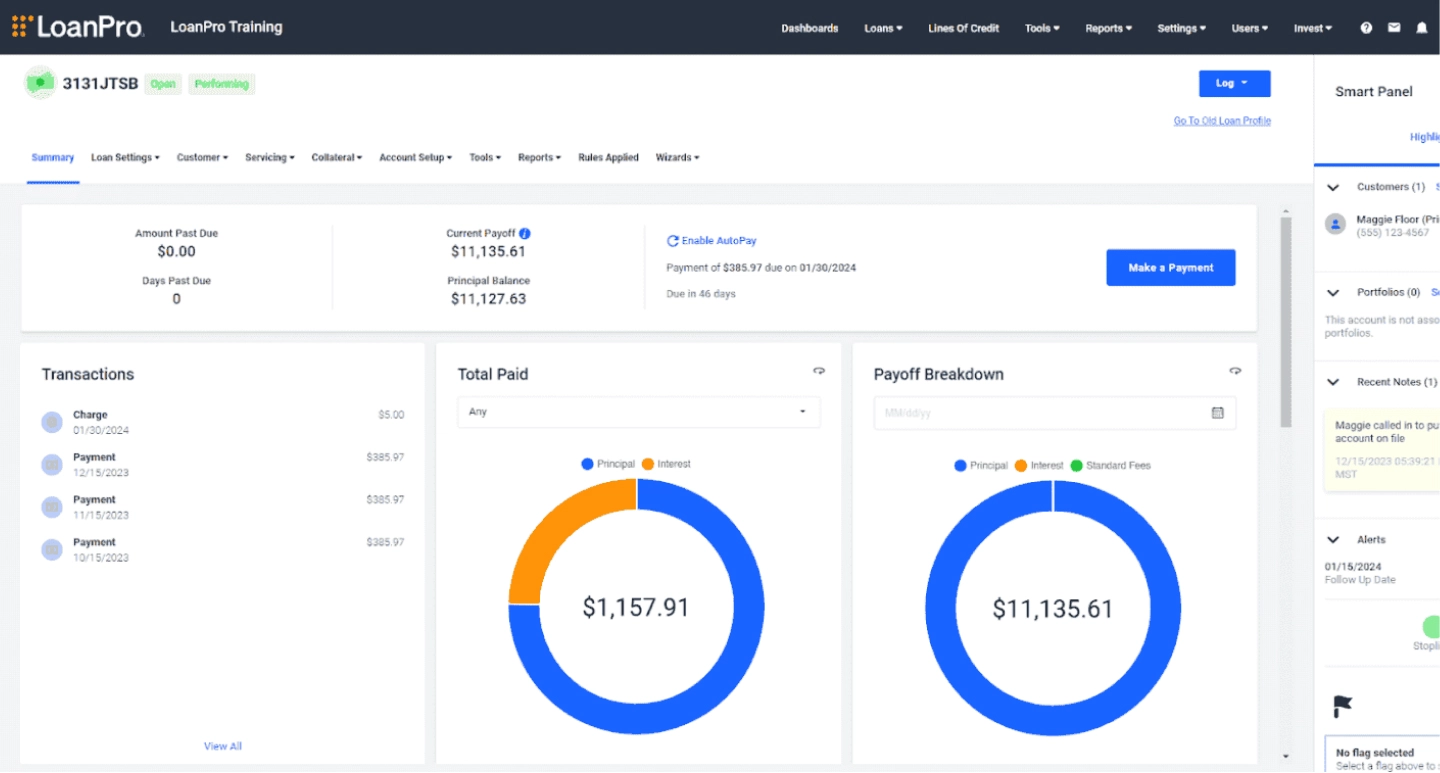
A cloud-based loan servicing platform, LoanPro concentrates on the North American market, catering to tech-forward lenders with specific lending operations’ needs. It offers extensive automation and flexibility, making it a popular choice. It is a composable, API-first lending and credit platform spanning origination, servicing, collections, and payments, commonly used in fintech and modern lending stacks.
Key features:
- Automated loan servicing, payment processing, and collections tools
- Customizable workflows and loan product configurations
- Real-time reporting and analytics dashboards
- Customer portals and communication tools
- Extensive API and integration capabilities
Pros
- High automation reduces operational overhead costs
- Flexible configuration supports multiple loan types, including niche models
- User-friendly interface with strong support resources and documentation
- Scalable cloud architecture and API-first design
Cons
- Smaller enterprise footprint compared to global players
- Could require third-party tools for advanced underwriting
- Data structure can be complex for some users.
Encompass—ICE Mortgage Technology
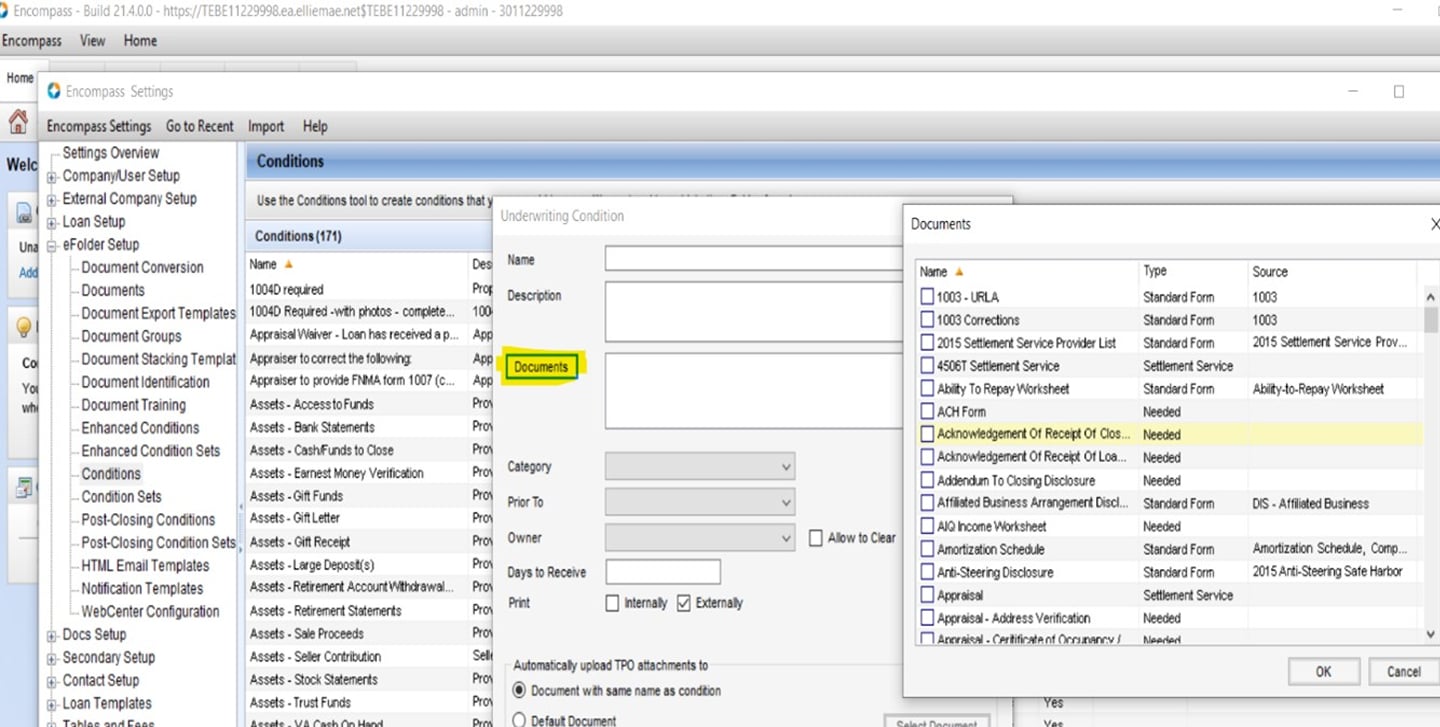
One of the world’s premier digital mortgage origination and servicing platforms. Encompass has been widely adopted by large banks and mortgage lenders for comprehensive loan lifecycle management, and is known as a mortgage industry staple. Encompass (ICE Mortgage Technology) - typically considered a mortgage loan origination system, so it fits better as “adjacent” software rather than a full LMS spanning servicing and collections as a single platform.
Key features:
- Automated mortgage loan application and processing
- Compliance-first document management systems
- Integrated closing and underwriting workflows
- Marketplace available for third-party integrations
- Developer tools, including APIs and customization frameworks for maximum flexibility
Pros
- Automation optimized for mortgage lending
- Compliance tools and regulatory support
- Extensive ecosystem
- Works with third-party tools
- Scalability for high-volume lenders and enterprises
Cons
Nortridge Software
- Niche product that is focused primarily on mortgages. It is less flexible for other loan types
- A complex onboarding process requires significant training for staff and can be less user-friendly for clients.

Nortridge Software—categorized here because it is positioned as configurable loan servicing/management software focused on running and servicing portfolios with lifecycle visibility and workflows (often alongside an external LOS). NLS is known for its customizable workflows and ability to support diverse loan products on a single system. It’s widely used in specialty finance, consumer lending, and niche credit markets in North America.
Key features:
- Full loan servicing and portfolio management
- Configurable payment and collection strategies
- Customer communication tools integrated
- Automated invoicing and reporting
- Integration with accounting systems
- 150+ built-in reports and dashboards
Pros
- Supports specialized loan products and small- to mid-sized lenders
- Flexible servicing workflows and payment plans
- Strong automation tools
- Caters to niche lending markets
Cons
- Smaller market presence with less brand recognition than other providers
- Limited advanced AI and automation features compared to larger platforms
- Large learning curve for users.
Calyx Software
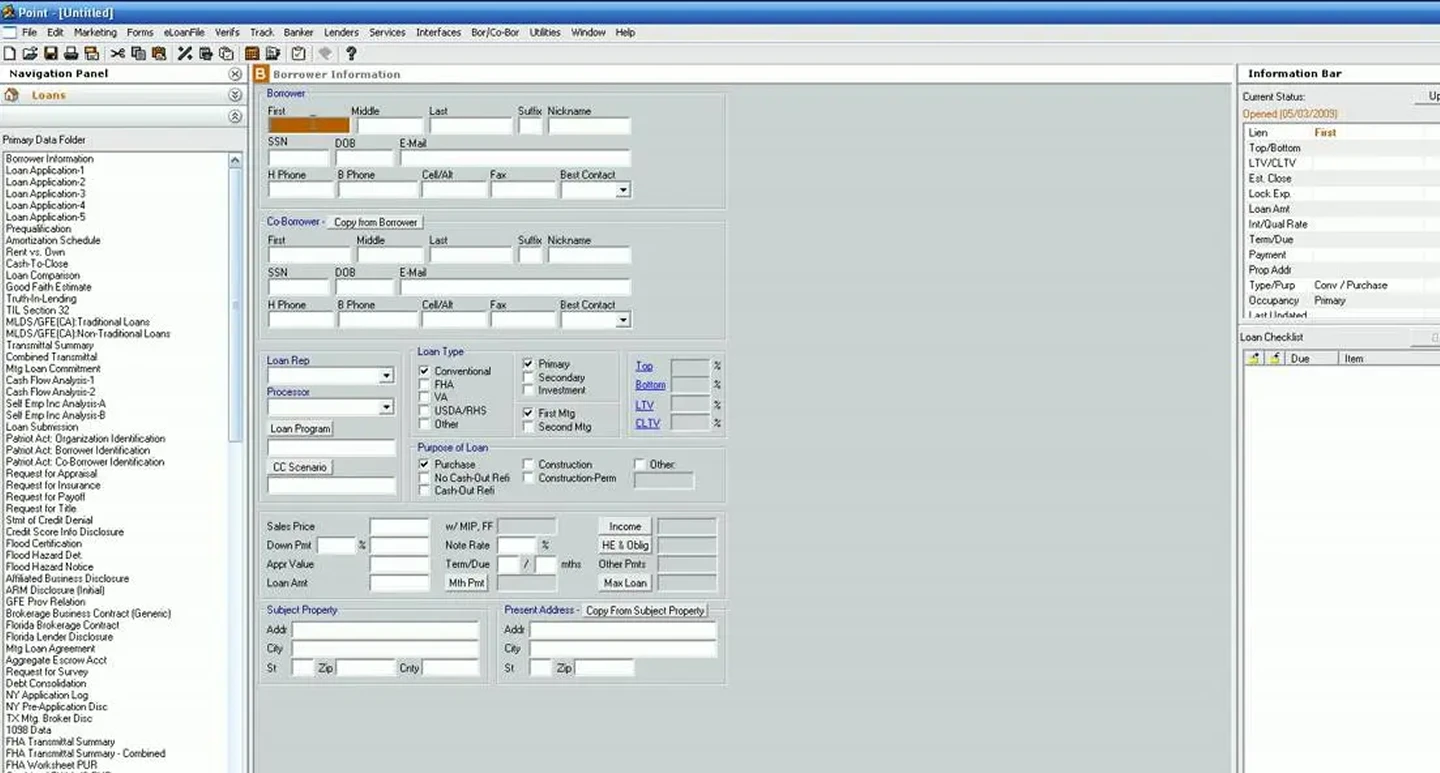
Dedicated to mortgage loan origination and processing with some additional avenues in lending, Calyx Software primarily serves the North American market and has a strong focus on automation and regulatory compliance. Calyx Software is primarily positioned around mortgage origination/LOS workflows (broker/lender origination tooling), making it less directly comparable to full lifecycle loan management platforms.
Key features:
- Mortgage loan origination and processing tools
- Automated compliance, regulatory forms, and audit functions
- Document management and e-signature integrations
- Reporting, pipeline tracking, and workflow management
- Integrations with credit bureaus, appraisal services, and other secondary market investors
Pros
- Experienced in mortgage lending
- Comprehensive compliance automation and form accuracy
- User-friendly interface tailored to mortgage professionals
- Effective integration with mortgage investors and agencies
- Cloud platforms available for growing businesses
Cons
- Limited scope mostly deals with mortgage loan origination
- Less suited for broader loan servicing or commercial lending
- Legacy versions still exist and can be outdated
What Makes for the Best Loan Management Software?
Besides a full-scale loan management software comparison, it's crucial to know which tools we really need, what truly distinguishes top loan management solutions from other offerings, and what to look for when making strategic decisions.
A few years ago, automation may have been the main focus of innovation. Today, the best loan management software in 2026 is defined by many more factors. All eyes are on flexibility, AI-driven intelligence, platform resilience, and, in turn, compliance and secure anti-fraud features.
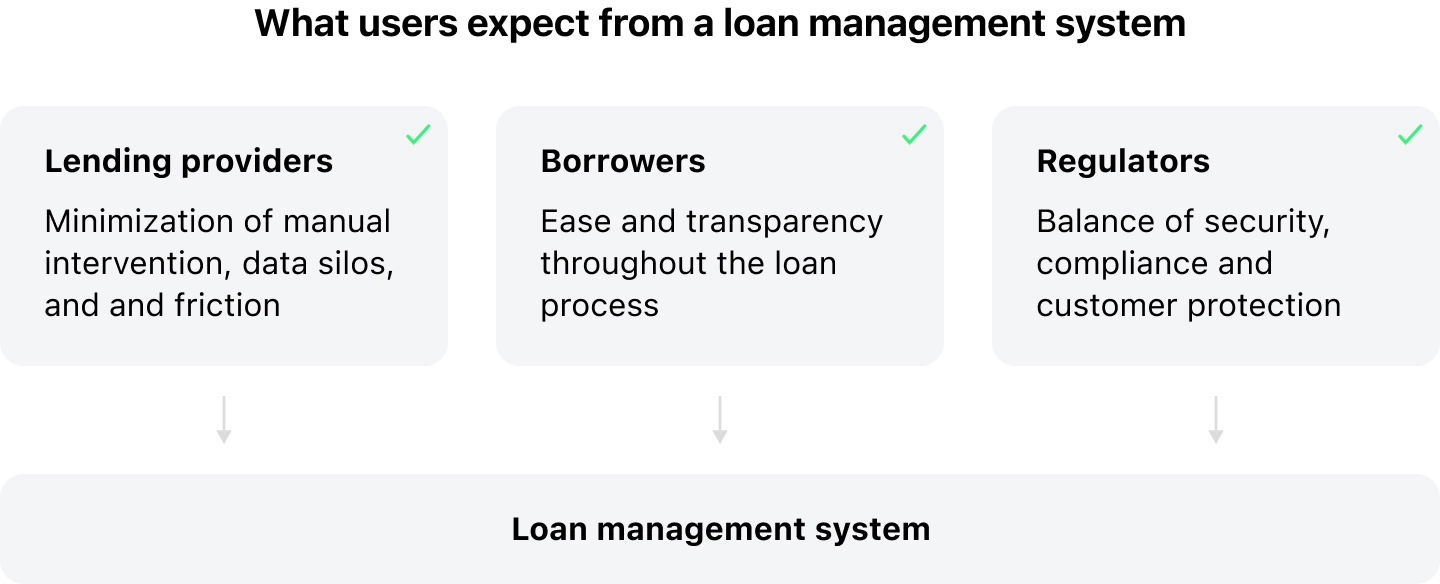
Modern lending providers aim to consolidate loan origination and servicing platforms into unified platforms to reduce manual intervention and data silos, reducing human error and friction. Meanwhile, borrowers expect ease and transparency throughout the loan process.
At the same time, regulators seek a balance of security, compliance, and customer protection—as it stands in today’s market, which includes ensuring that lending practices are fair and transparent while also safeguarding sensitive borrower information. Failing to balance these not only means customer churn, but also falling behind your competitors, higher costs, operational strain, and potentially sanctions. For lenders, that means prioritizing several components and ensuring they are woven into the fabric of their loan management systems.
What Features Should Loan Management Software Have?
Businesses evaluating loan management software should first understand the full loan lifecycle. By mapping lifecycle stages to clear software capabilities, organizations can define the features an LMS must include.
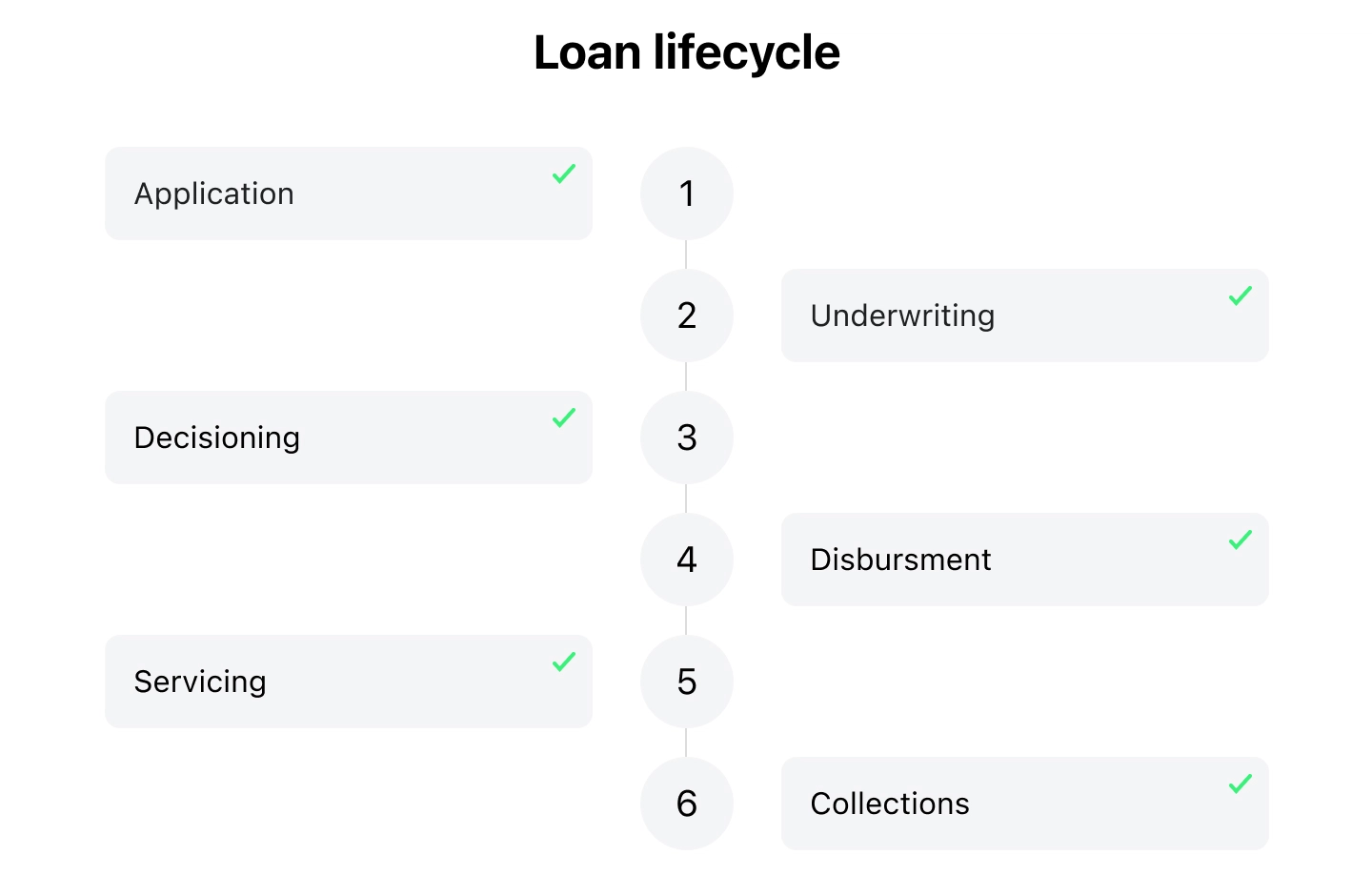
Here's a brief summary of the core features to be included at each stage of the loan lifecycle:
| Loan stage | Feature | Why it’s crucial | Must-have or nice-to-have | Business benefits | Development/integration complexity |
|---|---|---|---|---|---|
| Application intake | Automated onboarding | Eliminates manual data entry, reduces errors, and speeds up the start of the lending cycle. | Must-have, especially for digital-first lenders. | Higher conversion, lower operational costs, faster processing. | Medium – requires good UX, form logic, and data capture workflows. |
| Application intake | Streamlined KYC/AML checks | Ensures identity verification and regulatory compliance; reduces fraud risks. | Must-have for all regulated lenders. | Faster onboarding, reduced compliance workload, and fewer drop-offs. | Medium to High – requires integration with identity/KYC providers and meeting varied regulatory requirements. |
| Decisioning | Decisioning engine | Centralizes rules, scores and policies to produce fast, consistent outcomes | Must-have | Faster approvals; reduced bias; auditability. | Medium to High – requires APIs to bureaus/IDV, rule engine, model management and versioning. |
| Underwriting | AI-driven underwriting | Improves accuracy, consistency, and risk detection; enables faster decisions. | Becoming a must-have for competitive lenders; still optional for very small teams. | Better risk assessment, fewer defaults, ability to approve more borrowers safely. | High – needs data pipelines, model integration, explainability tools. |
| Disbursement | Flexible disbursement tools | Ensures smooth and fast loan payouts via bank transfers, cards, or wallets. | Must-have | Improved borrower experience, faster fund delivery, reduced manual work. | Medium – depends on payment processor APIs and reconciliation needs. |
| Servicing | Real-time compliance monitoring | Protects against regulatory breaches, errors, and missing documentation. | Must-have for regulated markets; strong “should-have” for fintechs. | Lower compliance risks, better audit readiness, fewer manual checks. | Medium to High – requires rules engine, monitoring logic, and up-to-date regulatory inputs. |
| Collection | Integrated debt collection workflows | Helps track missed payments, automate reminders, and recover late loans faster. | Must-have once the portfolio grows; nice-to-have for small lenders. | Higher recovery rates, early risk detection, reduced delinquency. | Variable: simple reminders = low; advanced workflows = high. |
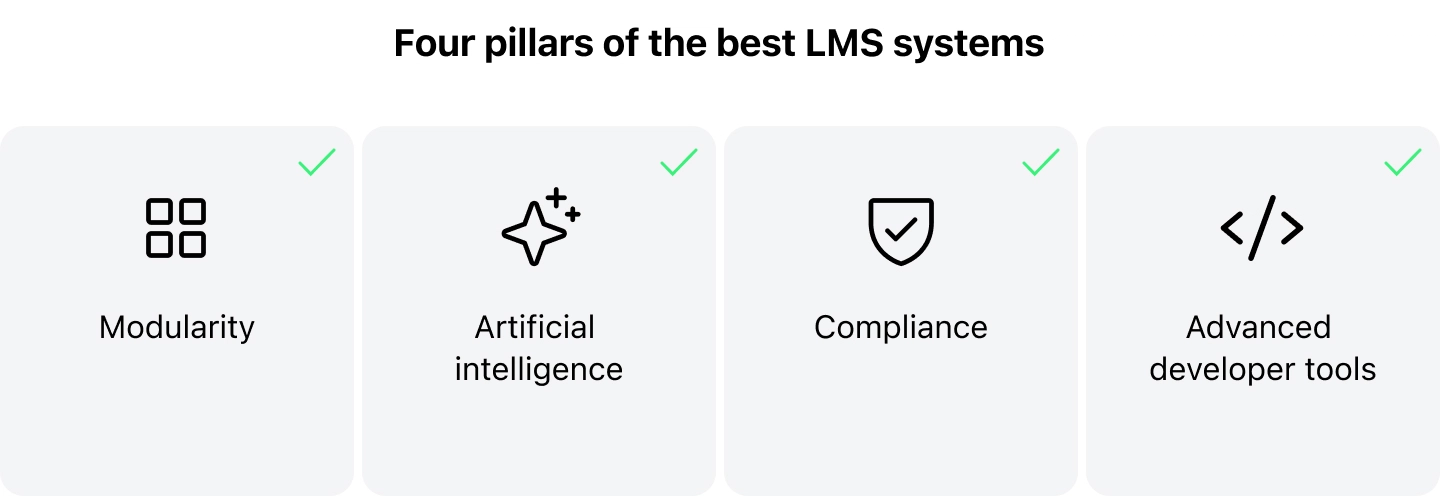
Four Pillars of the Best LMS Systems
We've covered the features crucial for building a market-ready loan management system. The next step is cementing this set with a robust architecture and operating model that reliably deliver the functionality across the entire loan lifecycle.
Cohesion and Modularity
Modern platforms should unify the full loan lifecycle in one environment to reduce fragmentation, improve accuracy, and lower risk, while staying modular. In practice, this means a system with deployable modular microservices for new loan products, customizable borrower portals, easy third-party integrations, and regional compliance.
Although this may sound like somewhat of a contradiction, the logic is quite simple. While the main platform should be complex and seamless, businesses need to onboard different tools for their needs. This flexibility lets lenders scale into new products or markets without costly system rebuilds, and lowers risk to the overall business.
Developer Empowerment
This is now a core differentiator. Lending software that provides REST APIs, webhooks, SDKs, event-driven architecture, and sandbox environments helps fuel rapid innovation and scaling for future business growth. Cloud-native, API-first platforms enable fintech agility and continuous evolution, adapting quickly to market changes, and allowing developers to focus on business needs that truly matter.
Artificial Intelligence
Last but not least, artificial intelligence that manages risk scoring, fraud detection, document and smart collection processing, and smart collections operations is playing a major role in the modern lending process.
When combined with advanced analytics, AI turns loan management into a smoother, automated, or half-automated process. It provides lenders with real-time insights that improve decisions, reduce defaults, and enhance borrower satisfaction and repayment performance.
Compliance and Security
Compliance and security are critical features in any lending platform and not boxes to tick. In the US alone, consumers lost over $12.5 billion to fraud in 2024. This is an almost 25% increase on the previous year's figures. Meanwhile, Visa’s 2024 Global eCommerce Payments & Fraud Report indicated that while 82% of merchants added at least one new payment method or more in the last year, showing an interest in diversification, at the same time, 80% struggle to effectively use data and technology to improve AI/ML fraud-prevention tools.
With fraud threats expanding and operational gaps on the rise, lending systems need to support the tools to target this. Strong security, including cloud-native architecture, strict access controls, and continuous threat detection, is essential in dealing with rapidly evolving financial crime.
What to Look for When Choosing Your Top Loan Management Software?
Selecting the best loan management software isn’t all about comparing features or the tech stack. You need to be able to match your business needs to a platform and operational model, taking into account deployment preferences, enterprise size, loan product mix, geographic strategy, and a variety of other factors. This balances the market landscape, technological demand, and business needs. Let’s take a look.
- Deployment mode
- Enterprise size
- Loan type
- Geography specifics
1. Deployment mode: cloud vs. on-premises
- Cloud-based systems are leading the market due to their scalability, faster rollout time, and lower initial costs. Fintech, SMEs, online lenders, and banks moving to digital-first architectures often choose these for their flexibility. Cloud platforms enable modular updates, automatic scaling, and rich API ecosystems for agility. But they’re not perfect for everyone, as there is often reliance on a third-party data provider, and this could cause some data residency or sovereignty risks, and therefore, compliance issues.
- On-premises solutions are often preferred by large financial institutions with complex security, compliance, and legacy demands. They allow for maximum data control and deeper customization but deploy more slowly and require a large investment for any sort of development. There are often high up-front costs to consider, as well as the need to manage and monitor every step.
2. Enterprise size: SMEs vs. large institutions
- SMEs generally favor cost-efficient, cloud-first platforms. These can offer fast onboarding, automated scoring, and user-friendly workflows to reduce staffing needs and cut costs. This delivers flexibility and agility to adjust to changing business demands without jeopardizing operations.
- Large enterprises often seek out highly customizable, enterprise-grade systems with extensive integrations, diverse loan portfolio support, and scalable architectures capable of handling millions of transactions. These types are suitable for long-term sustainability, but are more rarely open to rapid development.
3. Loan type: functional pressure points
The type of loans you plan to offer will demand a different approach to your platform. This choice will impact the type of provider you choose as your vendor. Mistakes in this area could prove costly, as tech debt can be expensive to fix down the line. Consider whether you will offer:
- Personal loans: These are high-volume and require automated decisioning, instant credit scoring, and agility.
- Auto loans: Consider adding in dealer integrations, title management, structured repayment plans, and more.
- Mortgage loans: Demand complex underwriting solutions, layered compliance, and long-term servicing to manage efficiently.
- Commercial loans: These are multi-entity structures that require collateral management solutions, covenants, and syndication workflows to work effectively.
- Buy Now, Pay Later (BNPL): This approach demands real-time risk assessment, almost instant approval processes, tight merchant integrations, and flexible installment management, without compromising security.
4. Geography: Regulation, Market Maturity, and Digital Adoption
Even in an increasingly globalized world, finance is an area where location matters. This is mainly due to regulations and national laws. However, it pays to check at the beginning where your chosen platform operates and compare it to your markets.
Varying regions come with very different expectations and challenges:
- North America leads in digital adoption but enforces strict regulatory standards.
- Europe is compliance-heavy, shaped by GDPR, PSD2, and fast-moving supervisory frameworks.
- Asia-Pacific grows at a remarkable speed, driven by mobile-first banking and financial inclusion, favoring cloud-first, highly scalable platforms.
- Latin America is modernizing quickly, with fintech expansion creating demand for agile, API-friendly systems.
- The Middle East and Africa are evolving rapidly as regulatory clarity and digital infrastructure improve, offering strong long-term growth potential.
That means any software adoption has to consider its key markets closely first.
Conclusion
Choosing the best loan management software is a strategic decision critical to your company’s ability to scale, innovate, and exceed borrower and regulator expectations. In a market where almost every vendor boasts their tools are the best, it’s by being able to ask the right questions and understand the tools you need that you will be able to automate your processes most effectively.
The right choice can transform your loan management process from frustration into a growth engine that is powered by efficiency, agility, and superior borrower experiences. The wrong one can be costly. The trick is getting it right, at the right time, and with the right team and tools at your back.
How We Evaluated These Platforms
This comparison is based on publicly available vendor materials, product pages, customer case studies, review platforms, and market positioning as of March 2026. Product capabilities, security scope, pricing, and implementation complexity may vary by configuration, region, integration depth, and service model. Where independent third-party validation was limited, we relied on publicly documented vendor information.
We assessed each platform across 8 dimensions:
- lifecycle coverage
- architectural flexibility
- deployment options
- scalability readiness
- security and compliance posture
- configurability and modularity
- UX and operational usability
- market maturity and customer validation
Each platform was reviewed using publicly available product documentation, implementation materials, client case studies, security pages, and third-party review sources where available.