On its way from application to final payment, a loan passes through identity checks, a credit decision, a repayment schedule and, if the borrower falls behind, a collections queue. At many lenders these steps sit in separate systems, so launching a product or changing a rule often means a vendor ticket or a manual workaround. Flexibility is now one of the first things lenders check when they choose a platform: how much their own team can configure without the vendor and how much control stays with them once the system is live. HES LoanBox, the lending platform from HES FinTech, is designed around both.
It is built as an end-to-end lending platform for banks, credit unions, and fintech lenders that want to manage a full loan lifecycle in one system. More than 160 businesses in 32 countries run on it today.
This guide covers what the platform includes, what a lender configures without code, what HES builds on request, and how deployment works.
What Is LoanBox?
HES LoanBox is a modular lending platform. It offers 20+ modules that a lender configures around its own loan products, credit policy, and operating processes.
Banks, credit unions, fintech companies, and alternative lenders set it up for consumer lending, including auto, BNPL, POS, payday, student, mortgage, microfinance, and P2P loans, as well as healthcare financing. On the business side, it covers SME, commercial, and working capital loans, merchant cash advances, factoring, leasing, trade finance and green finance. The same core supports Islamic finance with Sharia-compliant workflows.
The platform works in two layers:
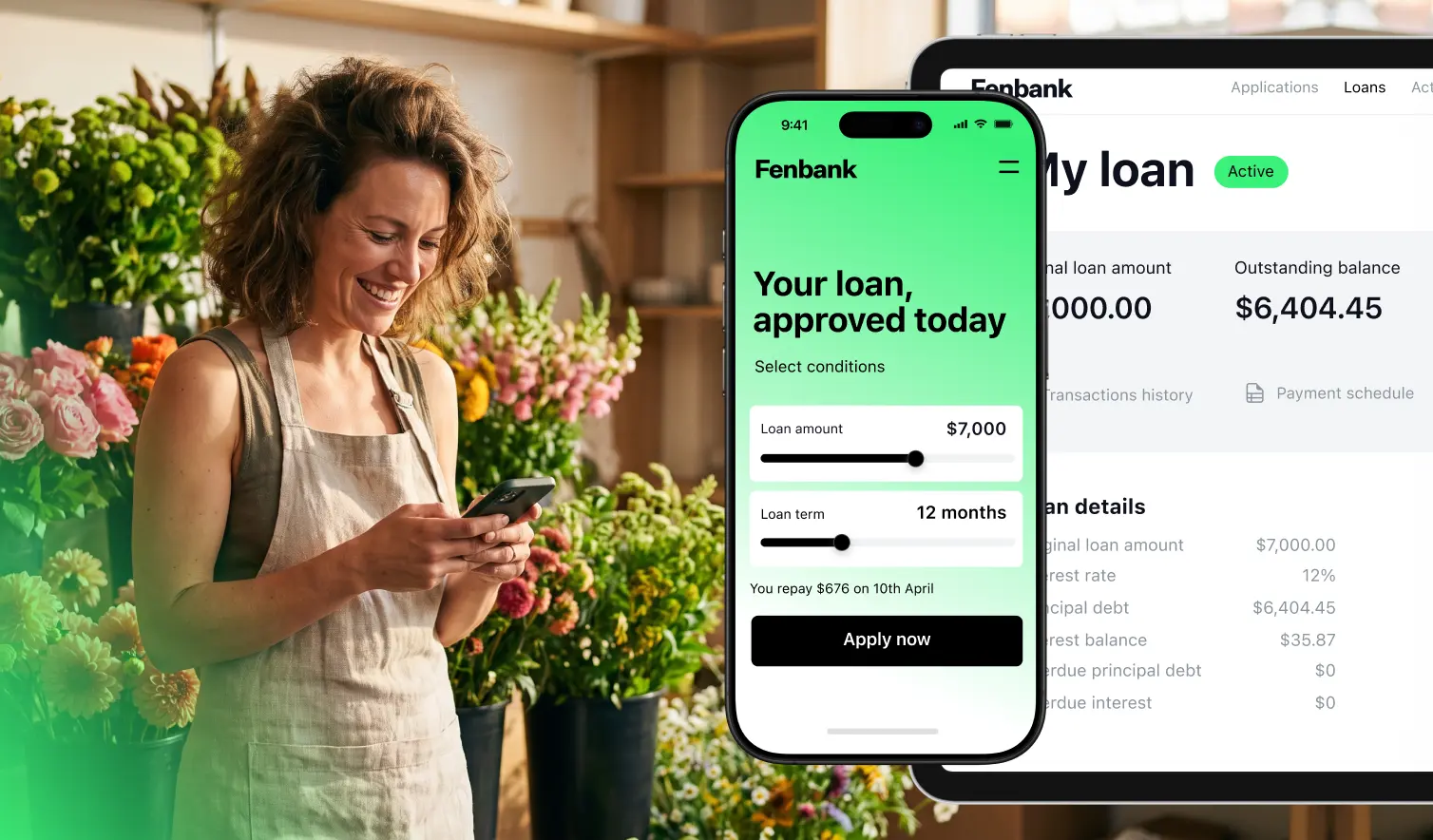
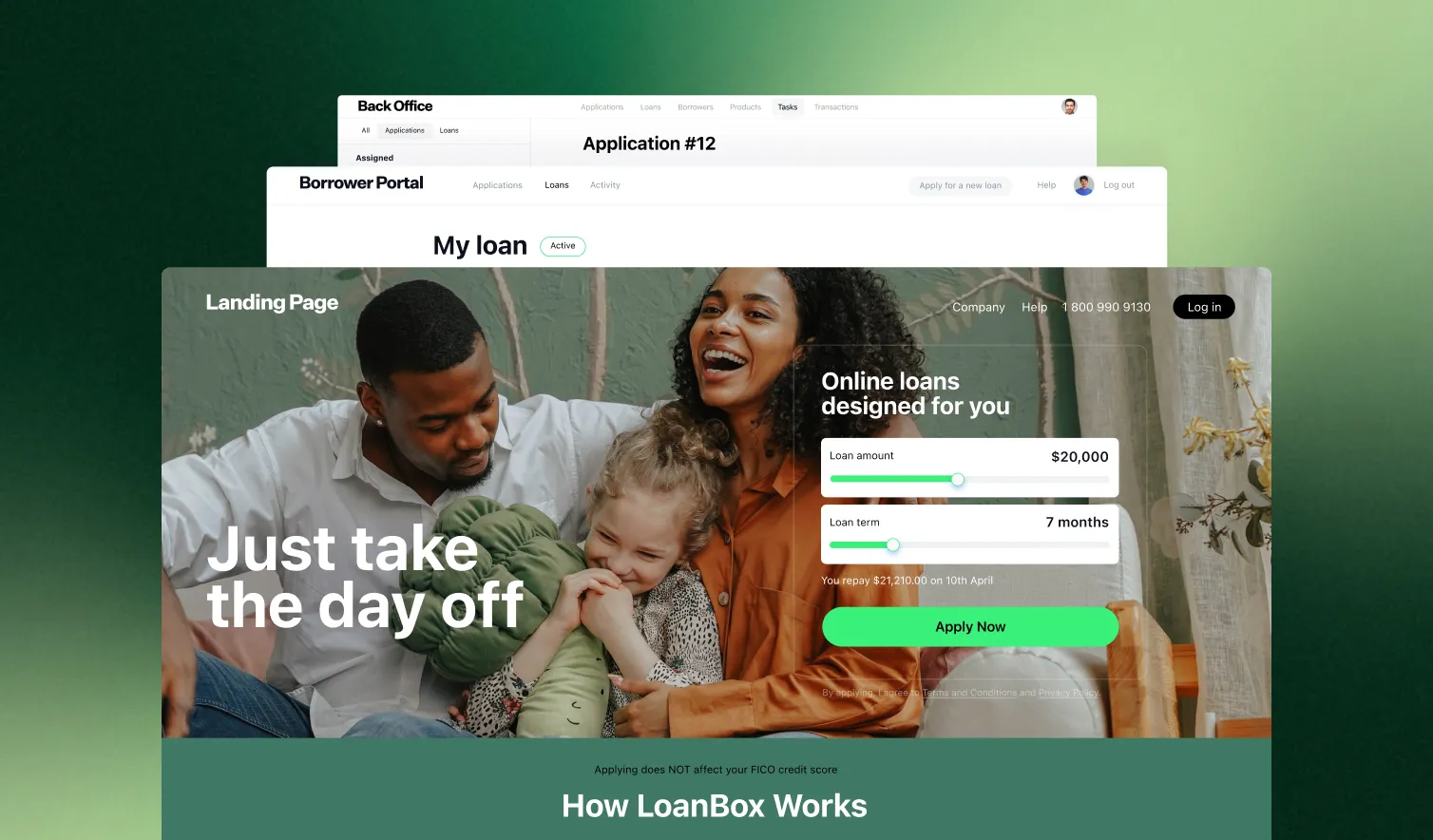
- Borrower-facing layer. A white-label onboarding page in the lender’s brand, with a loan calculator that shows the amount, rate, and terms before anyone applies, and a borrower portal where customers submit applications, check their status, follow active and repaid loans, and plan payments.
- Back office. The workspace for loan processing where staff review applications, make credit decisions, and manage loans from application to repayment, with access set by role.
A project starts with preconfigured modules already in place. From launch, scoring, task routing, borrower notifications, and payment posting can run automatically. How much manual review stays in each product is the lender’s decision. What sets the platform apart is how much of that core a lender can change, automate, and keep under its own control.
Customization Without Code
In HES LoanBox, most week-to-week changes in a lending business are configuration changes. Product teams set loan parameters such as amount and term ranges, interest and default interest rates, and overdue penalties. They can change a product as often as the business needs. Workflows and approval rules are built in a no-code editor based on BPMN 2.0. Custom application forms come from a Form.io modeler, with only the fields each product requires. On the borrower side, the onboarding page and portal carry the lender’s colors and logo, with calculator settings matching each product.
The platform has an API-first architecture, with 100+ possible integrations and an open API for connecting the KYC providers, credit bureaus, payment providers, and messaging services a market requires. Plaid, Flinks, and VoPay are among the ready connectors. When a requirement goes beyond configuration, the HES team adds features and integrations on request, including building the product from scratch.

Automation Across the Loan Lifecycle
Automation in HES LoanBox is set per product group, so a lender can run one product with automatic approvals and keep another under manual review. Credit decisions combine the lender’s own decision tables with GiniMachine scoring. Depending on the result and the underwriting mode set for the product group (automatic, semi-automatic, or manual), the application is either decided automatically or sent to a credit officer.
Outside credit decisions, identity and sanctions checks run during onboarding, while SMS and email notifications update borrowers on their applications and payments. In the back office, tasks are assigned to team members and tracked until they close. On the servicing side, the platform matches incoming transactions and posts them in real time. A loan that goes overdue moves into the collections workflow the lender has configured for it.
Control: What Stays With the Lender
Vendor guides usually draw the line at operational control: the lender configures products and workflows, and the vendor keeps the core. HES LoanBox moves that line. The lender chooses where the platform runs and decides when to install new releases. The data model can be extended with new entities, not only fields. Source code ownership is available as an option: a developer license gives in-house engineers the platform source code.
The pricing model has no per-user fees, and the number of users and borrowers is unlimited. With a standard Java LTS stack and data export on demand, the lender is not locked into the vendor. HES FinTech is ISO 27001 certified and SOC 2 aligned.
Initial conversations with lenders used to focus on functionality. Today, CTOs ask early on where the platform will be hosted and who controls the release schedule. Lenders want a core system that works from launch and the ability to build their own products on it.

How HES LoanBox Covers the Loan Lifecycle
Many lenders run loan origination and servicing software from separate vendors. In HES LoanBox, all the stages described here run in one system. The application, the credit decision, and the loan that follows stay connected from the first form to the final payment.
Digital Onboarding: What's Special

The first thing a borrower sees is a white-label landing page under the lender’s brand. Visitors can try different amounts and terms in the loan calculator and see the rate before they apply. The same page carries an FAQ block for common questions. The loan application form is put together with Form.io, so each product asks only for the fields it needs.
Identity checks run inside the same flow. The platform screens applicants with KYC, KYB, and sanctions checks. When a case needs more evidence, the lender can add step-up identity and document checks through its KYC provider. An open banking provider can also be connected to pull account data for income verification. Once the form is submitted, the application and its check results move to the back office for KYC and risk analysis.
Borrower Portal
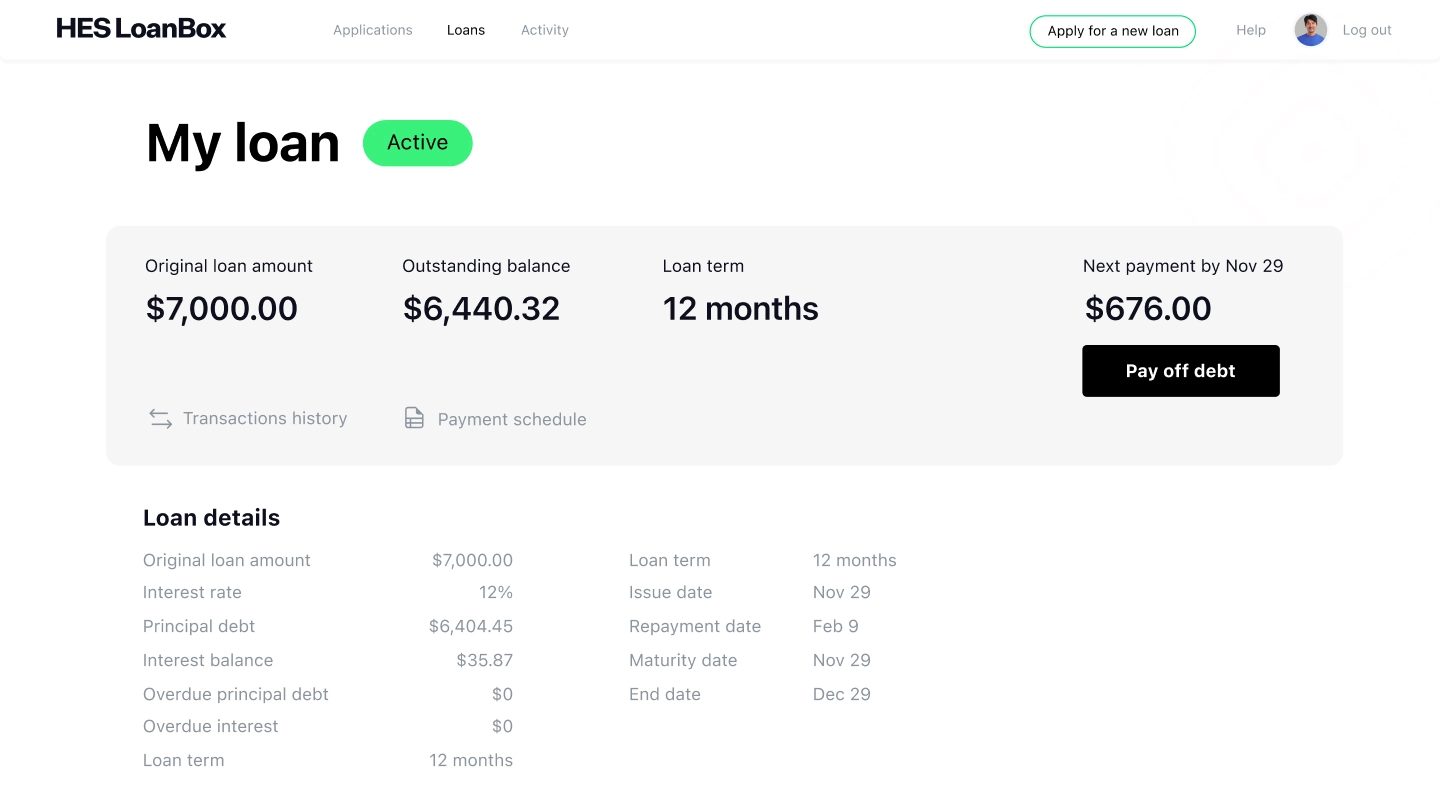
After applying, borrowers get a personal account in the HES LoanBox white-label portal. It includes:
- a borrower profile
- an applications section with the current status of each application
- a loans section listing current and closed loans, each with its repayment schedule
- an activity history
- notifications by SMS and email about applications and payments
From the portal, a borrower can apply for a new loan, follow a decision, and plan upcoming payments without calling the lender. Portal settings, including branding, are configurable.
Loan Origination and Credit Decisioning
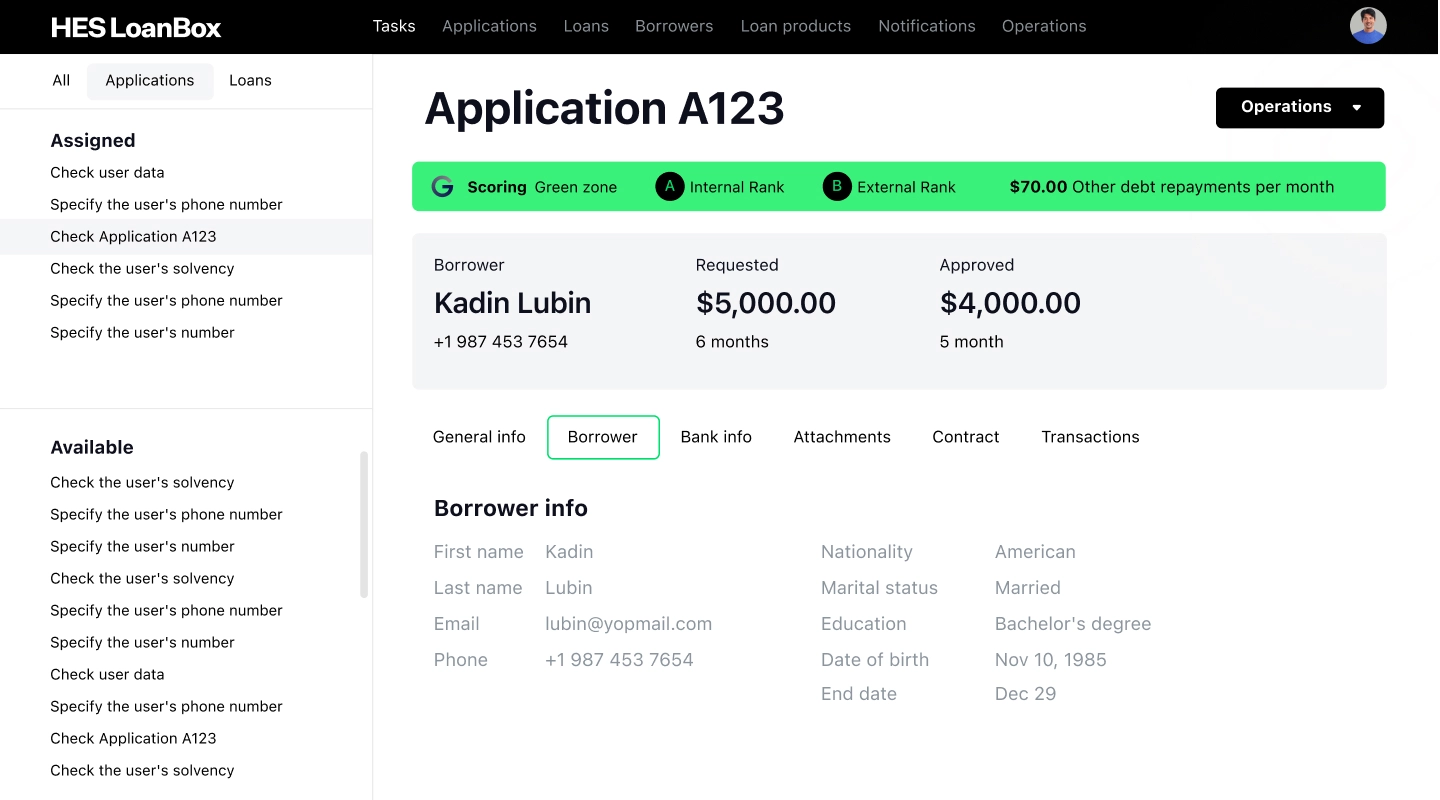
After the application reaches the back office, the platform can pull a credit report and other credit bureau data through a connected bureau and pass the full file to credit scoring and underwriting. Scoring settings belong to the product group: a consumer product and an SME product on the same instance can use different providers, models, and rules.
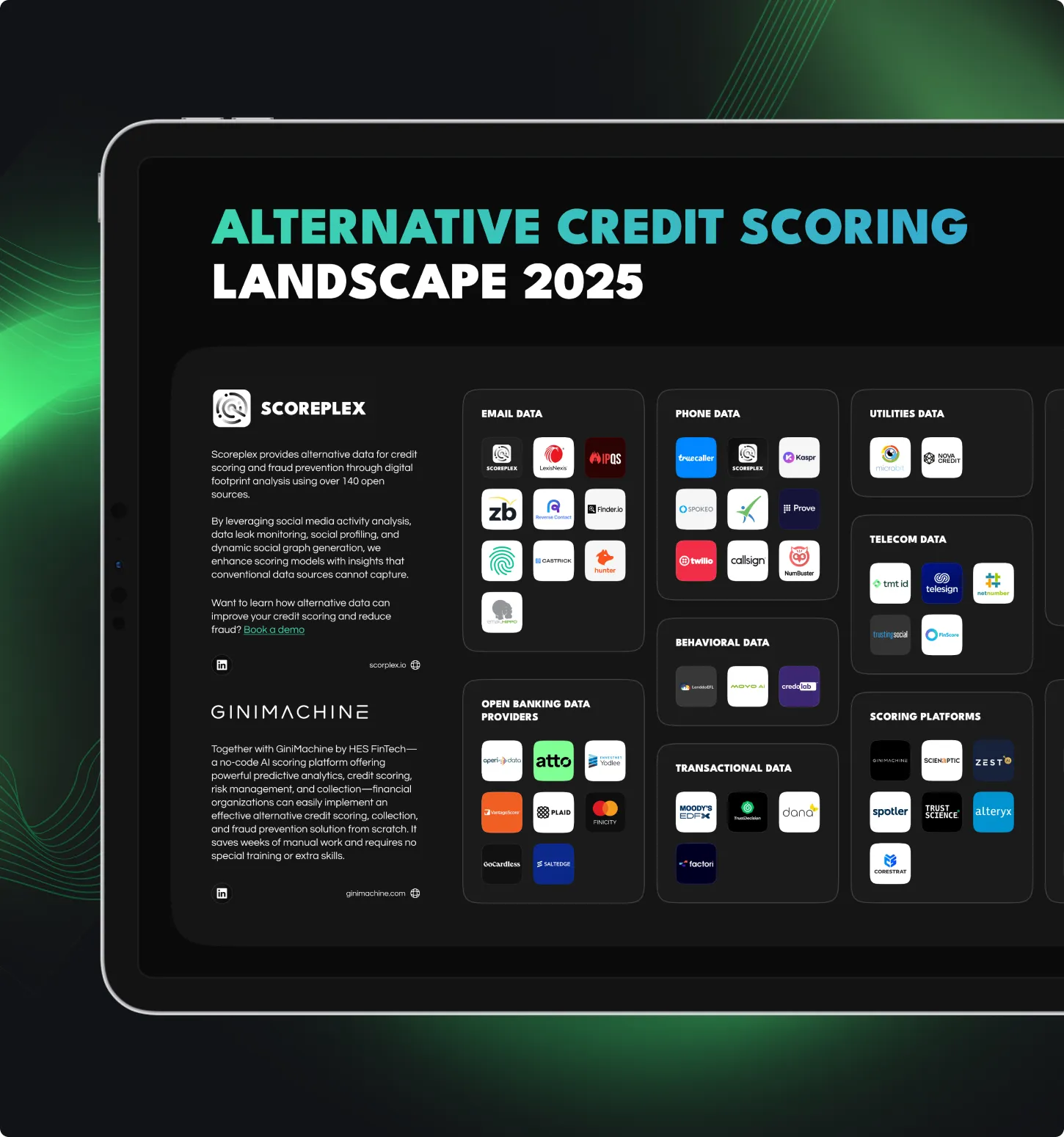
At the origination stage, HES LoanBox has two built-in scoring providers. The internal decision table applies the lender’s own credit policy and assigns an internal rank between A and E. The GiniMachine AI scoring engine returns a probability of repayment and a resolution such as Approve, along with attribute effects that show the direction and weight of each attribute’s contribution. One provider or both can be active, and a third-party provider can be added through customization.
The two results meet in a scoring result table, which assigns the application a zone. Green means both signals are positive, gray means they disagree or the internal rank sits in the middle, and red means all signals are negative. What happens next depends on the product group’s underwriting mode: automatic mode acts on the zone, while semi-automatic and manual modes send the application to a credit officer for review. A gray-zone result also goes to manual review.
How GiniMachine Fits Into Decisioning
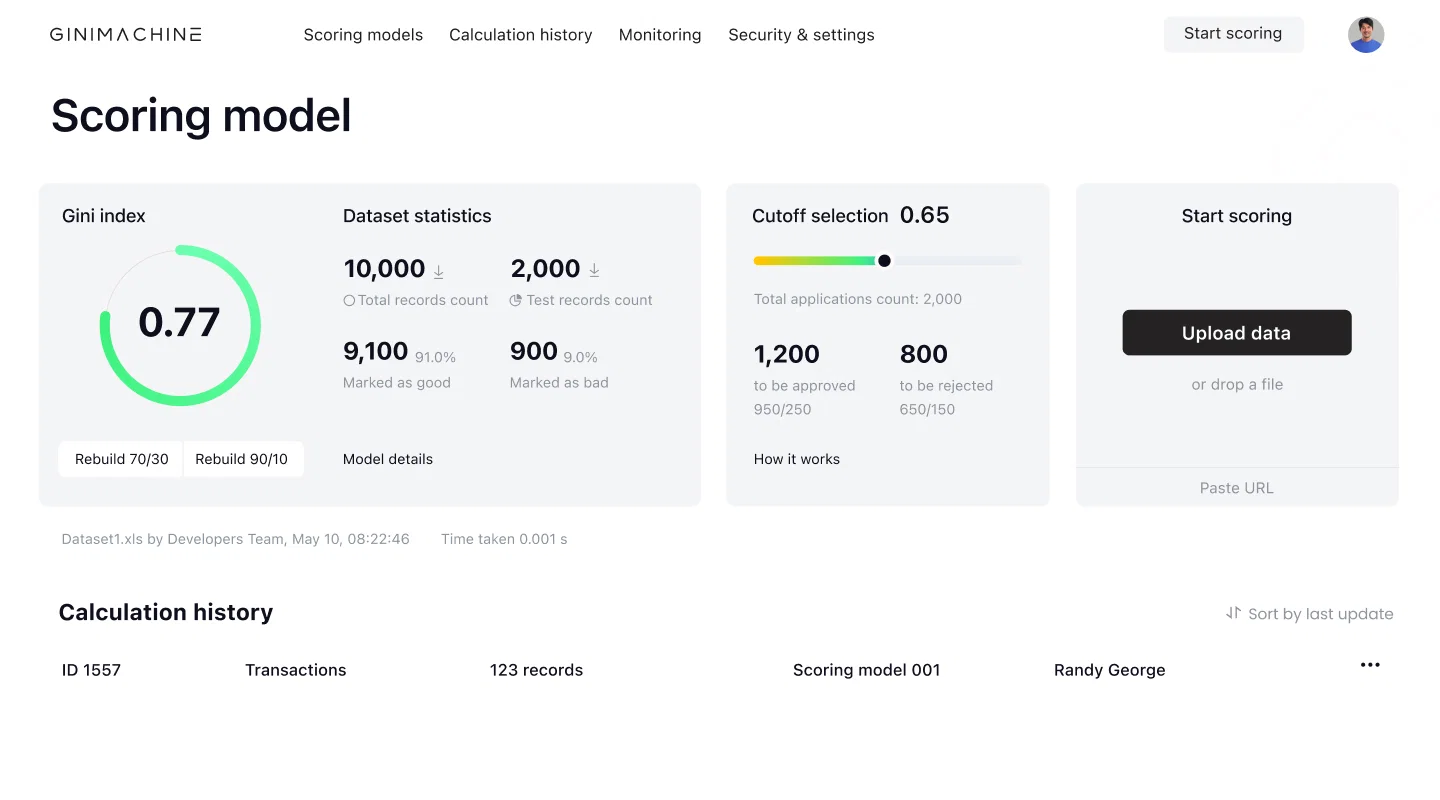
GiniMachine is HES’s AI credit-scoring engine and is also available as a standalone product. Inside HES LoanBox, it runs on a connected GiniMachine instance with a model trained on the lender’s own historical loan data. The model’s name is written into each application, so every decision can be traced back to the model that scored it.
Only the resolution goes into the scoring result table. The probability of repayment and the attribute effects stay in the application for the credit officer to review, sorted from the strongest contribution down. The largest negative effects give the officer a readable starting point for explaining a declined application. Running both providers keeps a policy the lender can read and audit next to a model trained on repayment history, and a disagreement between them is treated as a reason for review.
Loan Servicing and Payment Tracking
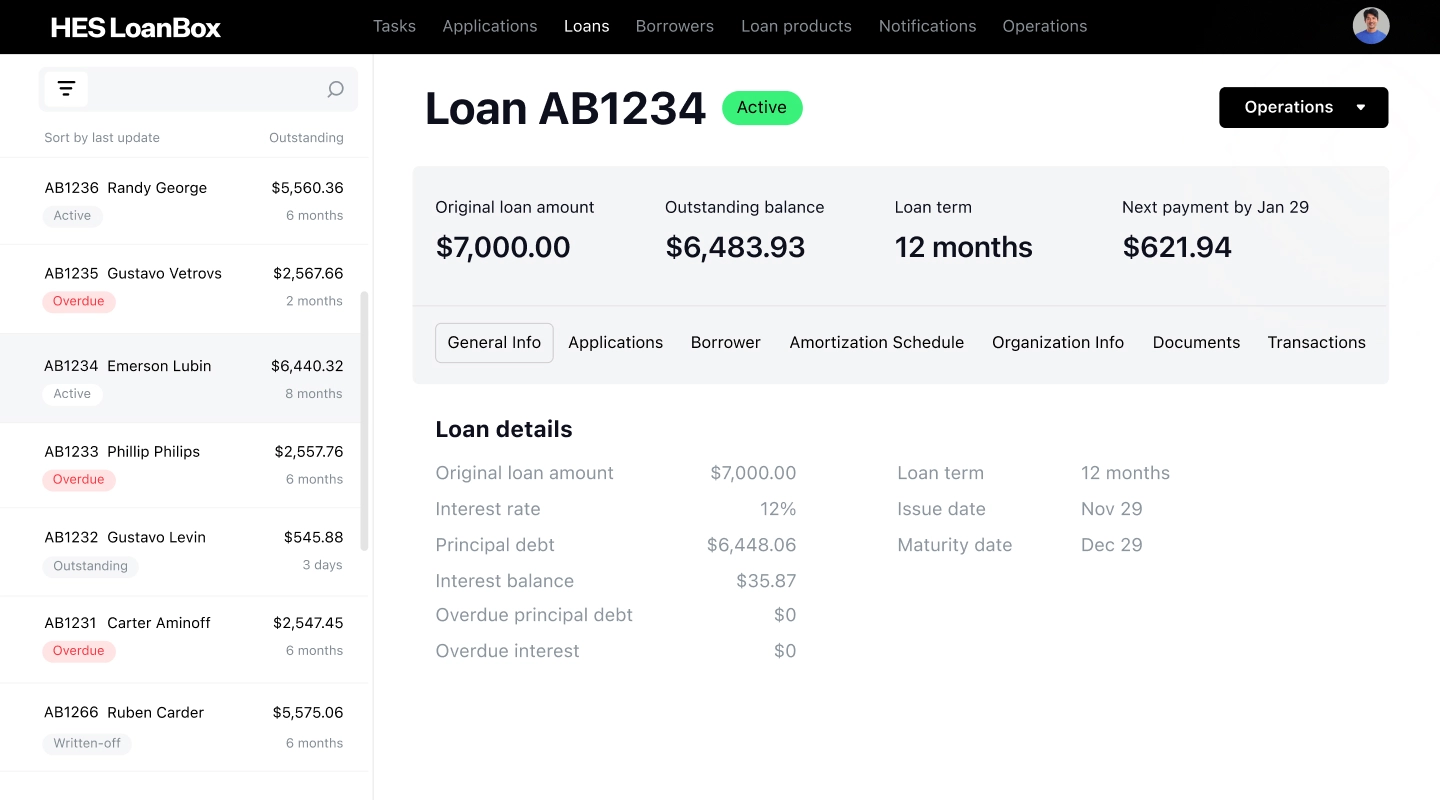
In HES LoanBox, servicing starts with loan disbursement through a connected payment provider. The calculation engine builds the repayment (amortization) schedule from the product’s terms. As payments come in, the loan moves from active to repaid.
Repayment processing runs through the payment providers the lender connects. Depending on the market and provider, the platform can work with ACH, SEPA, SWIFT, card payments, direct debit, mobile wallets, and bank transfers. Automated transaction matching links each incoming payment to the right loan and posts it in real time, so balances in the back office and the borrower portal stay current. Borrowers receive reminders before a payment is due. If a payment attempt fails, configurable retry rules apply.
Debt Collection
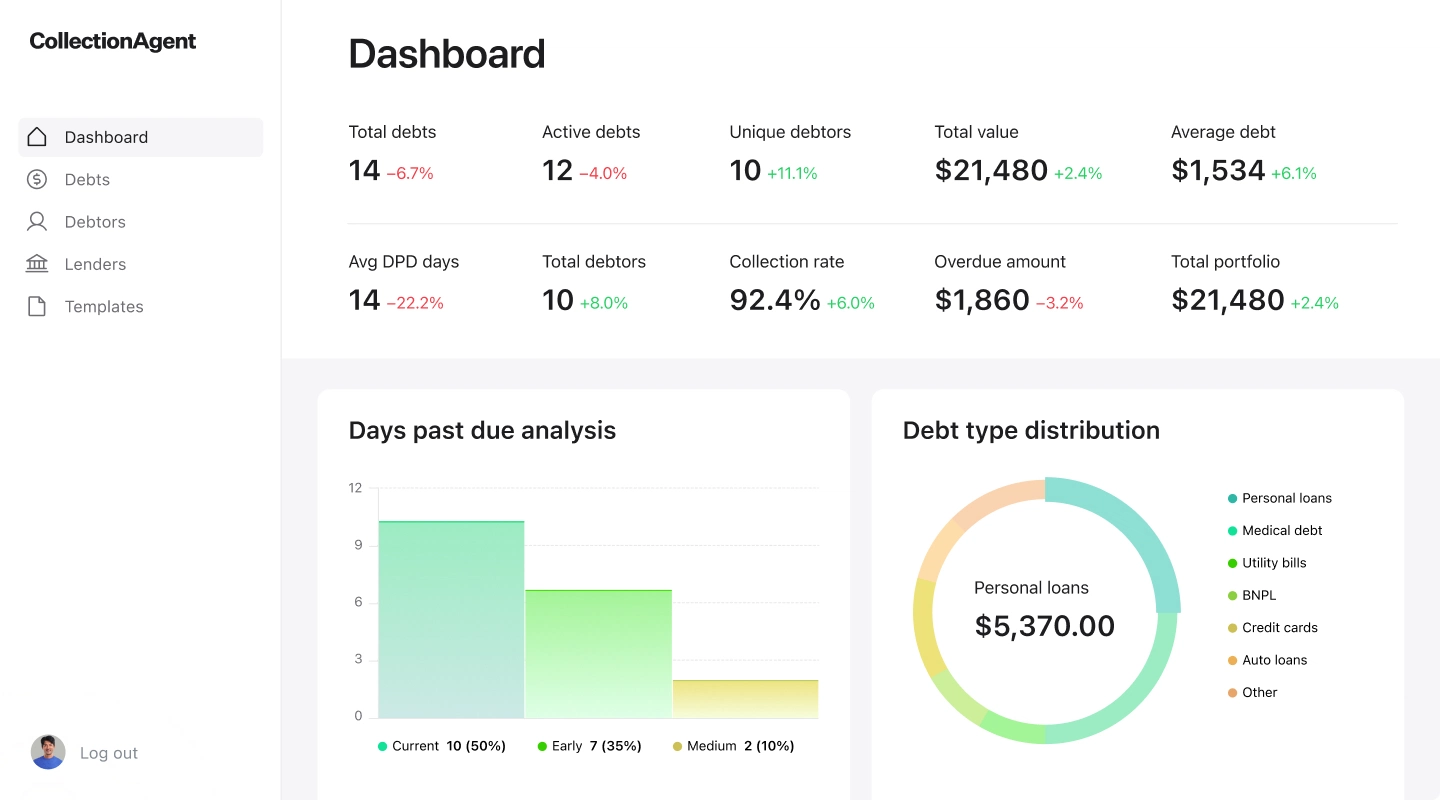
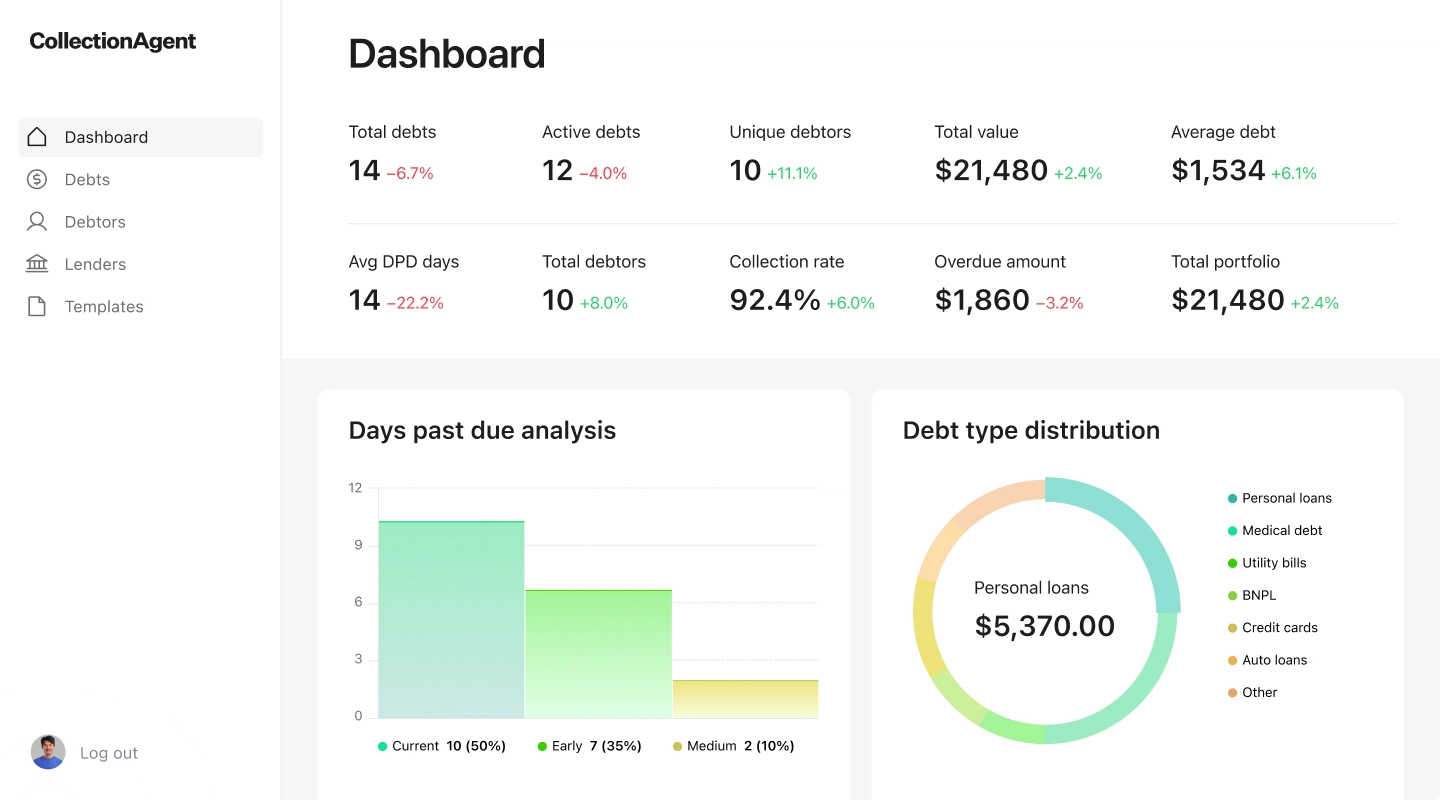
When a payment is missed, the loan moves to overdue status. From that point, the collection workflow set up for the product applies: overdue penalties follow the product’s terms, and collection tasks are queued for the assigned team in priority order. Lenders that want AI-driven debt collection can look at HES CollectionAgent, a separate HES tool built for that job.
Back Office: Products, Workflows and Control
The HES LoanBox back office is where staff set up the business and run it day to day. Configurable loan products are created in the product engine and the calculation engine, and can be changed without developer work. Process steps and rules are drawn with a no-code workflow builder that uses BPMN 2.0 notation. Once a process is live, the task management dashboard shows each team what is assigned to it and what is still waiting. Reports can be built in the platform or in third-party BI tools connected to it.
Access is managed through roles. Administrators grant permissions by job role, and application review supports a four-eye check. Staff actions are recorded in audit logs, and two-factor authentication protects sign-in.
Capabilities on Top of the Core Platform
The core of the platform covers the loan lifecycle. On top of it, HES LoanBox carries feature sets that financial institutions configure as their products and markets grow. Cases the platform does not cover go to separate HES products and services, described in the next section.
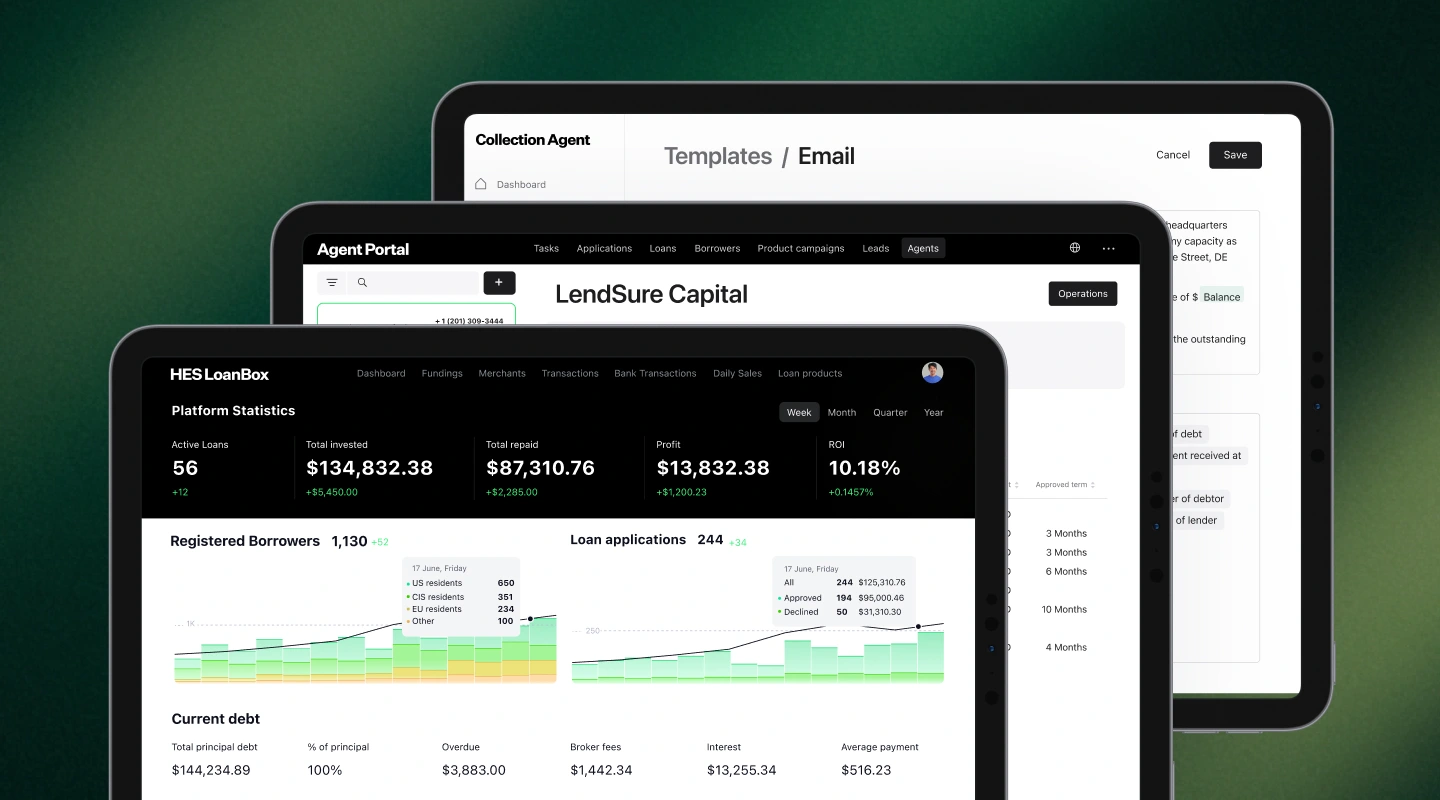
Contract and disclosure templates. Loan agreements and disclosures are generated from reusable templates. Wording can be set per market, so documents for each jurisdiction come out with the right text without manual edits.
Event-based message templates. SMS, email and portal messages run on configurable templates tied to loan events: an approval, an upcoming due date, full repayment or the resolution of a dispute.
Merchant and partner portals. For POS and BNPL programs, merchants, marketplaces and POS partners get dedicated portals where they track funded volumes and access settlement data.
Permission scopes. Borrower data, merchant records and partner portal access sit under separate permission scopes, on top of role-based access and two-factor authentication. User and system actions are logged, which gives reviewers an audit trail of who did what.
Workflow design on a visual canvas. Approval paths, branches for fraud checks and settlement workflows are drawn on a visual canvas without developer involvement. They can be updated as risk conditions change.
Dashboards and reports. Interactive reporting dashboards bring key performance metrics into one view. Reports can be customized to each team’s objectives. For deeper analysis, raw data can be exported or extended with custom metrics.
Collections workflows. Collection cases are prioritized by risk and potential recovery value, and the platform selects the communication channel and contact timing for each debtor. Reminders are scheduled before a payment becomes overdue. Penalty rules follow the loan product and the jurisdiction, and penalty calculations and borrower notifications are recorded in the audit trail.
Configurable compliance controls. Pre-contractual disclosures, affordability checks and cooling-off periods can be set up as configurable controls for the products that need them. The platform keeps records that auditors can review, while responsibility for meeting each regulation stays with the lender.
Deployment options. HES LoanBox runs on the lender’s own servers, in AWS or Google Cloud, or in a hybrid setup. A standard deployment goes live from three months. Projects with heavy customization or a large-scale data migration take six months or more.
Beyond the Platform: Custom Development and Other HES Products
HES also takes on custom development as a separate service, for lenders whose requirements go past what any platform configuration covers.
GiniMachine, HES’s AI credit-scoring engine, is also used as a standalone product. A lender that already scores with GiniMachine can connect it to HES LoanBox as a scoring provider, as described in the decisioning section.
HES CollectionAgent is a separate HES product that applies AI to collections decisioning, next to the collection workflows in the platform.
HES LoanBox Implementation: Case Studies
The two deployments below started from different needs. One lender wanted a working core in production quickly, while the other needed far more than configuration could cover.
ID Finance: A Working Core Running the Lender’s Own Risk Models
ID Finance is a Barcelona-based online consumer lender and the company behind the MoneyMan brand. It needed one platform to automate its whole lending process and operating procedures, with high-performance scoring models running in real time.
During the first three months, HES delivered the LoanBox core logic, workflows and business processes. The platform runs ID Finance’s proprietary risk models, so the credit logic behind each approval stayed with the lender, while LoanBox handled the process around it. To date, more than 400,000 loans have been issued through the platform.
Tavan Bogd Finance: Building Beyond Configuration for Four Loan Types
Tavan Bogd Finance, the financial services arm of Mongolia’s Tavan Bogd Group, runs four loan types: installment loans, BNPL, pledged and trusted pledged loans. It was moving off its existing loan software, needed a complete data migration and wanted loan decisions automated.
The HES team built the loan origination and loan management systems from scratch for these products. They include 11 restructuring options, annuity and differentiated repayment schedules with quarterly payment logic, overdue-based provision rates and branch management with automatic application assignment. A middleware layer connects more than 20 Mongolian services.
Tavan Bogd’s own team developed the mobile app, while HES provided the endpoints and back-office connectivity, and the two were built at the same time. Since launch, more than $63M in loans has gone through the platform across the four products. Over 268,000 customers have passed its verification and onboarding flow, and loan limits are calculated within two minutes.
HES LoanBox reviews from platform users are published on G2 and Capterra, and the product also has a profile on Gartner Peer Insights. Teams still building a vendor shortlist can find loan management software compared side by side in our separate review.
FAQ
Does the platform cover both loan origination and servicing?
With HES LoanBox, onboarding, origination, decisioning, servicing and collections run in one system, so a loan keeps a single record from the first form to the last installment. Scoring and payment posting are automated inside the platform.
How does HES LoanBox pricing work?
Licensing does not depend on headcount: staff users and borrowers are not capped, and nothing is charged per user. The cost of a project depends on its scope, from the modules and integrations a lender needs to any custom development and the chosen deployment model. A developer license with source code access is optional, and HES prepares a quote once the scope is defined.
Which integrations does HES LoanBox support?
HES LoanBox works with more than 100 integrations, including Plaid, Flinks, VoPay, Ondato, Jumio and Creditinfo. A lender connects the credit bureaus its market relies on, its CRM or its core banking system through the open API. HES adds missing integrations on request.
Can lenders change workflows and credit rules without developers?
Approval workflows are modeled in BPMN 2.0 and application forms in a Form.io modeler, both without code. The credit team edits the decision tables behind its policy. Development work starts only when a requirement goes beyond configuration, and HES can take it on.
When is HES LoanBox not the right choice?
HES LoanBox suits lenders that want to configure their own products, workflows and credit policy. A lender that needs a fixed, ready-to-run product with no setup work may find it more than it needs. Projects with heavy customization or data migration also take longer than three months.