When planning how to start an auto finance company in 2026, you need to establish four critical pillars: a clear lending model (direct consumer loans or indirect dealer partnerships), region-specific licensing, a robust credit decisioning framework powered by AI and alternative data, and scalable auto finance software to support end-to-end operations.
A car today is more than transportation—it represents freedom, flexibility, and necessity. As vehicle demand grows, so does the need for financing, with over 80% of new car purchases being financed. This creates strong opportunities for lenders, investors, and dealerships to benefit from rising auto finance demand.
This ever-growing reliance on auto loans has made auto financing a $1.6 trillion industry, now the second-largest category of consumer debt, trailing only mortgages. Buyers are borrowing more than ever, with the average auto loan hitting a record $42,113. Monthly payments have also climbed, now averaging $754, up from $739 the previous year.
As vehicle costs rise, so do loan amounts and repayment terms, creating a new reality where 1 in 5 drivers are committing to monthly payments exceeding $1,000, a figure that would have been unthinkable just a decade ago.
Key Takeaways
- Auto finance success depends on a clear lending model, regulatory licensing (e.g. NMLS in the U.S.), strong underwriting based on core ratios (LTV/PTI/DTI), and scalable loan origination software.
- Modern lenders use automation, APIs, and integrated platforms to improve speed, accuracy, and customer experience.
- Profitability comes from combining risk management with the right technology that supports scalable operations and compliance while adapting to market trends such as EV financing and digital lending.
How to Start an Auto Finance Company: Where to Begin?
Data from Experian reveals that banks still dominate the auto financing landscape, holding 28.7% of the market, leveraging their scale and competitive rates for prime borrowers. Credit unions follow closely at 23.7%, capturing loyalty with lower fees and member-focused perks.
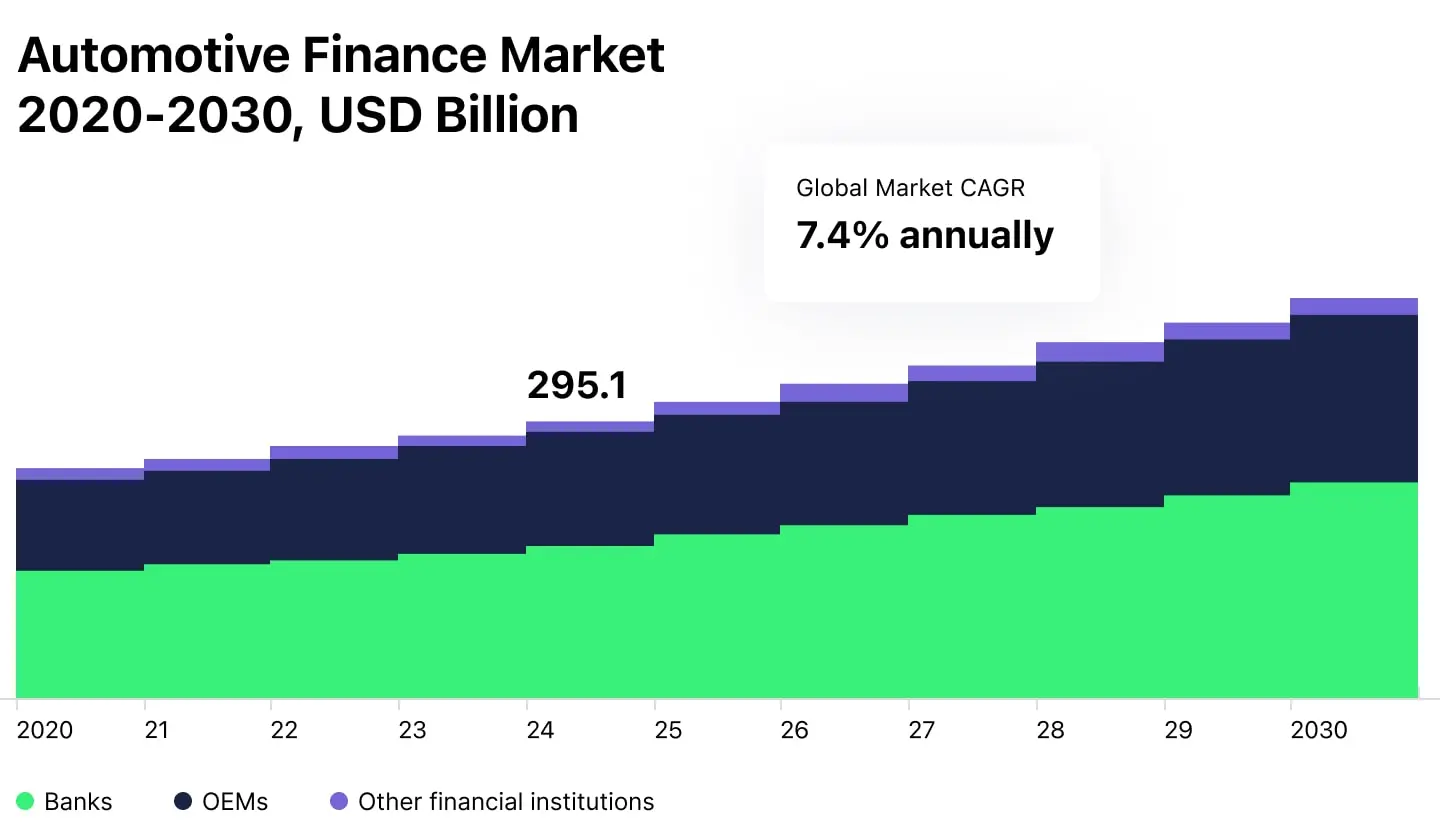
Meanwhile, lenders—automakers' financing arms—control 21.9%, using exclusive incentives to keep buyers within their brand ecosystem. These numbers pinpoint that opportunity exists, but success depends on finding the gaps—whether in pricing, customer experience, or underwriting flexibility.
As consumer preferences evolve, so do opportunities for lenders—electric vehicles (EVs) are no longer niche purchases but mainstream investments.
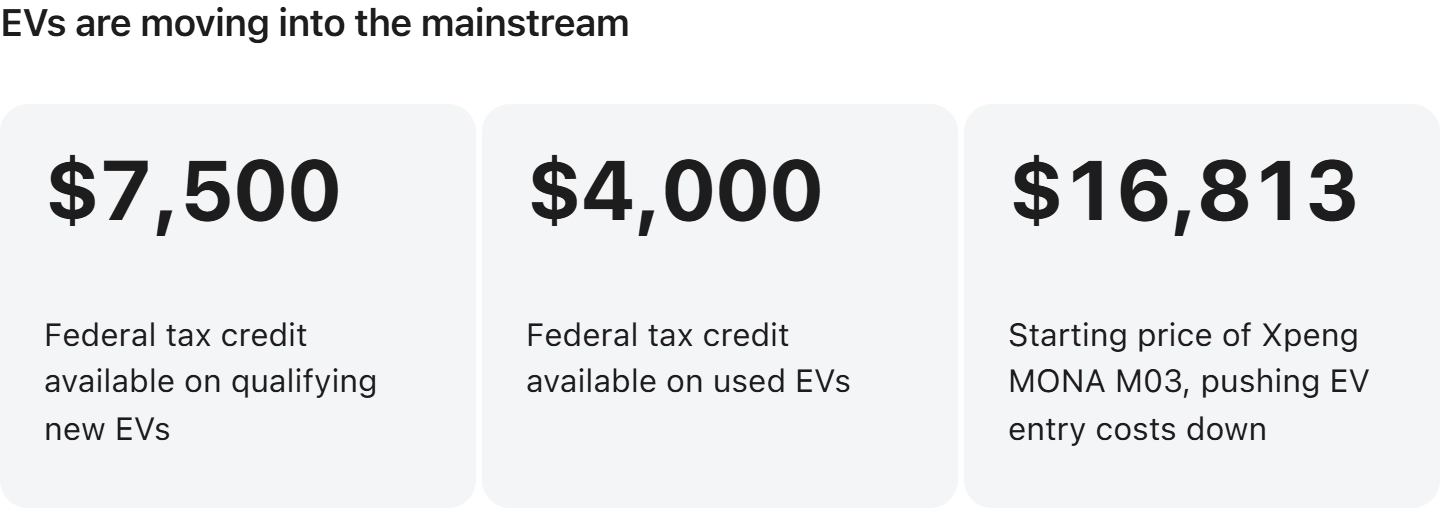
The introduction of more affordable EVs is dismantling the perception that electric cars are only for high-end buyers. Federal incentives continue to be a critical driver. Buyers of qualifying new EVs can receive up to $7,500 in tax credits, while used EV buyers can access up to $4,000. Legacy automakers and emerging players alike are flooding the market with budget-friendly EVs.
The 2024 Nissan Leaf ($28,140) remains one of the most accessible options, while Chinese manufacturers like Xpeng are pushing pricing even lower—their MONA M03 starts at just $16,813.
It should be noted that electric vehicle financing is increasingly supported by sustainability-focused funding programs, such as Green Bonds, providing cheaper capital in the EU and UAE. EV funding options include warehouse lines, securitization (tranches, credit enhancement), and institutional debt or equity capital.
Exploring the Automotive Market Dynamics
Auto financing has long been a battleground of convenience versus cost, where consumers often trade long-term savings for immediate accessibility. The market is controlled by three key players—dealerships, traditional lenders, and digital disruptors—each competing for dominance in an increasingly debt-driven auto economy.
For most buyers, the dealership remains the default gateway to financing. With embedded lending partnerships, dealers make it seamless to secure a loan on the spot, eliminating the friction of shopping around. But that convenience comes at a price—higher interest rates, hidden fees, and financing structures that favor the lender, not the borrower. Many consumers accept these terms simply because they are baked into the car-buying experience.
Traditional banks and credit unions still set the benchmark for low-interest auto loans, particularly for prime and super-prime borrowers. Credit unions, in particular, offer some of the most competitive rates in the market, but their stricter underwriting standards limit accessibility. For younger buyers, gig workers, or those with subprime credit, these institutions remain out of reach, pushing them toward higher-cost alternatives.
The real disruptors are online lenders and fintech financing platforms, which have rewritten the rules of auto lending. These digital-first players emphasize speed, automation, and alternative credit assessments, expanding access to borrowers who would otherwise struggle to secure financing.
For lenders, differentiation comes down to three key factors: price, speed, and service. Staying ahead of market trends, such as lending trends in 2025, can help businesses refine their strategies and adapt to shifting consumer demands.
What Are the Main Competitors in the Auto Finance Market?
Direct competitors reveal how similar lenders price, package, and market their financing, but the real insights come from looking beyond your immediate rivals.
Banks, fintech disruptors, and captive lenders all have different strengths; some leverage AI-powered risk models, others push instant digital approvals, and some use bundled incentives to lock in customers. Are competitors cutting rates to capture market share or focusing on high-margin premium financing? What’s working, and what’s missing? Altogether, these insights can reveal market gaps and areas for differentiation.
What Are the Four Main Types of Auto Lending Business Models?
Lenders price loans based on risk, market conditions, and their own auto finance business goals. McKinsey has identified four recurrent archetypes in the market, as some prioritize stability, others chase market share, and a few offer premium financing for brand-loyal customers.
Formulaic Pricing: Cost-Driven & Conservative
- Prices reflect external factors like interest rates and inflation, often passed directly to borrowers.
- Common among banks where auto loans are a secondary focus, particularly in super-prime lending.
- Prioritizes stable margins over aggressive market expansion.
Competition-Based Pricing: Balancing Risk & Growth
- Lenders adjust pricing based on competitive pressures, acting as either price leaders or followers.
- Popular among banks and finance companies seeking market share while managing risk.
- Often applied in prime and super-prime lending to attract reliable borrowers without excessive rate cutting.
Value-Centric Pricing: Focused on Long-Term Market Position
- Delays passing cost increases to customers, maximizing customer value and retention.
- Most effective for lenders with a low cost of funds, efficient operations, or strong dealer relationships.
- Competitive edge comes from scale, operational efficiency, or a full-service financing suite.
Premium Pricing: Niche & Brand-Driven
- Rare in auto lending but used by captive finance arms of automakers.
- Justified through exclusive services, dealer incentives, and brand perks.
- Targets luxury buyers willing to pay for convenience and brand alignment.
While pricing strategy explains how loans are positioned in the market, another key dimension is how they are actually originated and distributed. A central part of auto finance is therefore the lending channel itself, especially through direct lending and indirect auto lending.
Direct vs Indirect Auto Lending: Which Model to Choose?
Both types serve the same purpose—financing a vehicle purchase—but they differ in how the loan is originated, who manages the process, and the level of transparency and convenience for the borrower.
As examples of direct lending, Bank of America offers auto loans and refinancing directly to consumers, while PenFed Credit Union and Navy Federal Credit Union provide direct lending to their members.
In indirect lending, such companies as Wells Fargo (with a nationwide network of nearly 11,000 dealerships) and Chase Auto Finance (part of JPMorgan Chase & Co.) operate through dealer-based financing channels while retaining responsibility for underwriting and funding. Other examples include Ally Financial, one of the largest dealer-based auto lenders in the U.S., and Santander Consumer USA, which primarily provides financing through dealership networks, often including non-prime borrowers.
Here's the comparison of direct and indirect lending across key factors:
| Dimension | Direct lending model | Indirect lending model |
|---|---|---|
| Licensing | Lender deals directly with the customer under its own regulated lending license | Lender operates through dealers who originate loans on its behalf |
| Margin | More control over pricing and spreads | Higher volume, but margins can be reduced or effected by dealer markups and incentives |
| Risk | Lender takes full credit risk and controls underwriting | Lender retains credit risk, but credit quality depends on dealer-sourced applications |
| Distribution | Self-generated (online, branches, marketing) | Dealer network is the main distribution channel |
| Speed / scale | Slower growth requires customer acquisition effort | Faster scaling through existing dealer relationships |
| Customer relationship | Direct relationship with borrower | The dealer acts as the intermediary between borrower and lender and controls most of the customer interaction |
| Examples | Banks, credit unions, fintech lenders | Dealer-arranged financing, captive and partner lenders |
Direct lending provides greater control over pricing, underwriting, and customer experience but requires more effort to acquire customers and scale. Indirect auto lending scales faster through dealer networks but offers less control over pricing and customer flow.
Licensing in Auto Lending
Auto lending in the U.S. is a regulated activity that requires lenders to be properly licensed before they can offer consumer credit. This licensing is handled through the Nationwide Multistate Licensing System (NMLS), which serves as a centralized platform for applications and compliance tracking and standardizes the application process for non-bank lenders, though requirements vary by state.
In auto lending, NMLS is commonly used by non-bank lenders, fintech companies, and indirect (dealer-based) finance providers operating across state lines. It helps regulators verify that lenders meet state-specific consumer lending requirements and maintain proper authorization to originate and service loans.
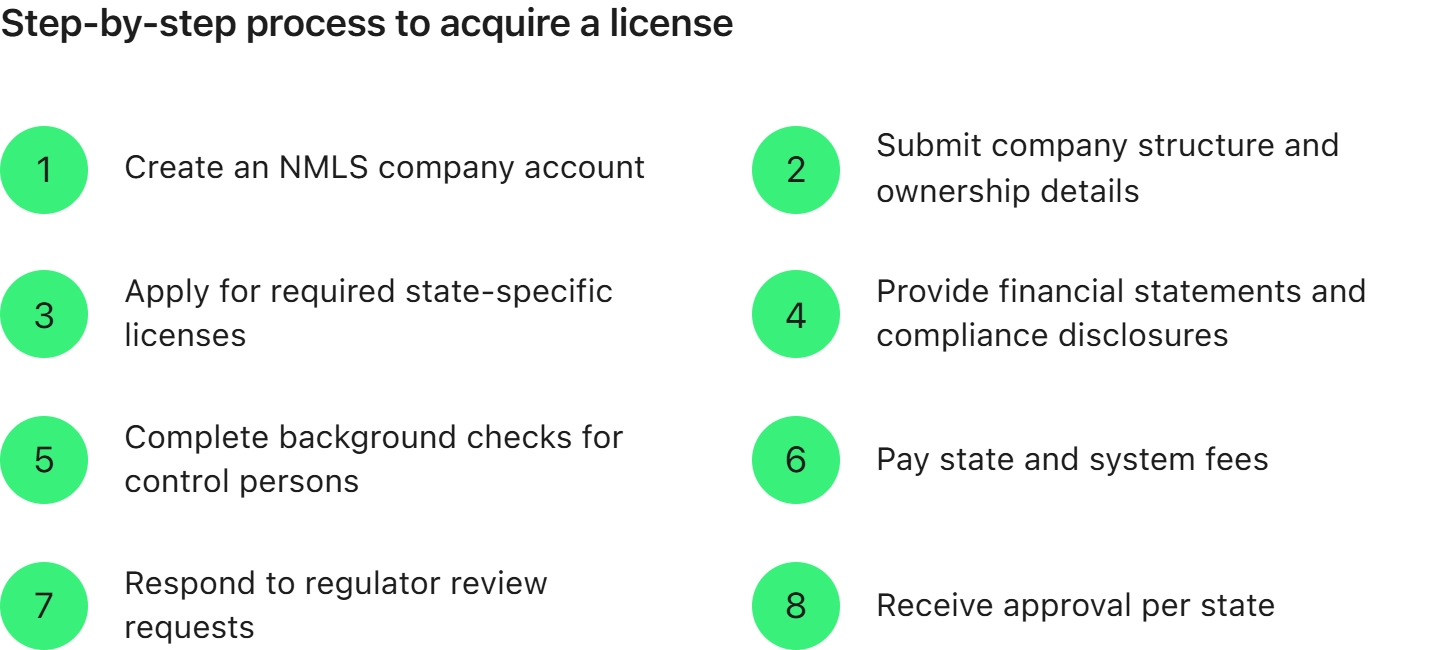
Step-by-step process to acquire a license:
- Create an NMLS company account
- Submit company structure and ownership details
- Apply for required state-specific licenses
- Provide financial statements and compliance disclosures
- Complete background checks for control persons
- Pay state and system fees
- Respond to regulator review requests
- Receive approval per state
The process usually takes around 4–8 weeks per state, but timelines can extend depending on the number of states involved, document quality, background check results, and the complexity of the business model
Costs are generally in the range of $500–$1,500 per state (filing fees), plus additional expenses such as NMLS system fees, background checks, and surety bonds ($25,000 to $100,000), which are required in many states and vary based on lending volume and risk.
Key license types relevant to auto and consumer lending include the Consumer Finance License, Motor Vehicle Finance License, and Sales Finance Company License, depending on the state. These licenses define whether a company can legally originate, purchase, or service auto loans.
Overall, NMLS forms a core part of the U.S. regulatory infrastructure for auto lending, enabling legal multi-state operations while ensuring transparency, consumer protection, and continuous compliance.
What Segment Will You Target?
Each borrower segment has distinct needs, requiring tailored loan structures and messaging to maximize conversions and retention.
- Subprime Borrowers: Usually excluded from traditional financing due to low credit scores and need structured repayment plans with risk-adjusted terms. Lenders mitigate default risks by offering higher interest rates, extended loan durations, or alternative credit assessments such as income verification. Success in this segment depends on balancing accessibility with sustainable risk management.
- First-time Buyers: Often struggle with loan terms and approval processes. Providing educational tools, transparent pricing, and pre-approval options simplifies decision-making and builds confidence. Lenders that guide these borrowers through the financing process can foster long-term loyalty while capturing a growing market of younger consumers.
- Luxury Buyers: Prioritize exclusivity and convenience over cost. Concierge-style financing, extended credit lines, and loyalty-driven perks cater to their expectations. Captive lenders and premium financial institutions dominate this space by integrating financing with brand-driven incentives, ensuring a seamless and prestigious borrowing experience.
- Budget-Conscious Buyers: Focus on securing low interest rates, rebates, and clear loan terms. Competitive pricing, promotional financing, and transparent conditions appeal to this segment. Lenders that emphasize affordability and value-driven offers can attract and retain cost-conscious borrowers while maintaining healthy loan volumes.
Targeting the right borrower segments requires tailored loan structures and messaging to meet distinct needs, drive conversions, and maximize long-term retention.
What is Your Unique Selling Point?
Car buyers have many options, so why should they choose you? Some lenders thrive on speed, offering instant approvals and frictionless digital experiences, while others focus on premium, concierge-style financing for high-end buyers. A competitive edge can also come from transparent pricing, flexible repayment structures, or embedded finance solutions that integrate seamlessly with dealerships and online auto marketplaces.
How to Start an Auto Finance Company: Next Steps
Develop a Strong Business Plan
A sharp business plan outlines where your company fits in the market, how you’ll attract borrowers, and what strategies will drive long-term profitability. Below, we expand upon the most essential components that should be included in your business plan:
| Section | Key Components | Purpose |
|---|---|---|
| Executive summary | Car financing business overview, market opportunity, financial highlights, funding needs. | Provides a high-level snapshot to engage investors and lenders. |
| Business structure & Management | Legal structure, ownership breakdown, location strategy, management team. | Defines auto finance business framework and leadership credibility. |
| Products & Services | Lease types, vehicle fleet, value-added services (maintenance, insurance, roadside assistance), customer support. | Highlights service offerings and competitive edge. |
| Market analysis | Target customers, competition, industry trends, and regulatory requirements. | Ensures market viability and strategic positioning. |
| Business strategy | Unique selling proposition, pricing model, sales & marketing, key milestones, risk management. | Defines growth strategy and market differentiation. |
| Operations plan | Staffing, fleet management, technology, supplier agreements, operating hours. | Ensures efficient business operations and service delivery. |
| Financial plan | Revenue model, operating costs, profitability forecast, funding strategy. | Establishes financial viability and investment potential. |
Secure Stable Funding Streams
Auto finance is capital-intensive, requiring stable funding sources to scale, such as:
- Debt financing: Warehouse lines of credit from major banks.
- Equity financing: Investors specializing in fintech or alternative lending.
- Auto Loan Securitization (ABS): Packaging loans for sale to institutional investors.
- Government & ESG Programs: EV-specific financing backed by green bonds or tax incentives.
Asses Regulations & Specific Car Finance Company Requirements
Regulatory non-compliance has cost auto lenders millions in fines, with Wells Fargo paying $3.7 billion in penalties in 2022 for misconduct in auto lending. Lending is a heavily regulated industry, and missing compliance requirements can lead to lawsuits, fines, or shutdowns:
- State Auto Lending Licenses: Required in most states, processed via NMLS.
- Truth in Lending Act (TILA): Transparency in loan disclosures and fees.
- Fair Credit Reporting Act (FCRA): Governs credit checks and borrower data usage.
Build a Skilled Auto Financing Team
Auto lending requires expertise in risk assessment, compliance, tech infrastructure, and dealership relations, with some of the most important roles being:
- Chief Risk Officer: Designs credit scoring models and loss mitigation strategies.
- Compliance Officer: Ensures state and federal lending law adherence.
- Loan Underwriters: Manage borrower risk profiles.
- Tech & Product Managers: Develop loan origination platforms and digital underwriting tools.
A strong auto finance team combines risk, compliance, underwriting, and tech expertise to enable accurate, compliant, and scalable lending.
Plan Marketing Activities
To really make your auto loan business stand out, your marketing approach should spark genuine interest and guide customers from curiosity to action. The moment someone types “How do I finance a car?” is the moment you want your business to appear, not just as an option, but as the obvious choice.
A strong digital presence puts you exactly where customers are looking. Invest in search-driven marketing so your brand ranks when financing questions arise. Make your website useful, clear, and interactive—loan calculators, side-by-side rate comparisons, and real customer stories turn passive visitors into engaged prospects. When information feels effortless, decisions follow.
But beyond the digital screen, real-world connections matter. Strengthen relationships with local dealerships to integrate financing directly into the car-buying process. Explore partnerships with insurance providers, repair shops, and gig economy platforms where financing plays a crucial role. These touchpoints position your business in the natural flow of car ownership.
Evaluate Adequate Auto Loan Structures
Lenders must offer loan structures that balance borrower affordability with profitability:
- Direct Auto Loans: Borrower applies directly (higher control, slower volume).
- Indirect Lending (Dealer Financing): Loan provided through dealerships.
- Lease & Balloon Financing: Alternative loan structures gaining traction in the EV and fleet markets.
How to Select the Right Loan Origination Software for a Startup
Traditional, paperwork-heavy processes are giving way to seamless, data-driven lending models, where loan approvals happen in minutes instead of days.
Choosing the Right Model: Build, Buy, or Integrate?
Lenders must determine their car loan business structure before selecting a technology solution. API-driven integrations work best for fintech firms or automakers expanding into lending, connecting with banks, credit bureaus, and dealership networks. Standalone platforms require a full-stack Loan Origination System (LOS) with automated underwriting to manage high loan volumes. For those building from scratch, modular, cloud-based systems offer flexibility but demand higher investment and compliance oversight.
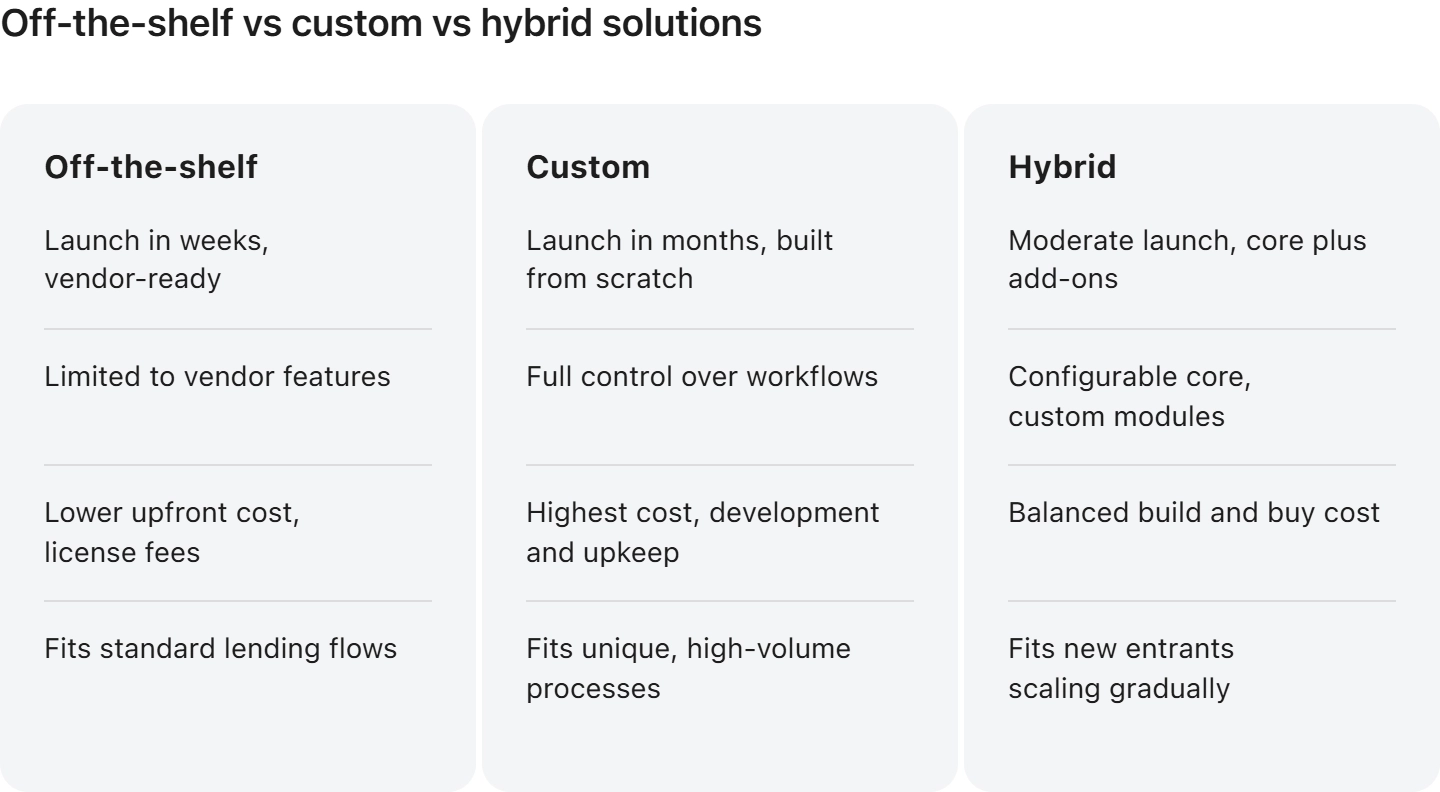
Off-the-Shelf vs. Custom Tech Solutions
Any automobile finance company can choose between pre-built lending software, custom-built platforms, or hybrid approaches. Some solutions offer quick deployment but limit customization. Fully custom platforms provide maximum flexibility in underwriting and borrower experience but require high upfront costs. A hybrid model combines off-the-shelf infrastructure with custom AI and automation layers, balancing speed, scalability, and adaptability.
From Idea to Execution: Structuring Your Car Finance Business
Process automation can be the ultimate catalyst for accelerating the growth of an innovative auto loan business, but it requires a strategic approach. HES FinTech brings in-depth industry knowledge and 10+ years of experience, we focus on practical solutions that streamline operations, enhance risk management, and ultimately increase profitability.
Building the Trust Layer: Compliance, Systems, and Standards
To operate at scale, an auto lending platform must ensure its systems support key industry standards and regulatory processes:
• ISO 20022—may be required for direct integration with banks or payment networks; the system should support it as a standardized payment messaging format that ensures structured, consistent, and interoperable transaction data.
• SOC 2—the platform should be designed with controls aligned to the SOC 2 audit framework, based on the Trust Services Criteria framework. This covers security, availability, processing integrity, confidentiality, and privacy of borrowers. It requires strong internal controls such as encryption, access management, monitoring, and auditability.
• KYC / AML—the system must integrate identity verification and transaction monitoring capabilities, either built-in or via third-party providers, to meet regulatory requirements.
These are not optional features—they are baseline expectations. The platform must be designed to support them from the outset to ensure compliance, scalability, and trust with partners and regulators.
How to Measure Success
To understand how well an auto lending business is performing, lenders rely on a set of operational and portfolio-level metrics that reflect risk exposure, conversion efficiency, and cost structure:
• Delinquency rate (30+ days past due)—the proportion of borrowers who are more than 30 days behind on payments. Typical levels are around 2–4% for prime portfolios and higher for subprime segments.
• Net charge-offs—the percentage of loans written off as uncollectible, net of recoveries. Generally, about 0.5–1.5% in prime portfolios and up to 5–10% or more in higher-risk segments.
• Loan-to-value (LTV)—the ratio of the loan amount to the vehicle’s value at origination. Typical ranges are 80–110%, often exceeding 100% due to add-ons or negative equity rollovers, with higher levels implying greater risk.
• Cost per origination—the average cost to acquire and fund a loan, including marketing, underwriting, and dealer-related expenses. Costs vary widely depending on the channel, automation level, and dealer commissions but typically range from $300 to $1,000 depending on the distribution channel.
• Look-to-book ratio (also called application-to-funding conversion rate)—the percentage of applications that convert into funded loans. 5–10% is common in direct channels, with higher ratios in dealer-driven models.
• Approval rate—the share of applicants approved for financing. Typical levels range from 40 to 60%.
Together, these metrics provide a balanced view of portfolio quality, profitability, and operational performance.
Conclusion
The auto finance industry is large, highly competitive, and driven by rising vehicle prices and heavy reliance on credit, including growth in EV financing, and is shaped by the competition between indirect vs direct auto lending models.
Success depends on choosing a clear lending model, building strong risk management, and securing proper licensing and compliance from the start. Modern auto lending is increasingly software-driven, with platforms handling loan origination, underwriting, servicing, and compliance workflows through automated systems.
From a financial perspective, performance is mainly determined by cost of capital, pricing strategy, underwriting quality, funding structure, recovery performance, and operational efficiency rather than loan volume alone. To maintain control over portfolio health, lenders need to track key metrics such as delinquency rate, net charge-offs, and LTV, which are essential for monitoring portfolio health.
Platforms such as HES FinTech are designed to support this approach by providing configurable tools within a single environment.